

Strategy for Regional Seasonal Forecasts
Continuity
an
..>.
a
::.t:. = -V· (pV) --(pw);
at
az
Thermodynamic equation
Equation of state
p = pRT
dT = F
dt
'
181
(5)
(6)
(7)
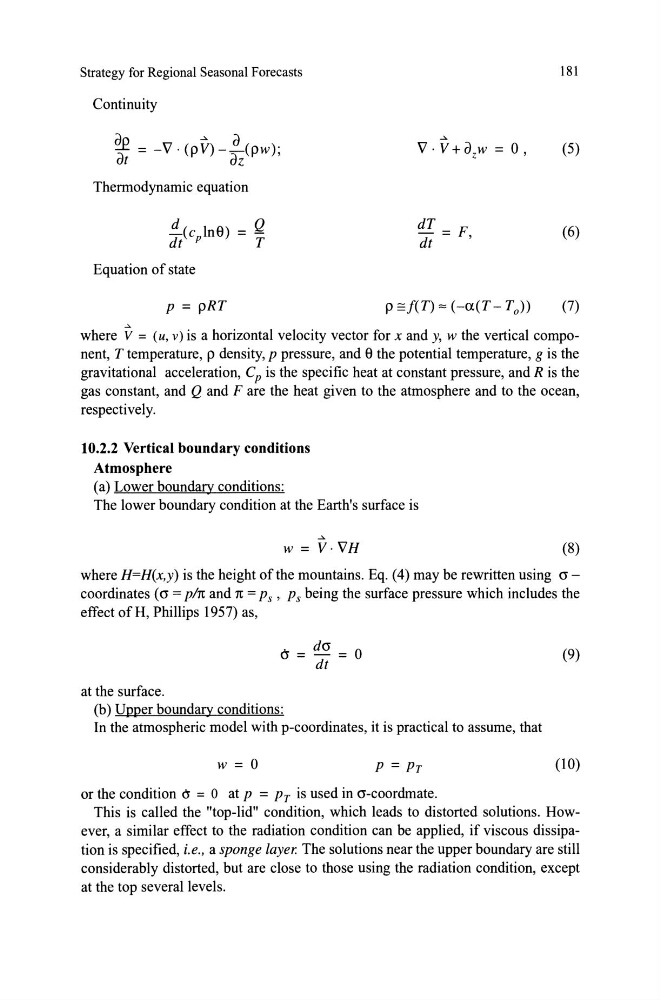
where V = (u, v) is a horizontal velocity vector for x and y, w the vertical component, T temperature, p density, p pressure, and e the potential temperature, g is the
gravitational acceleration, C p is the specific heat at constant pressure, and Ris the
gas constant, and Q and F are the heat given to the atmosphere and to the ocean,
respectively.
10.2.2 Vertical boundary conditions
Atmosphere
(a) Lower boundaty conditions:
The lower boundary condition at the Earth's surface is
..>.
W = V· VH
(8)
where H=H(x,y) is the height ofthe mountains. Eq. (4) may be rewritten using crcoordinates (cr = pin and n = Ps' Ps being the surface pressure which includes the
effect of R, Phillips 1957) as,
(9)
at the surface.
(b) Uwer boundary conditions:
In the atmospheric model with p-coordinates, it is practical to assume, that
w=o
P = PT
(10)
or the condition cr = O at p = PT is used in cr-coordmate.
This is called the "top-lid" condition, which leads to distorted solutions. Rowever, a similar effect to the radiation condition can be applied, if viscous dissipation is specified, i.e., a sponge layer. The solutions near the upper boundary are still
considerably distorted, but are close to those using the radiation condition, except
at the top severallevels.
Continuity
an
..>.
a
::.t:. = -V· (pV) --(pw);
at
az
Thermodynamic equation
Equation of state
p = pRT
dT = F
dt
'
181
(5)
(6)
(7)
where V = (u, v) is a horizontal velocity vector for x and y, w the vertical component, T temperature, p density, p pressure, and e the potential temperature, g is the
gravitational acceleration, C p is the specific heat at constant pressure, and Ris the
gas constant, and Q and F are the heat given to the atmosphere and to the ocean,
respectively.
10.2.2 Vertical boundary conditions
Atmosphere
(a) Lower boundaty conditions:
The lower boundary condition at the Earth's surface is
..>.
W = V· VH
(8)
where H=H(x,y) is the height ofthe mountains. Eq. (4) may be rewritten using crcoordinates (cr = pin and n = Ps' Ps being the surface pressure which includes the
effect of R, Phillips 1957) as,
(9)
at the surface.
(b) Uwer boundary conditions:
In the atmospheric model with p-coordinates, it is practical to assume, that
w=o
P = PT
(10)
or the condition cr = O at p = PT is used in cr-coordmate.
This is called the "top-lid" condition, which leads to distorted solutions. Rowever, a similar effect to the radiation condition can be applied, if viscous dissipation is specified, i.e., a sponge layer. The solutions near the upper boundary are still
considerably distorted, but are close to those using the radiation condition, except
at the top severallevels.