

On North Atlantic Intedecadal Variability: A Stochastic View
a)
spectral density
~ ~ .,o. ....
~ . . ~ .. "
"'\.
.......
..
...
ocean
.. '
.un.
- ------f
b)
pec[ral density
. ~ ....
... 1 ',
... / Î , ...
••••• /
I , ....
.. #-"
I
I \
... ocean
. .
/
, " ..
/ /aun.
'\ " ..
.,
, " .
."
" ..
, '.
, ' .
..... :: ..
F
00
' 0 0
frequency
0 ' 0
frequcncy
159
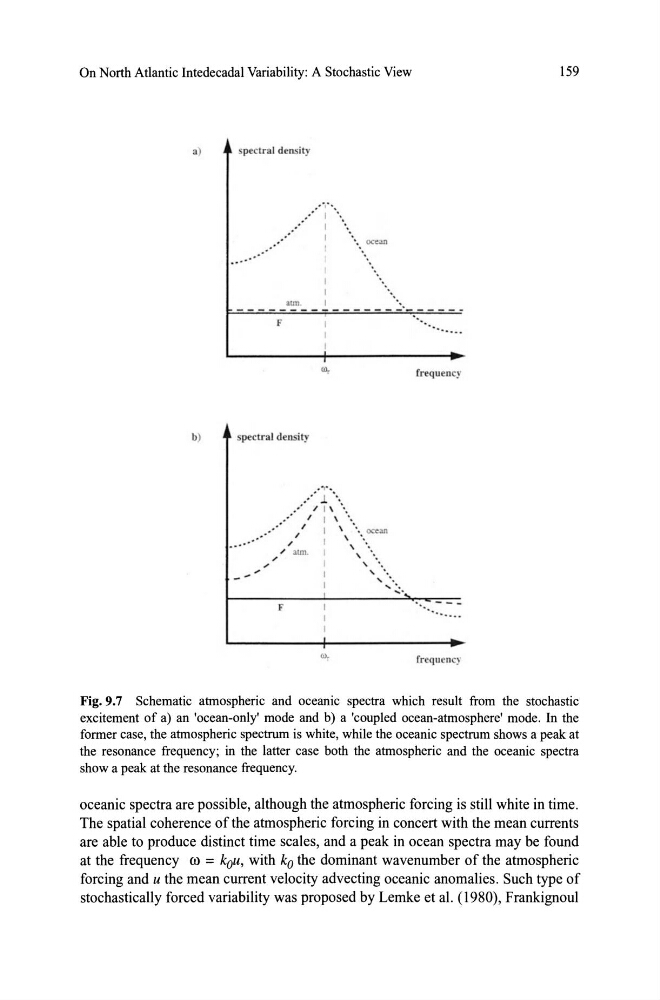
Fig,9.7 Schematic atmospheric and oceanic spectra which result from the stochastic
excitement of a) an 'ocean-only' mode and b) a 'coupled ocean-atmosphere' mode. In the
former case, the atmospheric spectrum is white, while the oceanic spectrum shows a peak at
the resonance frequency; in the latter case both the atmospheric and the oceanic spectra
show a peak at the resonance frequency.
oceanic spectra are possible, although the atmospheric forcing is still white in time.
The spatial coherence of the atmospheric forcing in concert with the mean currents
are able to produce distinct time scales, and a peak in ocean spectra may be found
at the frequency O) = kou, with k o the dominant wavenumber of the atmospheric
forcing and u the mean current velocity advecting oceanic anomalies. Such type of
stochastically forced variability was proposed by Lemke et al. (1980), Frankignoul
a)
spectral density
~ ~ .,o. ....
~ . . ~ .. "
"'\.
.......
..
...
ocean
.. '
.un.
- ------f
b)
pec[ral density
. ~ ....
... 1 ',
... / Î , ...
••••• /
I , ....
.. #-"
I
I \
... ocean
. .
/
, " ..
/ /aun.
'\ " ..
.,
, " .
."
" ..
, '.
, ' .
..... :: ..
F
00
' 0 0
frequency
0 ' 0
frequcncy
159
Fig,9.7 Schematic atmospheric and oceanic spectra which result from the stochastic
excitement of a) an 'ocean-only' mode and b) a 'coupled ocean-atmosphere' mode. In the
former case, the atmospheric spectrum is white, while the oceanic spectrum shows a peak at
the resonance frequency; in the latter case both the atmospheric and the oceanic spectra
show a peak at the resonance frequency.
oceanic spectra are possible, although the atmospheric forcing is still white in time.
The spatial coherence of the atmospheric forcing in concert with the mean currents
are able to produce distinct time scales, and a peak in ocean spectra may be found
at the frequency O) = kou, with k o the dominant wavenumber of the atmospheric
forcing and u the mean current velocity advecting oceanic anomalies. Such type of
stochastically forced variability was proposed by Lemke et al. (1980), Frankignoul