

Assimilation of Satellite Altimetry in Ocean Models
123
1.2
1! 1.0
li;
c:
2
~ 0.8
!!
a
'O
j 0.6
. .
~ 0.4
g
.,
a: 0.2
l.:··' ·' ·,
".
Surface 1000 m
....... , ..
'-.:
--":- ···~··'-·.i·'····,
,
-O.O- ' - r - - - - - , - - - - - , r - - - , - - -
o
50
100
150
Oayo from 1 SI January
1.2
Ci 1.0
~
c:
2
:! 0.8
~
'O
.§ 0.6
13
~
.,
~
~ 0.4
2
:;;
ti)
::l!
tI: 0.2
Below looom
1
.. ·· .. ·
:'"''''''
I .... · ~
1- ~ . _
.-'1- _
1 - · .... - - _ _
- . ~- '\'- '- '- _ . .,,O .O-'-r----,----,---,-- -
o
50
100
150
Days from 1 si January
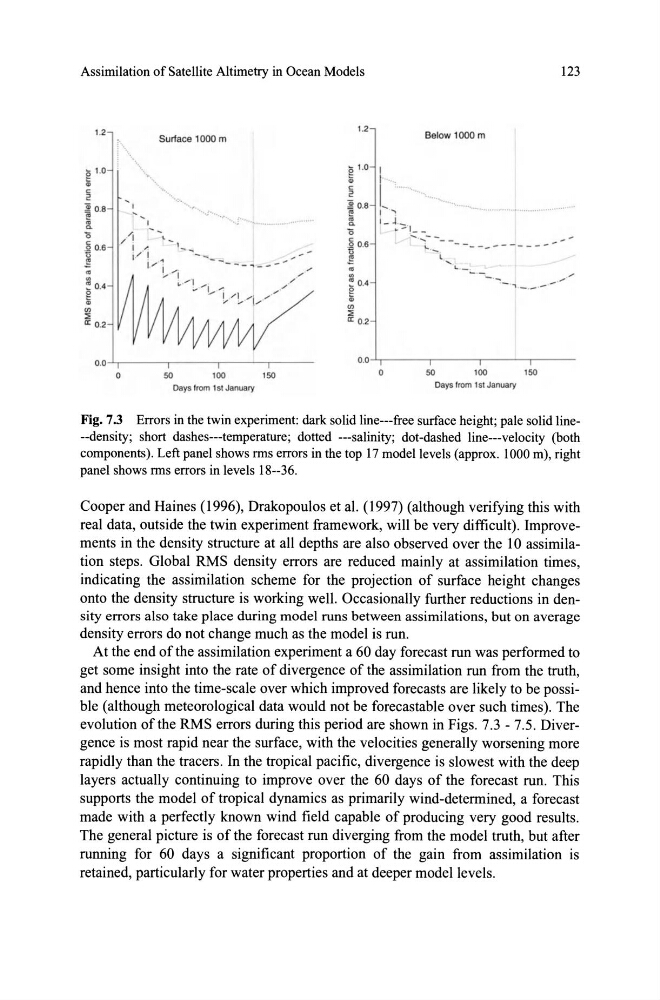
Fig. 7.3 Errors in the twin experiment: dark solid line---free surface height; paie solid line--density; short dashes---temperature; dotted ---salinity; dot-dashed line---velocity (both
components). Left panel shows rms errors in the top 17 modellevels (approx. 1000 m), right
panel shows rms errors in levels 18--36.
Cooper and Haines (1996), Drakopoulos et al. (1997) (although verifying this with
real data, outside the twin experiment framework, will be very difficult). Improvements in the density structure at all depths are also observed over the 10 assimilation steps. Global RMS density errors are reduced mainly at assimilation times,
indicating the assimilation scheme for the projection of surface height changes
onto the density structure is working well. Occasionally further reductions in density errors also take place during model mns between assimilations, but on average
density errors do not change much as the model is run.
At the end of the assimilation experiment a 60 day forecast run was performed to
get some insight into the rate of divergence of the assimilation run from the truth,
and hence into the time-scale over which improved forecasts are likely to be possibie (although meteorological data would not be forecastable over such times). The
evolution ofthe RMS errors during this period are shown in Figs. 7.3 - 7.5. Divergence is most rapid near the surface, with the velocities generally worsening more
rapidly than the tracers. In the tropical pacific, divergence is slowest with the deep
layers actually continuing to improve over the 60 days of the forecast run. This
supports the model of tropical dynamics as primarily wind-determined, a forecast
made with a perfectly known wind field capable of produc ing very good results.
The general picture is of the forecast run diverging from the model truth, but after
running for 60 days a significant proportion of the gain from assimilation is
retained, particularly for water properties and at deeper model levels.
123
1.2
1! 1.0
li;
c:
2
~ 0.8
!!
a
'O
j 0.6
. .
~ 0.4
g
.,
a: 0.2
l.:··' ·' ·,
".
Surface 1000 m
....... , ..
'-.:
--":- ···~··'-·.i·'····,
,
-O.O- ' - r - - - - - , - - - - - , r - - - , - - -
o
50
100
150
Oayo from 1 SI January
1.2
Ci 1.0
~
c:
2
:! 0.8
~
'O
.§ 0.6
13
~
.,
~
~ 0.4
2
:;;
ti)
::l!
tI: 0.2
Below looom
1
.. ·· .. ·
:'"''''''
I .... · ~
1- ~ . _
.-'1- _
1 - · .... - - _ _
- . ~- '\'- '- '- _ . .,,O .O-'-r----,----,---,-- -
o
50
100
150
Days from 1 si January
Fig. 7.3 Errors in the twin experiment: dark solid line---free surface height; paie solid line--density; short dashes---temperature; dotted ---salinity; dot-dashed line---velocity (both
components). Left panel shows rms errors in the top 17 modellevels (approx. 1000 m), right
panel shows rms errors in levels 18--36.
Cooper and Haines (1996), Drakopoulos et al. (1997) (although verifying this with
real data, outside the twin experiment framework, will be very difficult). Improvements in the density structure at all depths are also observed over the 10 assimilation steps. Global RMS density errors are reduced mainly at assimilation times,
indicating the assimilation scheme for the projection of surface height changes
onto the density structure is working well. Occasionally further reductions in density errors also take place during model mns between assimilations, but on average
density errors do not change much as the model is run.
At the end of the assimilation experiment a 60 day forecast run was performed to
get some insight into the rate of divergence of the assimilation run from the truth,
and hence into the time-scale over which improved forecasts are likely to be possibie (although meteorological data would not be forecastable over such times). The
evolution ofthe RMS errors during this period are shown in Figs. 7.3 - 7.5. Divergence is most rapid near the surface, with the velocities generally worsening more
rapidly than the tracers. In the tropical pacific, divergence is slowest with the deep
layers actually continuing to improve over the 60 days of the forecast run. This
supports the model of tropical dynamics as primarily wind-determined, a forecast
made with a perfectly known wind field capable of produc ing very good results.
The general picture is of the forecast run diverging from the model truth, but after
running for 60 days a significant proportion of the gain from assimilation is
retained, particularly for water properties and at deeper model levels.