

104 Geir Evensen
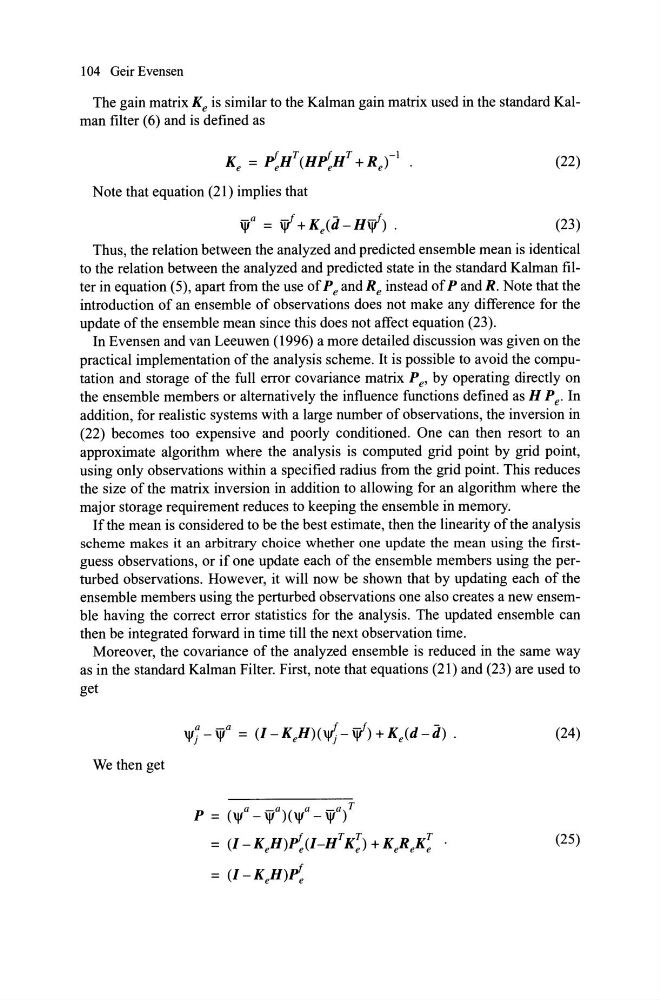
The gain matrix Ke is similar to the Kalman gain matrix used in the standard Kalman filter (6) and is defined as
~f
T
~f
T
-1
Ke = reH (HreH + Re)
(22)
Note that equation (21) implies that
(23)
Thus, the relation between the analyzed and predicted ensemble mean is identical
to the relation between the analyzed and predicted state in the standard Kalman filter in equation (5), apart from the use of Pe and Re instead of P and R. Note that the
introduction of an ensemble of observations does not make any difference for the
update ofthe ensemble mean since this does not affect equation (23).
In Evensen and van Leeuwen (1996) a more detailed discussion was given on the
practic al implementation ofthe analysis scheme. It is possible to avoid the computation and storage of the full error covariance matrix Pe' by operating direct1y on
the ensemble members or altematively the inf1uence functions defined as H Pe. In
addition, for realistic systems with a large number of observations, the inversion in
(22) becomes too expensive and poorly conditioned. One can then resort to an
approximate algorithm where the analysis is computed grid point by grid point,
using only observations within a specified radius from the grid point. This reduces
the size of the matrix invers ion in addition to allowing for an algorithm where the
major storage requirement reduces to keeping the ensemble in memory.
If the mean is considered to be the best estimate, then the linearity of the analysis
scheme makes it an arbitrary choice whether one update the mean using the firstguess observations, or if one update each of the ensemble members using the perturbed observations. However, it will now be shown that by updating each of the
ensemble members using the perturbed observations one also creates a new ensembIe having the correct error statistics for the analysis. The updated ensemble can
then be integrated forward in time till the next observation time.
Moreover, the covariance of the analyzed ensemble is reduced in the same way
as in the standard Kalman Filter. First, note that equations (21) and (23) are used to
get
(24)
We thenget
(25)
The gain matrix Ke is similar to the Kalman gain matrix used in the standard Kalman filter (6) and is defined as
~f
T
~f
T
-1
Ke = reH (HreH + Re)
(22)
Note that equation (21) implies that
(23)
Thus, the relation between the analyzed and predicted ensemble mean is identical
to the relation between the analyzed and predicted state in the standard Kalman filter in equation (5), apart from the use of Pe and Re instead of P and R. Note that the
introduction of an ensemble of observations does not make any difference for the
update ofthe ensemble mean since this does not affect equation (23).
In Evensen and van Leeuwen (1996) a more detailed discussion was given on the
practic al implementation ofthe analysis scheme. It is possible to avoid the computation and storage of the full error covariance matrix Pe' by operating direct1y on
the ensemble members or altematively the inf1uence functions defined as H Pe. In
addition, for realistic systems with a large number of observations, the inversion in
(22) becomes too expensive and poorly conditioned. One can then resort to an
approximate algorithm where the analysis is computed grid point by grid point,
using only observations within a specified radius from the grid point. This reduces
the size of the matrix invers ion in addition to allowing for an algorithm where the
major storage requirement reduces to keeping the ensemble in memory.
If the mean is considered to be the best estimate, then the linearity of the analysis
scheme makes it an arbitrary choice whether one update the mean using the firstguess observations, or if one update each of the ensemble members using the perturbed observations. However, it will now be shown that by updating each of the
ensemble members using the perturbed observations one also creates a new ensembIe having the correct error statistics for the analysis. The updated ensemble can
then be integrated forward in time till the next observation time.
Moreover, the covariance of the analyzed ensemble is reduced in the same way
as in the standard Kalman Filter. First, note that equations (21) and (23) are used to
get
(24)
We thenget
(25)