

98 Geir Evensen
dicted model state which are required at analysis times are contained in the ensembIe.
In Evensen (1994b) an analysis scheme was proposed where the traditional
update equation used in the Kalman Filter (KF) is applied, except that the gain is
calculated from the error covariances provided by the ensemble of model states. It
was also illustrated that a new ensemble representing the analyzed state could be
generated by updating each ensemble member individually using the same analysis
equation.
The EnKF is attractive since it avoids many of the problems associated with the
traditional extended Kalman filter, e.g., there is no closure problem as is introduced
in the extended Kalman filter by neglecting contributions from higher order statistical moments in the error covariance evolution equation. It can also be computed
at a much lower numerical cost since only a few hundred model states may be sufficient for reasonable statistical convergence. For practical ensemble sizes, say O
(100), the errors will be dominated by statistical noise, not by closure problems or
unbounded error variance growth.
The EnKF has been further discussed and applied with success in a twin experiment in Evensen (1994a), in a realistic application for the Agulhas Current using
Geosat altimeter data in Evensen and van Leeuwen (1996) and with the strongly
nonlinear Lorenz equations in Evensen (1997).
This paper will briefly outline the ensemble Kalman filter (EnKF) and illustrate
its properties with a few simple examples. Further, some preliminary results from
an implementation with an OGCM will be presented.
6.2 Extended Kalman fllter
It is instructive first to give a brief review of the extended Kalman filter algorithm. The derivation of the extended Kalman filter on matrix form can be found in
a number ofbooks on control theory (e.g., Gelb (1974), Jazwinski (1970».
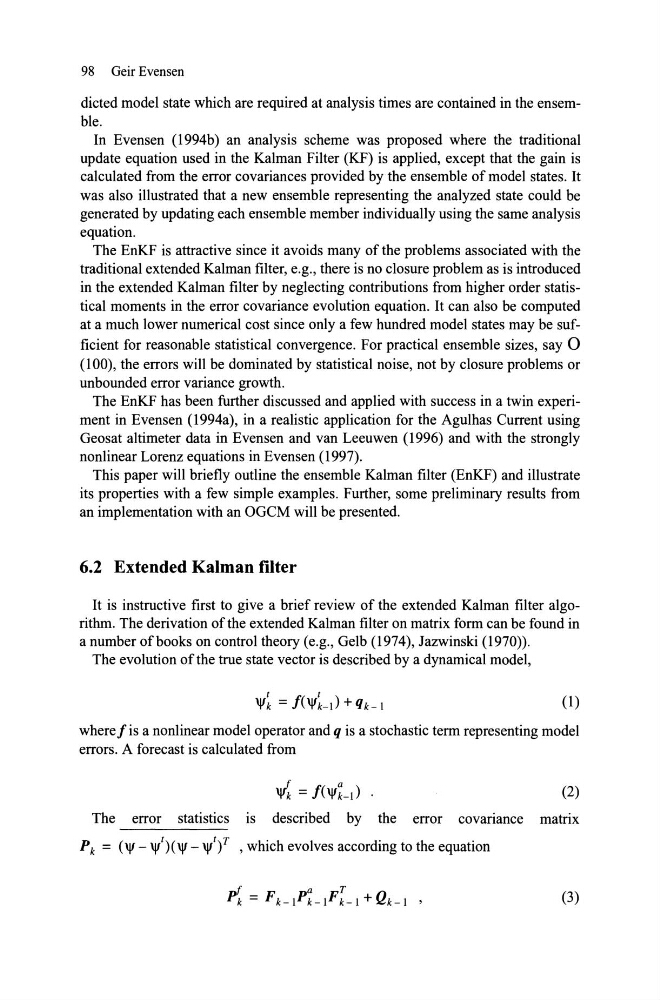
The evolution ofthe true state vector is described by a dynamical model,
(1)
where fis a nonlinear model operator and q is a stochastic term representing model
errors. A forecast is calculated from
(2)
The error statistics is described by the error covariance matrix
P k = (", - "/)(,,, - ",y ,which evolves according to the equation
(3)
dicted model state which are required at analysis times are contained in the ensembIe.
In Evensen (1994b) an analysis scheme was proposed where the traditional
update equation used in the Kalman Filter (KF) is applied, except that the gain is
calculated from the error covariances provided by the ensemble of model states. It
was also illustrated that a new ensemble representing the analyzed state could be
generated by updating each ensemble member individually using the same analysis
equation.
The EnKF is attractive since it avoids many of the problems associated with the
traditional extended Kalman filter, e.g., there is no closure problem as is introduced
in the extended Kalman filter by neglecting contributions from higher order statistical moments in the error covariance evolution equation. It can also be computed
at a much lower numerical cost since only a few hundred model states may be sufficient for reasonable statistical convergence. For practical ensemble sizes, say O
(100), the errors will be dominated by statistical noise, not by closure problems or
unbounded error variance growth.
The EnKF has been further discussed and applied with success in a twin experiment in Evensen (1994a), in a realistic application for the Agulhas Current using
Geosat altimeter data in Evensen and van Leeuwen (1996) and with the strongly
nonlinear Lorenz equations in Evensen (1997).
This paper will briefly outline the ensemble Kalman filter (EnKF) and illustrate
its properties with a few simple examples. Further, some preliminary results from
an implementation with an OGCM will be presented.
6.2 Extended Kalman fllter
It is instructive first to give a brief review of the extended Kalman filter algorithm. The derivation of the extended Kalman filter on matrix form can be found in
a number ofbooks on control theory (e.g., Gelb (1974), Jazwinski (1970».
The evolution ofthe true state vector is described by a dynamical model,
(1)
where fis a nonlinear model operator and q is a stochastic term representing model
errors. A forecast is calculated from
(2)
The error statistics is described by the error covariance matrix
P k = (", - "/)(,,, - ",y ,which evolves according to the equation
(3)