

86 Andrew C. Lorenc
5.6.4 Analysis, aUowing for gross errors
The normal way of dealing with non-Gaussian, long-tailed distributions such as
these is to detect and reject probable gross errors in a quality control step prior to
the analysis, and then to assume that the errors of the remaining observations come
from a Gaussian distribution. The quality control decision can either use pragmatic
criteria, or apply the discrete Bayes' theorem to the event G "there is a gross error"
(Lorenc and Hammon, 1988):
.1
.1
oM
oM
..
..
..
..
/ '
•
•
/
•
D
4
• •
4
oi
.1
.1
a
a
..
,-.
..
I "
..
, ..
\
\
•
\
•
\ ,
D
•
4
oi
• •
•
4
•
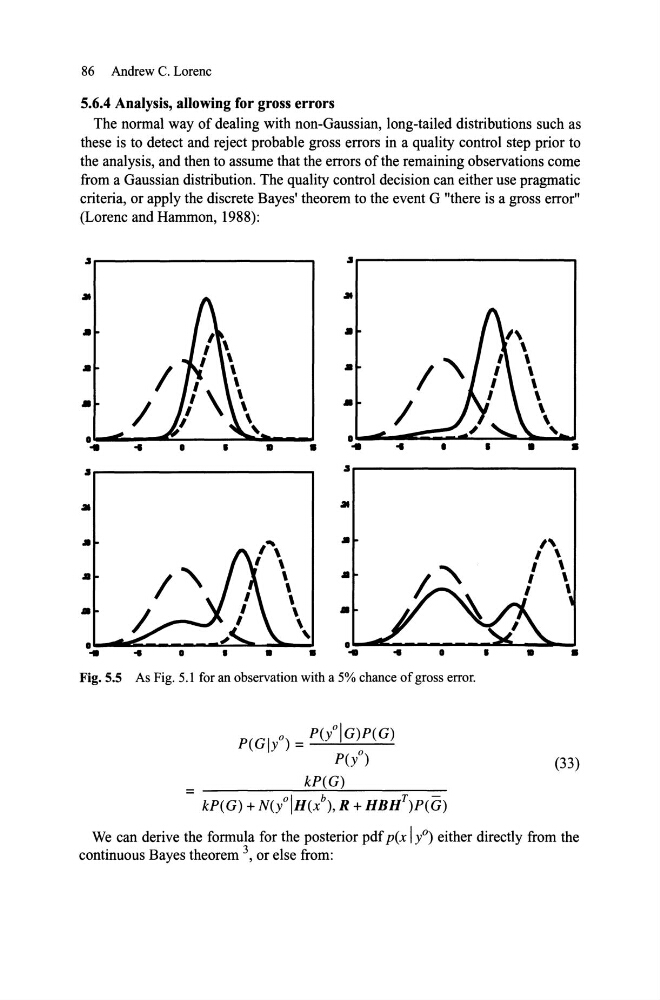
Fig. 5.5 As Fig. 5.1 fOf an observation with a 5% chance of gross errOf.
P(Gll) = p(lIG)p(G)
p(l)
= _____ kP-' (>-G...<..) _ _ _ _ _
kP(G) + N(lIH(i), R + HBHT)P(G)
1\ , , , , , , ,
'\ •
l'
I \
I
,
I
\
I
\
•
(33)
We can derive the formula for the posterior pdf p(x I yO) either direct1y from the
continuous Bayes theorem 3, or else from:
5.6.4 Analysis, aUowing for gross errors
The normal way of dealing with non-Gaussian, long-tailed distributions such as
these is to detect and reject probable gross errors in a quality control step prior to
the analysis, and then to assume that the errors of the remaining observations come
from a Gaussian distribution. The quality control decision can either use pragmatic
criteria, or apply the discrete Bayes' theorem to the event G "there is a gross error"
(Lorenc and Hammon, 1988):
.1
.1
oM
oM
..
..
..
..
/ '
•
•
/
•
D
4
• •
4
oi
.1
.1
a
a
..
,-.
..
I "
..
, ..
\
\
•
\
•
\ ,
D
•
4
oi
• •
•
4
•
Fig. 5.5 As Fig. 5.1 fOf an observation with a 5% chance of gross errOf.
P(Gll) = p(lIG)p(G)
p(l)
= _____ kP-' (>-G...<..) _ _ _ _ _
kP(G) + N(lIH(i), R + HBHT)P(G)
1\ , , , , , , ,
'\ •
l'
I \
I
,
I
\
I
\
•
(33)
We can derive the formula for the posterior pdf p(x I yO) either direct1y from the
continuous Bayes theorem 3, or else from: