

86
Homogeneous Models of the Ocean Circulation
( An)'/
2
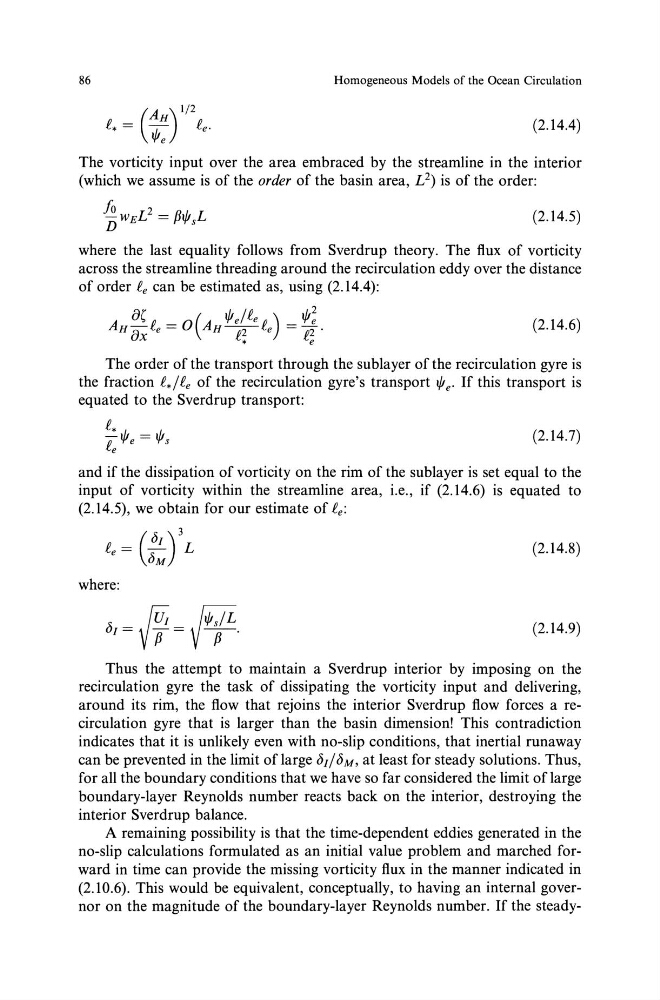
£. = If: fe.
(2.14.4)
The vorticity input over the area embraced by the streamline in the interior
(which we assume is of the order of the basin area, L 2 ) is of the order:
~ WEL 2 = Pt/JsL
(2.14.5)
where the last equality follows from Sverdrup theory. The flux of vorticity
across the streamline threading around the recirculation eddy over the distance
of order fe can be estimated as, using (2.14.4):
8( 0
(
t/J e / fe 0 )
t/J;
An Bx.r.e = 0 AnT.r.e = t;.
(2.14.6)
The order of the transport through the sub layer of the recirculation gyre is
the fraction £./ fe of the recirculation gyre's transport t/1 e· If this transport is
equated to the Sverdrup transport:
£.
fe t/Je = t/Js
(2.14.7)
and if the dissipation of vorticity on the rim of the sublayer is set equal to the
input of vorticity within the streamline area, i.e., if (2.14.6) is equated to
(2.14.5), we obtain for our estimate of fe:
fe = (:~r L
(2.14.8)
where:
(2.14.9)
Thus the attempt to maintain a Sverdrup interior by imposing on the
recirculation gyre the task of dissipating the vorticity input and delivering,
around its rim, the flow that rejoins the interior Sverdrup flow forces a recirculation gyre that is larger than the basin dimension! This contradiction
indicates that it is unlikely even with no-slip conditions, that inertial runaway
can be prevented in the limit oflarge {}J/{)M, at least for steady solutions. Thus,
for all the boundary conditions that we have so far considered the limit of large
boundary-layer Reynolds number reacts back on the interior, destroying the
interior Sverdrup balance.
A remaining possibility is that the time-dependent eddies generated in the
no-slip calculations formulated as an initial value problem and marched forward in time can provide the missing vorticity flux in the manner indicated in
(2.10.6). This would be equivalent, conceptually, to having an internal governor on the magnitude of the boundary-layer Reynolds number. If the steady-
Homogeneous Models of the Ocean Circulation
( An)'/
2
£. = If: fe.
(2.14.4)
The vorticity input over the area embraced by the streamline in the interior
(which we assume is of the order of the basin area, L 2 ) is of the order:
~ WEL 2 = Pt/JsL
(2.14.5)
where the last equality follows from Sverdrup theory. The flux of vorticity
across the streamline threading around the recirculation eddy over the distance
of order fe can be estimated as, using (2.14.4):
8( 0
(
t/J e / fe 0 )
t/J;
An Bx.r.e = 0 AnT.r.e = t;.
(2.14.6)
The order of the transport through the sub layer of the recirculation gyre is
the fraction £./ fe of the recirculation gyre's transport t/1 e· If this transport is
equated to the Sverdrup transport:
£.
fe t/Je = t/Js
(2.14.7)
and if the dissipation of vorticity on the rim of the sublayer is set equal to the
input of vorticity within the streamline area, i.e., if (2.14.6) is equated to
(2.14.5), we obtain for our estimate of fe:
fe = (:~r L
(2.14.8)
where:
(2.14.9)
Thus the attempt to maintain a Sverdrup interior by imposing on the
recirculation gyre the task of dissipating the vorticity input and delivering,
around its rim, the flow that rejoins the interior Sverdrup flow forces a recirculation gyre that is larger than the basin dimension! This contradiction
indicates that it is unlikely even with no-slip conditions, that inertial runaway
can be prevented in the limit oflarge {}J/{)M, at least for steady solutions. Thus,
for all the boundary conditions that we have so far considered the limit of large
boundary-layer Reynolds number reacts back on the interior, destroying the
interior Sverdrup balance.
A remaining possibility is that the time-dependent eddies generated in the
no-slip calculations formulated as an initial value problem and marched forward in time can provide the missing vorticity flux in the manner indicated in
(2.10.6). This would be equivalent, conceptually, to having an internal governor on the magnitude of the boundary-layer Reynolds number. If the steady-