

Inertial Runaway
85
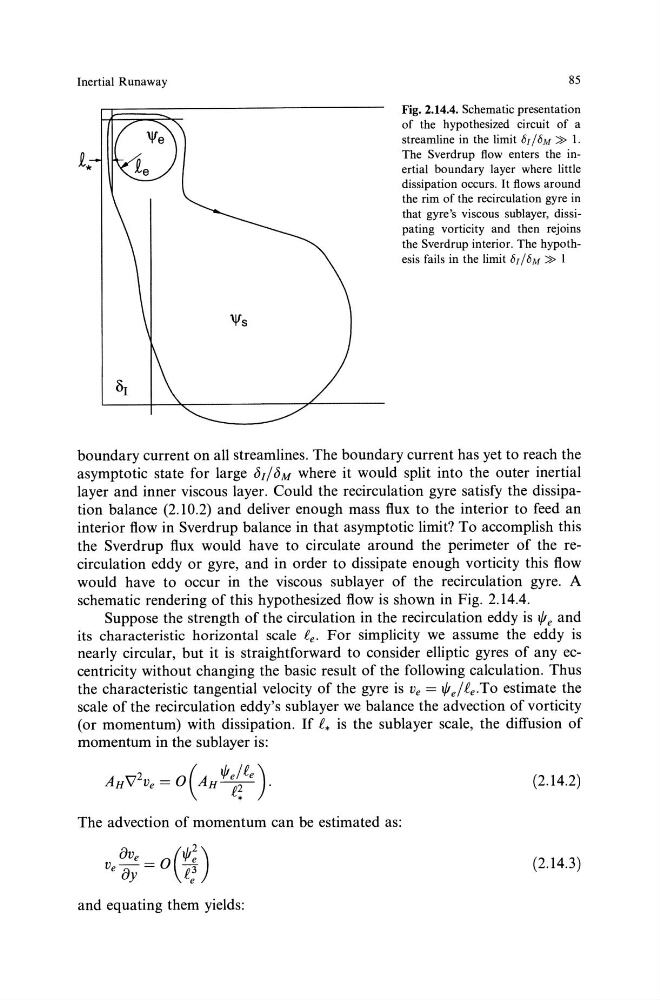
Fig. 2.14.4. Schematic presentation
of the hypothesized circuit of a
streamline in the limit fh/8M » I.
The Sverdrup flow enters the inertial boundary layer where little
dissipation occurs. It flows around
the rim of the recirculation gyre in
that gyre's viscous sub layer, dissipating vorticity and then rejoins
the Sverdrup interior. The hypothesis fails in the limit 8r/8M » I
boundary current on all streamlines. The boundary current has yet to reach the
asymptotic state for large th / (J M where it would split into the outer inertial
layer and inner viscous layer. Could the recirculation gyre satisfy the dissipation balance (2.10.2) and deliver enough mass flux to the interior to feed an
interior flow in Sverdrup balance in that asymptotic limit? To accomplish this
the Sverdrup flux would have to circulate around the perimeter of the recirculation eddy or gyre, and in order to dissipate enough vorticity this flow
would have to occur in the viscous sublayer of the recirculation gyre. A
schematic rendering of this hypothesized flow is shown in Fig. 2.14.4.
Suppose the strength of the circulation in the recirculation eddy is 1/Je and
its characteristic horizontal scale R.e. For simplicity we assume the eddy is
nearly circular, but it is straightforward to consider elliptic gyres of any eccentricity without changing the basic result of the following calculation. Thus
the characteristic tangential velocity of the gyre is Ve = 1/Je/R.e.To estimate the
scale of the recirculation eddy's sublayer we balance the advection of vorticity
(or momentum) with dissipation. If £. is the sublayer scale, the diffusion of
momentum in the sublayer is:
2
O (
1/J e/ fe)
AHV Ve =
Aw-:er- .
(2.14.2)
The advection of momentum can be estimated as:
ave_ o(lj;;)
Ve a -
£3
Y
e
(2.14.3)
and equating them yields:
85
Fig. 2.14.4. Schematic presentation
of the hypothesized circuit of a
streamline in the limit fh/8M » I.
The Sverdrup flow enters the inertial boundary layer where little
dissipation occurs. It flows around
the rim of the recirculation gyre in
that gyre's viscous sub layer, dissipating vorticity and then rejoins
the Sverdrup interior. The hypothesis fails in the limit 8r/8M » I
boundary current on all streamlines. The boundary current has yet to reach the
asymptotic state for large th / (J M where it would split into the outer inertial
layer and inner viscous layer. Could the recirculation gyre satisfy the dissipation balance (2.10.2) and deliver enough mass flux to the interior to feed an
interior flow in Sverdrup balance in that asymptotic limit? To accomplish this
the Sverdrup flux would have to circulate around the perimeter of the recirculation eddy or gyre, and in order to dissipate enough vorticity this flow
would have to occur in the viscous sublayer of the recirculation gyre. A
schematic rendering of this hypothesized flow is shown in Fig. 2.14.4.
Suppose the strength of the circulation in the recirculation eddy is 1/Je and
its characteristic horizontal scale R.e. For simplicity we assume the eddy is
nearly circular, but it is straightforward to consider elliptic gyres of any eccentricity without changing the basic result of the following calculation. Thus
the characteristic tangential velocity of the gyre is Ve = 1/Je/R.e.To estimate the
scale of the recirculation eddy's sublayer we balance the advection of vorticity
(or momentum) with dissipation. If £. is the sublayer scale, the diffusion of
momentum in the sublayer is:
2
O (
1/J e/ fe)
AHV Ve =
Aw-:er- .
(2.14.2)
The advection of momentum can be estimated as:
ave_ o(lj;;)
Ve a -
£3
Y
e
(2.14.3)
and equating them yields: