

82
Homogeneous Models of the Ocean Circulation
possible scale consistent with the dynamics and the boundary conditions, it is
stable to other eigenmode perturbations that have smaller scales. The natural
solutions in this limit are therefore steady. This is quite different than the noslip case where the strong shears in the sublayer maintain a region of small
spatial scale which is the source of continuous instability (Ierley and Young
1991).
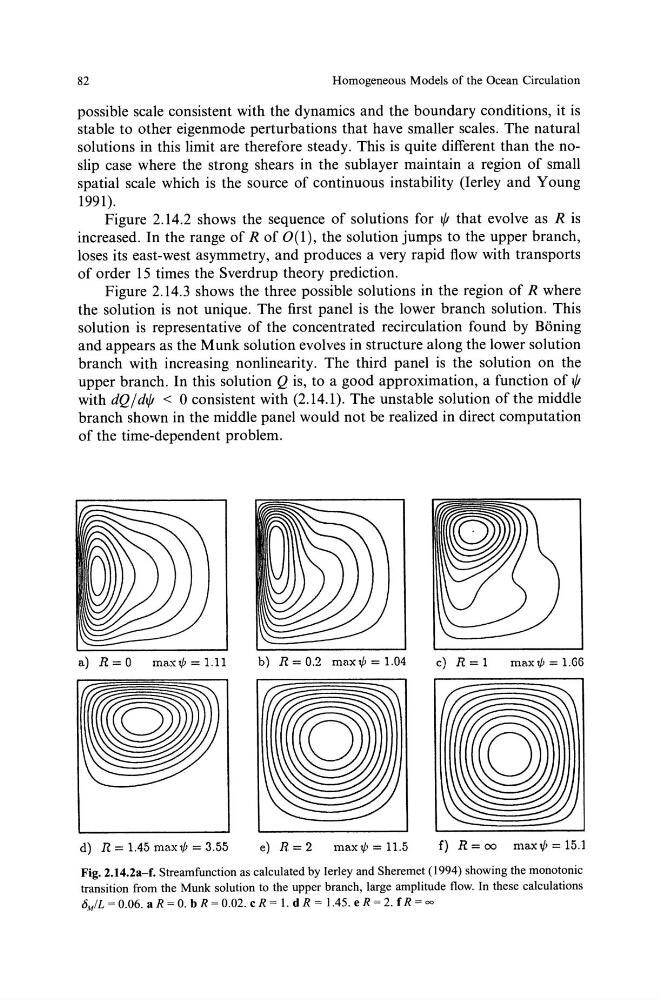
Figure 2.14.2 shows the sequence of solutions for lj; that evolve as R is
increased. In the range of R of 0(1), the solution jumps to the upper branch,
loses its east-west asymmetry, and produces a very rapid flow with transports
of order 15 times the Sverdrup theory prediction.
Figure 2.14.3 shows the three possible solutions in the region of R where
the solution is not unique. The first panel is the lower branch solution. This
solution is representative of the concentrated recirculation found by Boning
and appears as the Munk solution evolves in structure along the lower solution
branch with increasing nonlinearity. The third panel is the solution on the
upper branch. In this solution Q is, to a good approximation, a function of lj;
with dQ/ dlj; < 0 consistent with (2.14.1). The unstable solution of the middle
branch shown in the middle panel would not be realized in direct computation
of the time-dependent problem.
a) R=O
maxtp=l.ll
b) R = 0.2 maxt/1 = 1.04
c) R = 1 maxtf; = l.GG
d) R = 1.45 maxtp = 3.55
e) R = 2 max1/• = 11.5
f) R = oo maxt/1 = 15.1
Fig. 2.14.2a-f. Streamfunction as calculated by Ierley and Sheremet (1994) showing the monotonic
transition from the Munk solution to the upper branch, large amplitude flow. In these calculations
t5MIL = 0.06. a R = 0. b R = 0.02. c R =I. d R = 1.45. e R = 2. f R = oo
Homogeneous Models of the Ocean Circulation
possible scale consistent with the dynamics and the boundary conditions, it is
stable to other eigenmode perturbations that have smaller scales. The natural
solutions in this limit are therefore steady. This is quite different than the noslip case where the strong shears in the sublayer maintain a region of small
spatial scale which is the source of continuous instability (Ierley and Young
1991).
Figure 2.14.2 shows the sequence of solutions for lj; that evolve as R is
increased. In the range of R of 0(1), the solution jumps to the upper branch,
loses its east-west asymmetry, and produces a very rapid flow with transports
of order 15 times the Sverdrup theory prediction.
Figure 2.14.3 shows the three possible solutions in the region of R where
the solution is not unique. The first panel is the lower branch solution. This
solution is representative of the concentrated recirculation found by Boning
and appears as the Munk solution evolves in structure along the lower solution
branch with increasing nonlinearity. The third panel is the solution on the
upper branch. In this solution Q is, to a good approximation, a function of lj;
with dQ/ dlj; < 0 consistent with (2.14.1). The unstable solution of the middle
branch shown in the middle panel would not be realized in direct computation
of the time-dependent problem.
a) R=O
maxtp=l.ll
b) R = 0.2 maxt/1 = 1.04
c) R = 1 maxtf; = l.GG
d) R = 1.45 maxtp = 3.55
e) R = 2 max1/• = 11.5
f) R = oo maxt/1 = 15.1
Fig. 2.14.2a-f. Streamfunction as calculated by Ierley and Sheremet (1994) showing the monotonic
transition from the Munk solution to the upper branch, large amplitude flow. In these calculations
t5MIL = 0.06. a R = 0. b R = 0.02. c R =I. d R = 1.45. e R = 2. f R = oo