

Inertial Runaway
Q
R
81
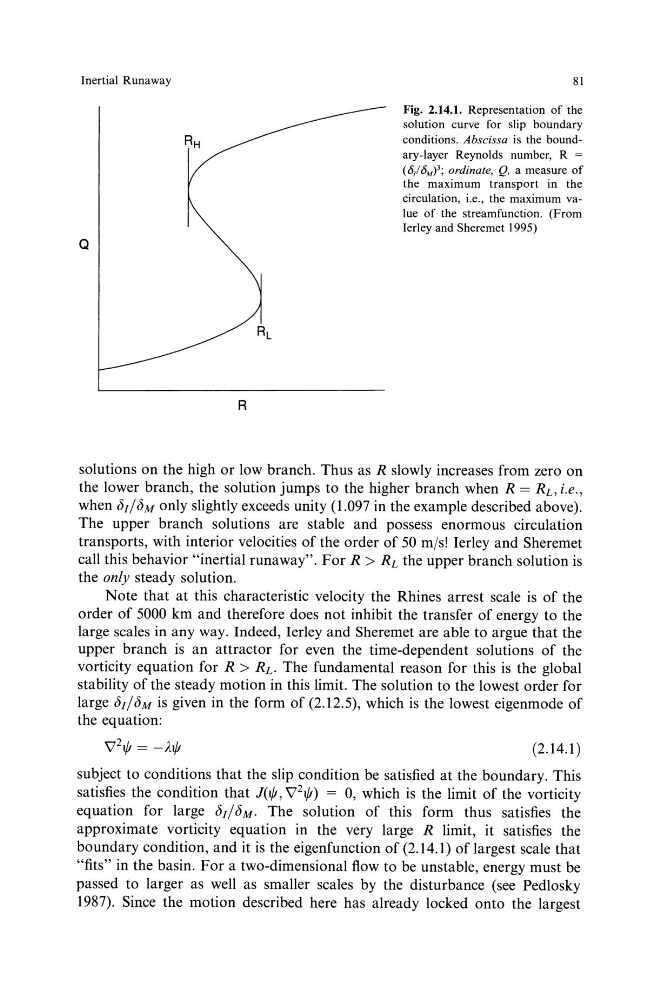
Fig. 2.14.1. Representation of the
solution curve for slip boundary
conditions. Abscissa is the boundary-layer Reynolds number, R =
( 6/ t5M) 3 ; ordinate, Q, a measure of
the maximum transport in the
circulation, i.e., the maximum value of the streamfunction. (From
Ierley and Sheremet 1995)
solutions on the high or low branch. Thus as R slowly increases from zero on
the lower branch, the solution jumps to the higher branch when R = RL, i.e.,
when ?h j [J M only slightly exceeds unity (1.097 in the example described above).
The upper branch solutions are stable and possess enormous circulation
transports, with interior velocities of the order of 50 m/s! Ierley and Sheremet
call this behavior "inertial runaway". For R > RL the upper branch solution is
the only steady solution.
Note that at this characteristic velocity the Rhines arrest scale is of the
order of 5000 km and therefore does not inhibit the transfer of energy to the
large scales in any way. Indeed, Ierley and Sheremet are able to argue that the
upper branch is an attractor for even the time-dependent solutions of the
vorticity equation for R > RL. The fundamental reason for this is the global
stability of the steady motion in this limit. The solution to the lowest order for
large bJ/bM is given in the form of (2.12.5), which is the lowest eigenmode of
the equation:
(2.14.1)
subject to conditions that the slip condition be satisfied at the boundary. This
satisfies the condition that J(ljJ, \7 2 1/J) = 0, which is the limit of the vorticity
equation for large bJ/bM. The solution of this form thus satisfies the
approximate vorticity equation in the very large R limit, it satisfies the
boundary condition, and it is the eigenfunction of (2.14.1) of largest scale that
"fits" in the basin. For a two-dimensional flow to be unstable, energy must be
passed to larger as well as smaller scales by the disturbance (see Pedlosky
1987). Since the motion described here has already locked onto the largest
Q
R
81
Fig. 2.14.1. Representation of the
solution curve for slip boundary
conditions. Abscissa is the boundary-layer Reynolds number, R =
( 6/ t5M) 3 ; ordinate, Q, a measure of
the maximum transport in the
circulation, i.e., the maximum value of the streamfunction. (From
Ierley and Sheremet 1995)
solutions on the high or low branch. Thus as R slowly increases from zero on
the lower branch, the solution jumps to the higher branch when R = RL, i.e.,
when ?h j [J M only slightly exceeds unity (1.097 in the example described above).
The upper branch solutions are stable and possess enormous circulation
transports, with interior velocities of the order of 50 m/s! Ierley and Sheremet
call this behavior "inertial runaway". For R > RL the upper branch solution is
the only steady solution.
Note that at this characteristic velocity the Rhines arrest scale is of the
order of 5000 km and therefore does not inhibit the transfer of energy to the
large scales in any way. Indeed, Ierley and Sheremet are able to argue that the
upper branch is an attractor for even the time-dependent solutions of the
vorticity equation for R > RL. The fundamental reason for this is the global
stability of the steady motion in this limit. The solution to the lowest order for
large bJ/bM is given in the form of (2.12.5), which is the lowest eigenmode of
the equation:
(2.14.1)
subject to conditions that the slip condition be satisfied at the boundary. This
satisfies the condition that J(ljJ, \7 2 1/J) = 0, which is the limit of the vorticity
equation for large bJ/bM. The solution of this form thus satisfies the
approximate vorticity equation in the very large R limit, it satisfies the
boundary condition, and it is the eigenfunction of (2.14.1) of largest scale that
"fits" in the basin. For a two-dimensional flow to be unstable, energy must be
passed to larger as well as smaller scales by the disturbance (see Pedlosky
1987). Since the motion described here has already locked onto the largest