

Moore's Hypothesis
75
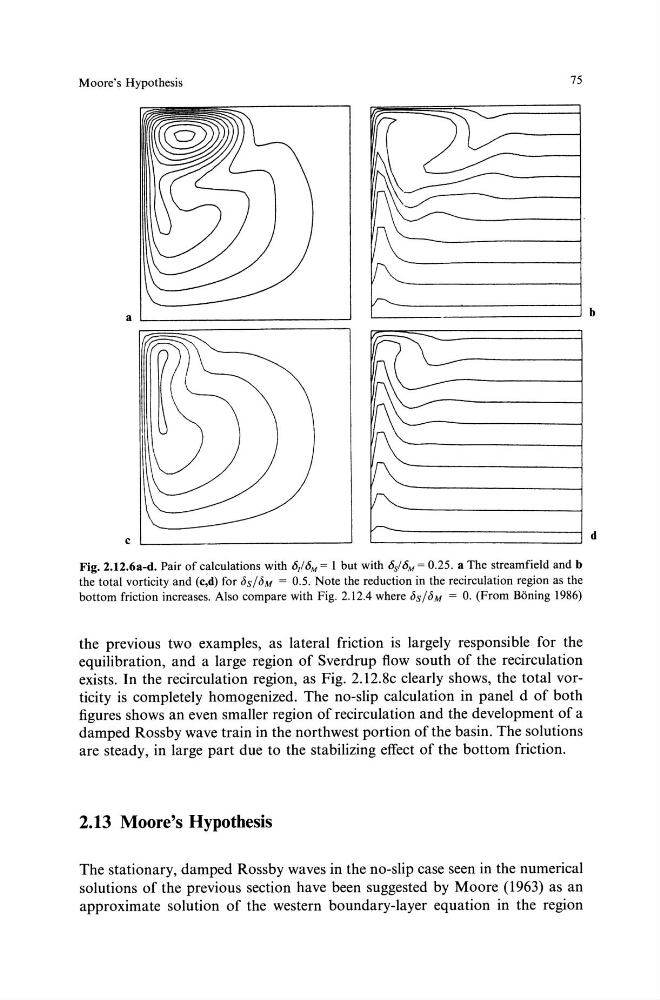
Fig. 2.12.6a-d. Pair of calculations with t5/t5M = 1 but with t5slt5M = 0.25. a The streamfield and b
the total vorticity and (c,d) for i5s/f>M = 0.5. Note the reduction in the recirculation region as the
bottom friction increases. Also compare with Fig. 2.12.4 where i5s/i5M = 0. (From Boning 1986)
the previous two examples, as lateral friction is largely responsible for the
equilibration, and a large region of Sverdrup flow south of the recirculation
exists. In the recirculation region, as Fig. 2.12.8c clearly shows, the total vorticity is completely homogenized. The no-slip calculation in panel d of both
figures shows an even smaller region of recirculation and the development of a
damped Ross by wave train in the northwest portion of the basin. The solutions
are steady, in large part due to the stabilizing effect of the bottom friction.
2.13 Moore's Hypothesis
The stationary, damped Rossby waves in the no-slip case seen in the numerical
solutions of the previous section have been suggested by Moore (1963) as an
approximate solution of the western boundary-layer equation in the region
75
Fig. 2.12.6a-d. Pair of calculations with t5/t5M = 1 but with t5slt5M = 0.25. a The streamfield and b
the total vorticity and (c,d) for i5s/f>M = 0.5. Note the reduction in the recirculation region as the
bottom friction increases. Also compare with Fig. 2.12.4 where i5s/i5M = 0. (From Boning 1986)
the previous two examples, as lateral friction is largely responsible for the
equilibration, and a large region of Sverdrup flow south of the recirculation
exists. In the recirculation region, as Fig. 2.12.8c clearly shows, the total vorticity is completely homogenized. The no-slip calculation in panel d of both
figures shows an even smaller region of recirculation and the development of a
damped Ross by wave train in the northwest portion of the basin. The solutions
are steady, in large part due to the stabilizing effect of the bottom friction.
2.13 Moore's Hypothesis
The stationary, damped Rossby waves in the no-slip case seen in the numerical
solutions of the previous section have been suggested by Moore (1963) as an
approximate solution of the western boundary-layer equation in the region