

64
Homogeneous Models of the Ocean Circulation
position, y = Ye, that it had on the eastern boundary. If no-slip conditions are
applied on the western wall, 'is positive (v increasing with x) right at the wall.
This means that the intersection with the western wall of the isoline in the noslip case is at:
(2.11.8)
Thus in both cases of slip and no-slip there is a strong stretching process
operating on the vorticity isolines. The total vorticity isolines are anchored at
the western boundary at a position equal to or south of the position that they
had when they entered the boundary layer. Yet in the nonlinear limit they are
being advectively strongly stretched northward within the layer. This should
make for a very contorted geometry of the vorticity field in the vicinity of the
western boundary. Only in the case of superslip conditions or in the entire
absence of lateral friction and its associated boundary conditions are the
isolines of vorticity free to slide along the boundaries and be easily wrapped up
by the motion.
This has important consequences for the possibility of resonance with the
Fofonoff mode. In the inertial, strongly nonlinear parameter range the possibility exists, as we noted above, that the free nonlinear mode found by Fofonoff (discussed in Section 2.8) might be excited by the steady wind forcing. If
the mode were to resonate and to dominate the solution, we would have as a
first approximation the relation between total vorticity and streamfunction
given by (2.8.12). If this is used to evaluate the dissipation balance (2.10.2) we
obtain:
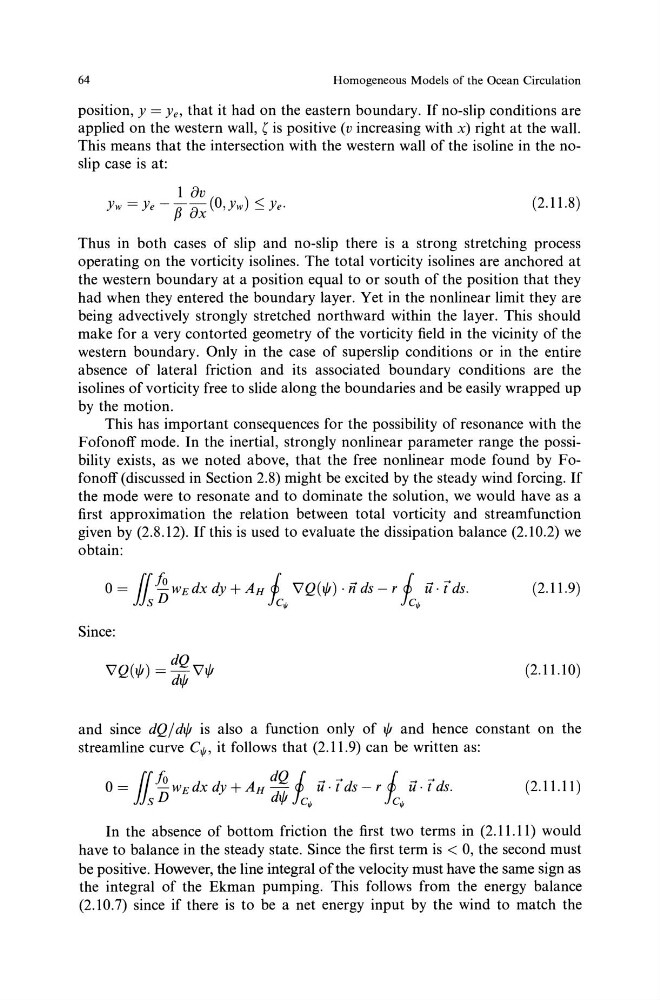
0= ff~wEdxdy+An1 \JQ(t/l)·iids-r1 u·tds.
~
k.
~
Since:
V'Q(t/1) = dQ V't/1
dt/1
(2.11.9)
(2.11.10)
and since dQj dt/1 is also a function only of t/1 and hence constant on the
streamline curve C"', it follows that (2.11.9) can be written as:
0 = [[ fo WE dx dy +An ~~ 1 u· t ds- r 1 u· t ds.
~D
o/~
~
(2.11.11)
In the absence of bottom friction the first two terms in (2.11.11) would
have to balance in the steady state. Since the first term is < 0, the second must
be positive. However, the line integral of the velocity must have the same sign as
the integral of the Ekman pumping. This follows from the energy balance
(2.1 0. 7) since if there is to be a net energy input by the wind to match the
Homogeneous Models of the Ocean Circulation
position, y = Ye, that it had on the eastern boundary. If no-slip conditions are
applied on the western wall, 'is positive (v increasing with x) right at the wall.
This means that the intersection with the western wall of the isoline in the noslip case is at:
(2.11.8)
Thus in both cases of slip and no-slip there is a strong stretching process
operating on the vorticity isolines. The total vorticity isolines are anchored at
the western boundary at a position equal to or south of the position that they
had when they entered the boundary layer. Yet in the nonlinear limit they are
being advectively strongly stretched northward within the layer. This should
make for a very contorted geometry of the vorticity field in the vicinity of the
western boundary. Only in the case of superslip conditions or in the entire
absence of lateral friction and its associated boundary conditions are the
isolines of vorticity free to slide along the boundaries and be easily wrapped up
by the motion.
This has important consequences for the possibility of resonance with the
Fofonoff mode. In the inertial, strongly nonlinear parameter range the possibility exists, as we noted above, that the free nonlinear mode found by Fofonoff (discussed in Section 2.8) might be excited by the steady wind forcing. If
the mode were to resonate and to dominate the solution, we would have as a
first approximation the relation between total vorticity and streamfunction
given by (2.8.12). If this is used to evaluate the dissipation balance (2.10.2) we
obtain:
0= ff~wEdxdy+An1 \JQ(t/l)·iids-r1 u·tds.
~
k.
~
Since:
V'Q(t/1) = dQ V't/1
dt/1
(2.11.9)
(2.11.10)
and since dQj dt/1 is also a function only of t/1 and hence constant on the
streamline curve C"', it follows that (2.11.9) can be written as:
0 = [[ fo WE dx dy +An ~~ 1 u· t ds- r 1 u· t ds.
~D
o/~
~
(2.11.11)
In the absence of bottom friction the first two terms in (2.11.11) would
have to balance in the steady state. Since the first term is < 0, the second must
be positive. However, the line integral of the velocity must have the same sign as
the integral of the Ekman pumping. This follows from the energy balance
(2.1 0. 7) since if there is to be a net energy input by the wind to match the