

Integral Balances for the Boundary Layer
63
important to note that this inertial advective term, when integrated over R,
involves only the tangential velocity in the boundary layer at the wall. Thus, for
no-slip conditions, for which that velocity must be zero, the planetary vorticity
imported into the region R from the interior must be locally completely dissipated in that region. Furthermore, it must be dissipated locally only by the
lateral friction since the integrated effect of the bottom friction also vanishes
for no-slip conditions. This is because the total relative vorticity in the
boundary layer (at least in the boundary-layer approximation) vanishes when
no-slip conditions apply, i.e.:
loo ( dx = -v(O,y) = 0.
(2.11.5)
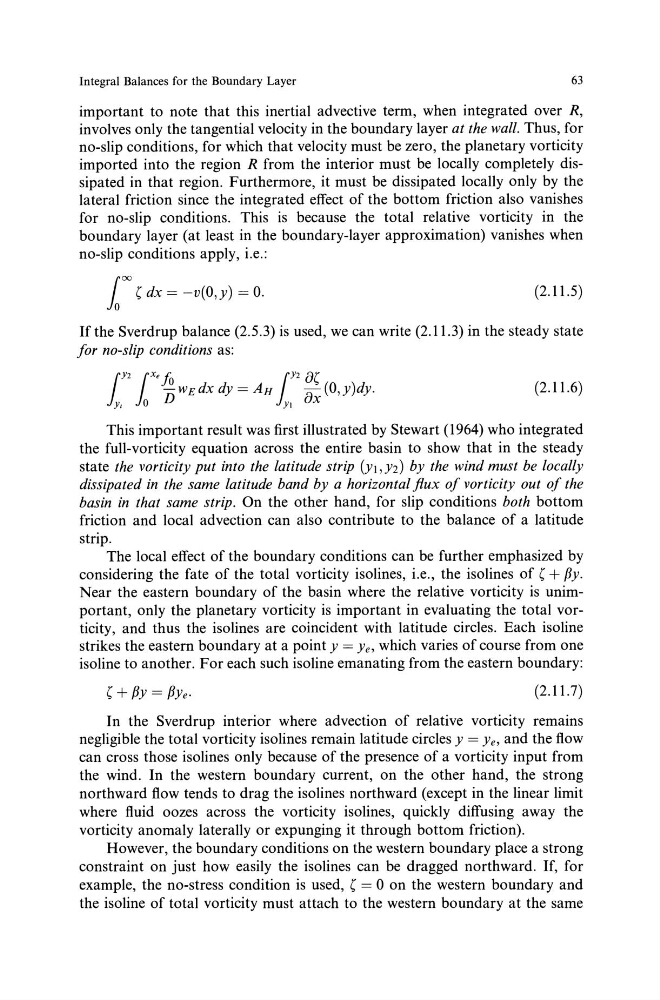
If the Sverdrup balance (2.5.3) is used, we can write (2.11.3) in the steady state
for no-slip conditions as:
(2.11.6)
This important result was first illustrated by Stewart (1964) who integrated
the full-vorticity equation across the entire basin to show that in the steady
state the vorticity put into the latitude strip (YJ, Y2) by the wind must be locally
dissipated in the same latitude band by a horizontal flux of vorticity out of the
basin in that same strip. On the other hand, for slip conditions both bottom
friction and local advection can also contribute to the balance of a latitude
strip.
The local effect of the boundary conditions can be further emphasized by
considering the fate of the total vorticity isolines, i.e., the isolines of ( + {3y.
Near the eastern boundary of the basin where the relative vorticity is unimportant, only the planetary vorticity is important in evaluating the total vorticity, and thus the isolines are coincident with latitude circles. Each isoline
strikes the eastern boundary at a pointy = Ye, which varies of course from one
isoline to another. For each such isoline emanating from the eastern boundary:
( + f3y = f3Ye·
(2.11.7)
In the Sverdrup interior where advection of relative vort1c1ty remains
negligible the total vorticity isolines remain latitude circles y = Ye, and the flow
can cross those isolines only because of the presence of a vorticity input from
the wind. In the western boundary current, on the other hand, the strong
northward flow tends to drag the isolines northward (except in the linear limit
where fluid oozes across the vorticity isolines, quickly diffusing away the
vorticity anomaly laterally or expunging it through bottom friction).
However, the boundary conditions on the western boundary place a strong
constraint on just how easily the isolines can be dragged northward. If, for
example, the no-stress condition is used, ( = 0 on the western boundary and
the isoline of total vorticity must attach to the western boundary at the same
63
important to note that this inertial advective term, when integrated over R,
involves only the tangential velocity in the boundary layer at the wall. Thus, for
no-slip conditions, for which that velocity must be zero, the planetary vorticity
imported into the region R from the interior must be locally completely dissipated in that region. Furthermore, it must be dissipated locally only by the
lateral friction since the integrated effect of the bottom friction also vanishes
for no-slip conditions. This is because the total relative vorticity in the
boundary layer (at least in the boundary-layer approximation) vanishes when
no-slip conditions apply, i.e.:
loo ( dx = -v(O,y) = 0.
(2.11.5)
If the Sverdrup balance (2.5.3) is used, we can write (2.11.3) in the steady state
for no-slip conditions as:
(2.11.6)
This important result was first illustrated by Stewart (1964) who integrated
the full-vorticity equation across the entire basin to show that in the steady
state the vorticity put into the latitude strip (YJ, Y2) by the wind must be locally
dissipated in the same latitude band by a horizontal flux of vorticity out of the
basin in that same strip. On the other hand, for slip conditions both bottom
friction and local advection can also contribute to the balance of a latitude
strip.
The local effect of the boundary conditions can be further emphasized by
considering the fate of the total vorticity isolines, i.e., the isolines of ( + {3y.
Near the eastern boundary of the basin where the relative vorticity is unimportant, only the planetary vorticity is important in evaluating the total vorticity, and thus the isolines are coincident with latitude circles. Each isoline
strikes the eastern boundary at a pointy = Ye, which varies of course from one
isoline to another. For each such isoline emanating from the eastern boundary:
( + f3y = f3Ye·
(2.11.7)
In the Sverdrup interior where advection of relative vort1c1ty remains
negligible the total vorticity isolines remain latitude circles y = Ye, and the flow
can cross those isolines only because of the presence of a vorticity input from
the wind. In the western boundary current, on the other hand, the strong
northward flow tends to drag the isolines northward (except in the linear limit
where fluid oozes across the vorticity isolines, quickly diffusing away the
vorticity anomaly laterally or expunging it through bottom friction).
However, the boundary conditions on the western boundary place a strong
constraint on just how easily the isolines can be dragged northward. If, for
example, the no-stress condition is used, ( = 0 on the western boundary and
the isoline of total vorticity must attach to the western boundary at the same