

50
Homogeneous Models of the Ocean Circulation
2.9 The Nonlinear Munk Problem
We have already seen that a purely inertial model of the western boundary
current is an inadequate model for the closure of the circulation. Dissipation
must be important to close the circulation, and yet in any realistic model of the
western boundary current the magnitude of the velocity is such that
nonlinearity cannot be ignored as in the Munk theory. Thus nonlinearity
and dissipation must be considered simultaneously. As might be imagined, this
requires numerical rather than analytical approaches to the full circulation
problem. However, numerical methods have their limitations as well. The
degree of affordable resolution and the fact that the complex results are
numerical rather than relational are both severe impediments to understanding. Before discussing the numerical work that has been performed on the
circulation problem, and especially with the problem of the closure of the
circulation in mind, we discuss in the next few sections some theoretical results
which are helpful in understanding and anticipating the numerical work.
We start here by considering the Munk problem for the western boundary
layer in the presence of nonnegligible nonlinearity. As in the linear Munk
problem, we ignore the effect of bottom friction. The problem was studied
originally by Il'in and Kamenkovich (1964) and by Ierley and Ruehr (1986).
We shall follow the discussion of Ierley and Ruehr and also Ierley (1987).
We consider the boundary layer equation in the form (2.6.2). It is useful for
the analysis that follows to consider the equation in nondimensional form. We
choose as the x length scale the Munk layer thickness, bM, and for they scale
we choose L, the basin or gyre scale. For the stream function scale we take a
characteristic value of the interior streamfunction at the western boundary,
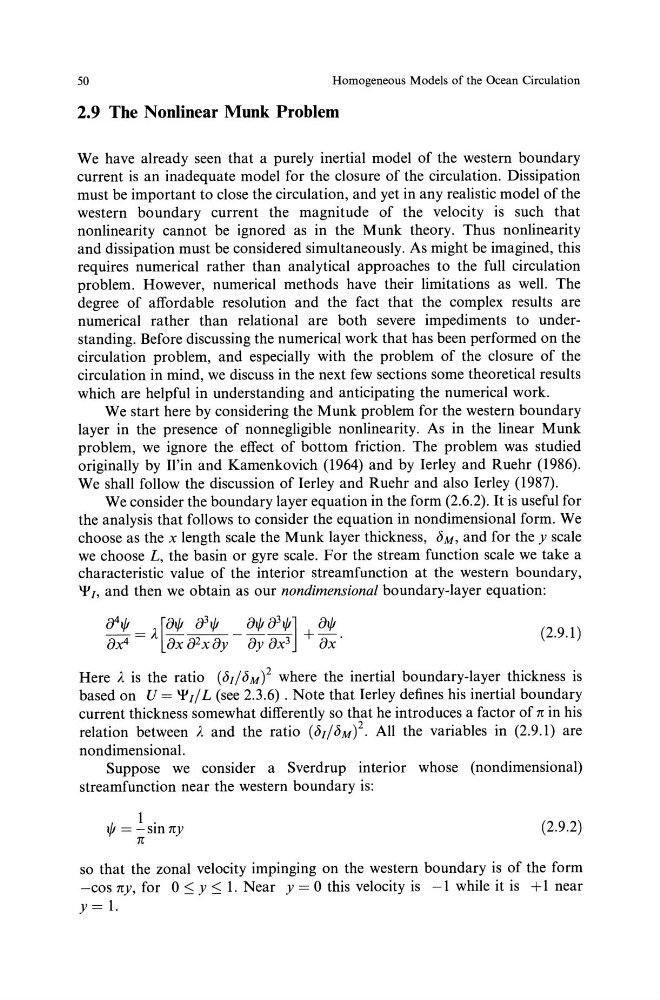
'PI. and then we obtain as our nondimensional boundary-layer equation:
(2.9.1)
Here A is the ratio (1Jf/1JM) 2 where the inertial boundary-layer thickness is
based on U ='PI/ L (see 2.3.6) . Note that Ierley defines his inertial boundary
current thickness somewhat differently so that he introduces a factor of n in his
relation between A and the ratio ( b I/ b M t All the variables in (2.9 .1) are
non dimensional.
Suppose we consider a Sverdrup interior whose (nondimensional)
streamfunction near the western boundary is:
.J,
1 .
'I'= -smny
(2.9.2)
n
so that the zonal velocity impinging on the western boundary is of the form
-cos ny, for 0 ~ y ~ 1. Near y = 0 this velocity is -1 while it is + 1 near
y=l.
Homogeneous Models of the Ocean Circulation
2.9 The Nonlinear Munk Problem
We have already seen that a purely inertial model of the western boundary
current is an inadequate model for the closure of the circulation. Dissipation
must be important to close the circulation, and yet in any realistic model of the
western boundary current the magnitude of the velocity is such that
nonlinearity cannot be ignored as in the Munk theory. Thus nonlinearity
and dissipation must be considered simultaneously. As might be imagined, this
requires numerical rather than analytical approaches to the full circulation
problem. However, numerical methods have their limitations as well. The
degree of affordable resolution and the fact that the complex results are
numerical rather than relational are both severe impediments to understanding. Before discussing the numerical work that has been performed on the
circulation problem, and especially with the problem of the closure of the
circulation in mind, we discuss in the next few sections some theoretical results
which are helpful in understanding and anticipating the numerical work.
We start here by considering the Munk problem for the western boundary
layer in the presence of nonnegligible nonlinearity. As in the linear Munk
problem, we ignore the effect of bottom friction. The problem was studied
originally by Il'in and Kamenkovich (1964) and by Ierley and Ruehr (1986).
We shall follow the discussion of Ierley and Ruehr and also Ierley (1987).
We consider the boundary layer equation in the form (2.6.2). It is useful for
the analysis that follows to consider the equation in nondimensional form. We
choose as the x length scale the Munk layer thickness, bM, and for they scale
we choose L, the basin or gyre scale. For the stream function scale we take a
characteristic value of the interior streamfunction at the western boundary,
'PI. and then we obtain as our nondimensional boundary-layer equation:
(2.9.1)
Here A is the ratio (1Jf/1JM) 2 where the inertial boundary-layer thickness is
based on U ='PI/ L (see 2.3.6) . Note that Ierley defines his inertial boundary
current thickness somewhat differently so that he introduces a factor of n in his
relation between A and the ratio ( b I/ b M t All the variables in (2.9 .1) are
non dimensional.
Suppose we consider a Sverdrup interior whose (nondimensional)
streamfunction near the western boundary is:
.J,
1 .
'I'= -smny
(2.9.2)
n
so that the zonal velocity impinging on the western boundary is of the form
-cos ny, for 0 ~ y ~ 1. Near y = 0 this velocity is -1 while it is + 1 near
y=l.