

The Inertial Boundary Layer
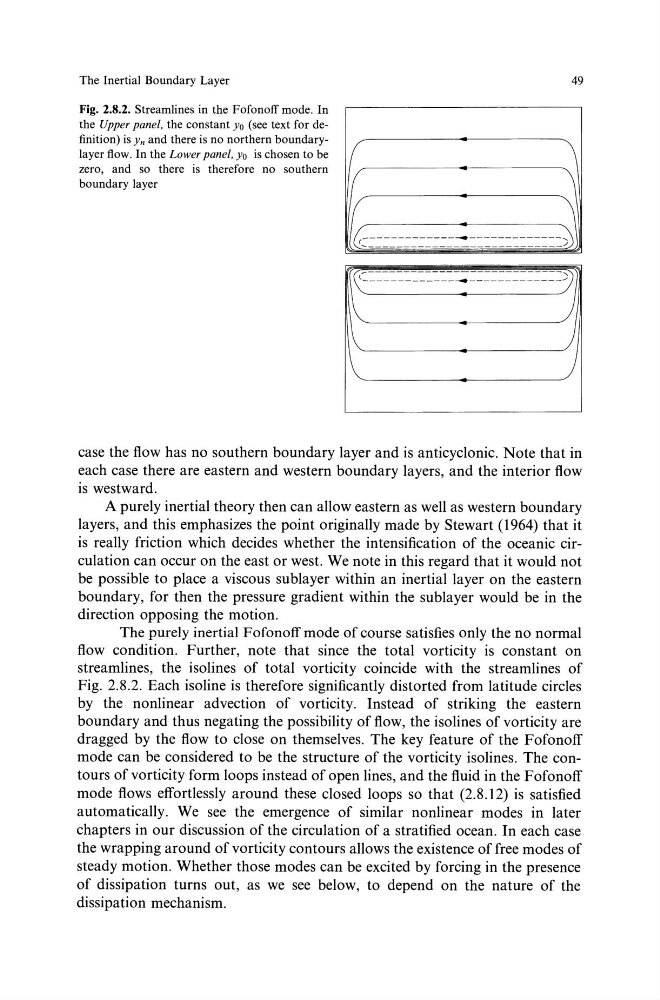
Fig. 2.8.2. Streamlines in the Fofonoff mode. In
the Upper panel, the constant Yo (see text for definition) is Yn and there is no northern boundarylayer flow. In the Lower panel, y0 is chosen to be
zero, and so there is therefore no southern
boundary layer
49
~~~~~~~~~~~~~~=============~
~============~=============~ •
case the flow has no southern boundary layer and is anticyclonic. Note that in
each case there are eastern and western boundary layers, and the interior flow
is westward.
A purely inertial theory then can allow eastern as well as western boundary
layers, and this emphasizes the point originally made by Stewart (1964) that it
is really friction which decides whether the intensification of the oceanic circulation can occur on the east or west. We note in this regard that it would not
be possible to place a viscous sublayer within an inertial layer on the eastern
boundary, for then the pressure gradient within the sublayer would be in the
direction opposing the motion.
The purely inertial Fofonoff mode of course satisfies only the no normal
flow condition. Further, note that since the total vorticity is constant on
streamlines, the isolines of total vorticity coincide with the streamlines of
Fig. 2.8.2. Each isoline is therefore significantly distorted from latitude circles
by the nonlinear advection of vorticity. Instead of striking the eastern
boundary and thus negating the possibility of flow, the isolines of vorticity are
dragged by the flow to close on themselves. The key feature of the Fofonoff
mode can be considered to be the structure of the vorticity isolines. The contours of vorticity form loops instead of open lines, and the fluid in the Fofonoff
mode flows effortlessly around these closed loops so that (2.8.12) is satisfied
automatically. We see the emergence of similar nonlinear modes in later
chapters in our discussion of the circulation of a stratified ocean. In each case
the wrapping around of vorticity contours allows the existence of free modes of
steady motion. Whether those modes can be excited by forcing in the presence
of dissipation turns out, as we see below, to depend on the nature of the
dissipation mechanism.
Fig. 2.8.2. Streamlines in the Fofonoff mode. In
the Upper panel, the constant Yo (see text for definition) is Yn and there is no northern boundarylayer flow. In the Lower panel, y0 is chosen to be
zero, and so there is therefore no southern
boundary layer
49
~~~~~~~~~~~~~~=============~
~============~=============~ •
case the flow has no southern boundary layer and is anticyclonic. Note that in
each case there are eastern and western boundary layers, and the interior flow
is westward.
A purely inertial theory then can allow eastern as well as western boundary
layers, and this emphasizes the point originally made by Stewart (1964) that it
is really friction which decides whether the intensification of the oceanic circulation can occur on the east or west. We note in this regard that it would not
be possible to place a viscous sublayer within an inertial layer on the eastern
boundary, for then the pressure gradient within the sublayer would be in the
direction opposing the motion.
The purely inertial Fofonoff mode of course satisfies only the no normal
flow condition. Further, note that since the total vorticity is constant on
streamlines, the isolines of total vorticity coincide with the streamlines of
Fig. 2.8.2. Each isoline is therefore significantly distorted from latitude circles
by the nonlinear advection of vorticity. Instead of striking the eastern
boundary and thus negating the possibility of flow, the isolines of vorticity are
dragged by the flow to close on themselves. The key feature of the Fofonoff
mode can be considered to be the structure of the vorticity isolines. The contours of vorticity form loops instead of open lines, and the fluid in the Fofonoff
mode flows effortlessly around these closed loops so that (2.8.12) is satisfied
automatically. We see the emergence of similar nonlinear modes in later
chapters in our discussion of the circulation of a stratified ocean. In each case
the wrapping around of vorticity contours allows the existence of free modes of
steady motion. Whether those modes can be excited by forcing in the presence
of dissipation turns out, as we see below, to depend on the nature of the
dissipation mechanism.