

Boundary Conditions
33
Which of these possible boundary layers is appropriate for the problem
depends on which of the boundary-layer thicknesses is the largest. As the
driving increases in magnitude, eventually ?h becomes larger than either of the
viscous boundary-layer scales, and the physics of the boundary layer becomes
nonlinear.
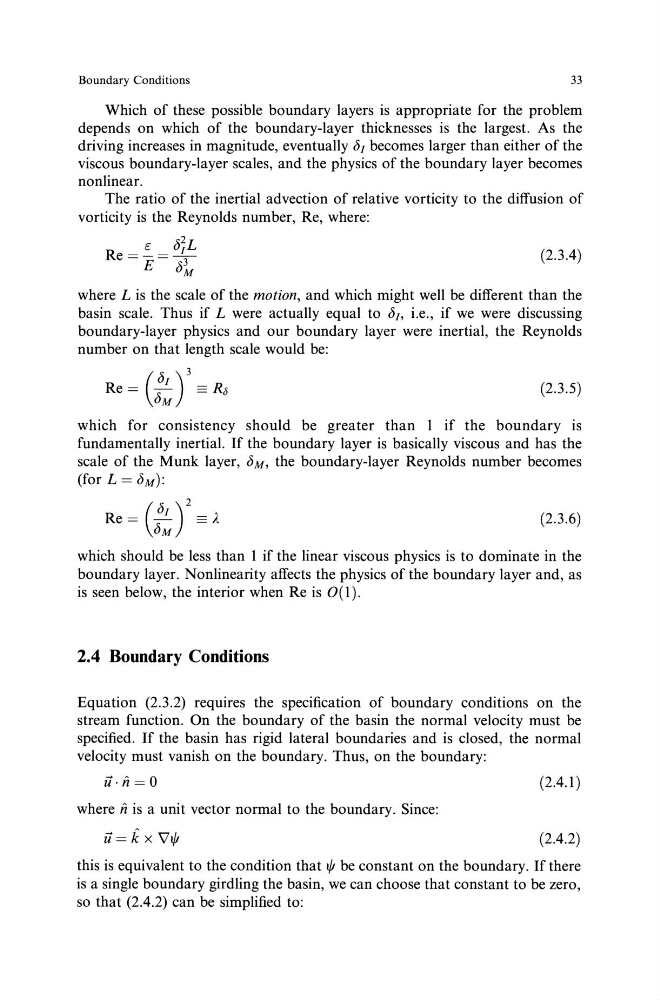
The ratio of the inertial advection of relative vorticity to the diffusion of
vorticity is the Reynolds number, Re, where:
Re = ~ = c5;L
E
c53 M
(2.3.4)
where L is the scale of the motion, and which might well be different than the
basin scale. Thus if L were actually equal to c5J. i.e., if we were discussing
boundary-layer physics and our boundary layer were inertial, the Reynolds
number on that length scale would be:
( c5[ ) 3
Re = c5M
= Rh
(2.3.5)
which for consistency should be greater than 1 if the boundary is
fundamentally inertial. If the boundary layer is basically viscous and has the
scale of the Munk layer, c5M, the boundary-layer Reynolds number becomes
(for L = c5M):
( c5[ )2
Re = c5M
=:A.
(2.3.6)
which should be less than 1 if the linear viscous physics is to dominate in the
boundary layer. Nonlinearity affects the physics of the boundary layer and, as
is seen below, the interior when Re is 0(1).
2.4 Boundary Conditions
Equation (2.3.2) requires the specification of boundary conditions on the
stream function. On the boundary of the basin the normal velocity must be
specified. If the basin has rigid lateral boundaries and is closed, the normal
velocity must vanish on the boundary. Thus, on the boundary:
il·n=O
(2.4.1)
where fz is a unit vector normal to the boundary. Since:
U = k X \lt/J
(2.4.2)
this is equivalent to the condition that t/1 be constant on the boundary. If there
is a single boundary girdling the basin, we can choose that constant to be zero,
so that (2.4.2) can be simplified to:
33
Which of these possible boundary layers is appropriate for the problem
depends on which of the boundary-layer thicknesses is the largest. As the
driving increases in magnitude, eventually ?h becomes larger than either of the
viscous boundary-layer scales, and the physics of the boundary layer becomes
nonlinear.
The ratio of the inertial advection of relative vorticity to the diffusion of
vorticity is the Reynolds number, Re, where:
Re = ~ = c5;L
E
c53 M
(2.3.4)
where L is the scale of the motion, and which might well be different than the
basin scale. Thus if L were actually equal to c5J. i.e., if we were discussing
boundary-layer physics and our boundary layer were inertial, the Reynolds
number on that length scale would be:
( c5[ ) 3
Re = c5M
= Rh
(2.3.5)
which for consistency should be greater than 1 if the boundary is
fundamentally inertial. If the boundary layer is basically viscous and has the
scale of the Munk layer, c5M, the boundary-layer Reynolds number becomes
(for L = c5M):
( c5[ )2
Re = c5M
=:A.
(2.3.6)
which should be less than 1 if the linear viscous physics is to dominate in the
boundary layer. Nonlinearity affects the physics of the boundary layer and, as
is seen below, the interior when Re is 0(1).
2.4 Boundary Conditions
Equation (2.3.2) requires the specification of boundary conditions on the
stream function. On the boundary of the basin the normal velocity must be
specified. If the basin has rigid lateral boundaries and is closed, the normal
velocity must vanish on the boundary. Thus, on the boundary:
il·n=O
(2.4.1)
where fz is a unit vector normal to the boundary. Since:
U = k X \lt/J
(2.4.2)
this is equivalent to the condition that t/1 be constant on the boundary. If there
is a single boundary girdling the basin, we can choose that constant to be zero,
so that (2.4.2) can be simplified to: