

32
Homogeneous Models of the Ocean Circulation
2.3 The Vorticity Equation in Nondimensional Form
It is illuminating to scale the variables of the problem to bring the vorticity
equation into nondimensional form, for this brings out very clearly the key
parameters of the problem. If the flow is contained in a basin of characteristic
scale L, which we suppose also characterizes the spatial scale of variation of the
Ekman pumping, we may provisionally associate L with the scale of the
motion, at least in the interior. We are, however, prepared for the fact that
motion on smaller scales occurs naturally in the region of the western boundary
current. We also provisionally suppose that the velocity, or transport in the
interior, is such that the Sverdrup balance is achieved for the interior. That is,
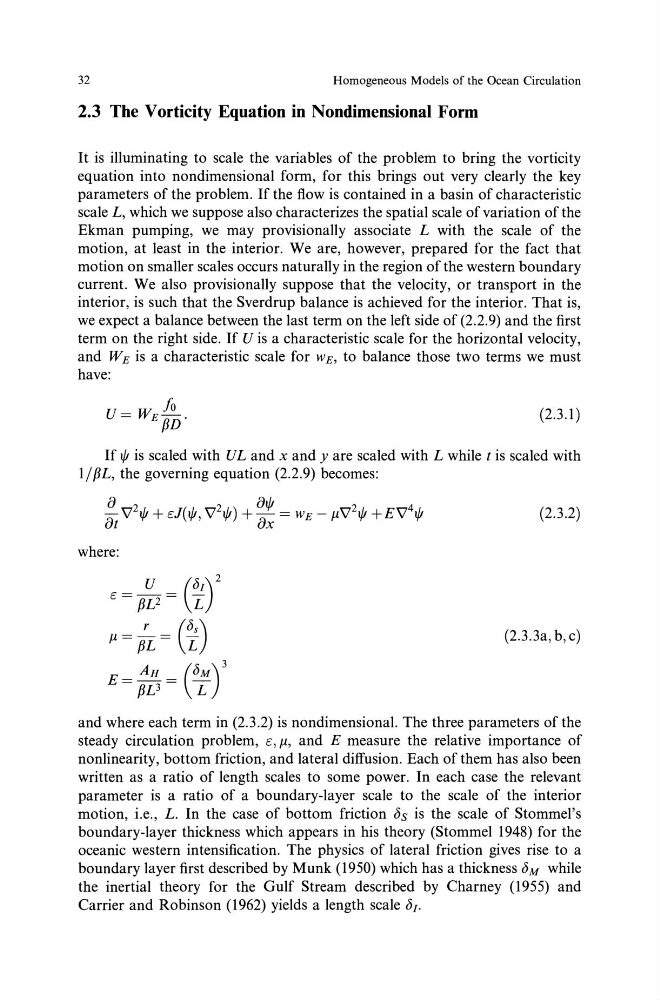
we expect a balance between the last term on the left side of (2.2.9) and the first
term on the right side. If U is a characteristic scale for the horizontal velocity,
and WE is a characteristic scale for WE, to balance those two terms we must
have:
(2.3.1)
If t/1 is scaled with ULand x andy are scaled with L while tis scaled with
1/PL, the governing equation (2.2.9) becomes:
(2.3.2)
where:
(2.3.3a, b, c)
and where each term in (2.3.2) is nondimensional. The three parameters of the
steady circulation problem, c:, f.l, and E measure the relative importance of
nonlinearity, bottom friction, and lateral diffusion. Each of them has also been
written as a ratio of length scales to some power. In each case the relevant
parameter is a ratio of a boundary-layer scale to the scale of the interior
motion, i.e., L. In the case of bottom friction bs is the scale of Stommel's
boundary-layer thickness which appears in his theory (Stommel 1948) for the
oceanic western intensification. The physics of lateral friction gives rise to a
boundary layer first described by Munk (1950) which has a thickness (JM while
the inertial theory for the Gulf Stream described by Charney (1955) and
Carrier and Robinson (1962) yields a length scale ()1.
Homogeneous Models of the Ocean Circulation
2.3 The Vorticity Equation in Nondimensional Form
It is illuminating to scale the variables of the problem to bring the vorticity
equation into nondimensional form, for this brings out very clearly the key
parameters of the problem. If the flow is contained in a basin of characteristic
scale L, which we suppose also characterizes the spatial scale of variation of the
Ekman pumping, we may provisionally associate L with the scale of the
motion, at least in the interior. We are, however, prepared for the fact that
motion on smaller scales occurs naturally in the region of the western boundary
current. We also provisionally suppose that the velocity, or transport in the
interior, is such that the Sverdrup balance is achieved for the interior. That is,
we expect a balance between the last term on the left side of (2.2.9) and the first
term on the right side. If U is a characteristic scale for the horizontal velocity,
and WE is a characteristic scale for WE, to balance those two terms we must
have:
(2.3.1)
If t/1 is scaled with ULand x andy are scaled with L while tis scaled with
1/PL, the governing equation (2.2.9) becomes:
(2.3.2)
where:
(2.3.3a, b, c)
and where each term in (2.3.2) is nondimensional. The three parameters of the
steady circulation problem, c:, f.l, and E measure the relative importance of
nonlinearity, bottom friction, and lateral diffusion. Each of them has also been
written as a ratio of length scales to some power. In each case the relevant
parameter is a ratio of a boundary-layer scale to the scale of the interior
motion, i.e., L. In the case of bottom friction bs is the scale of Stommel's
boundary-layer thickness which appears in his theory (Stommel 1948) for the
oceanic western intensification. The physics of lateral friction gives rise to a
boundary layer first described by Munk (1950) which has a thickness (JM while
the inertial theory for the Gulf Stream described by Charney (1955) and
Carrier and Robinson (1962) yields a length scale ()1.