

Effect of Ridges and Gaps
417
'l'r
Yss YsnY2s Y2nY1s
Y1n
Ys k-t---++------tl!--------t--.- Yn -
Y
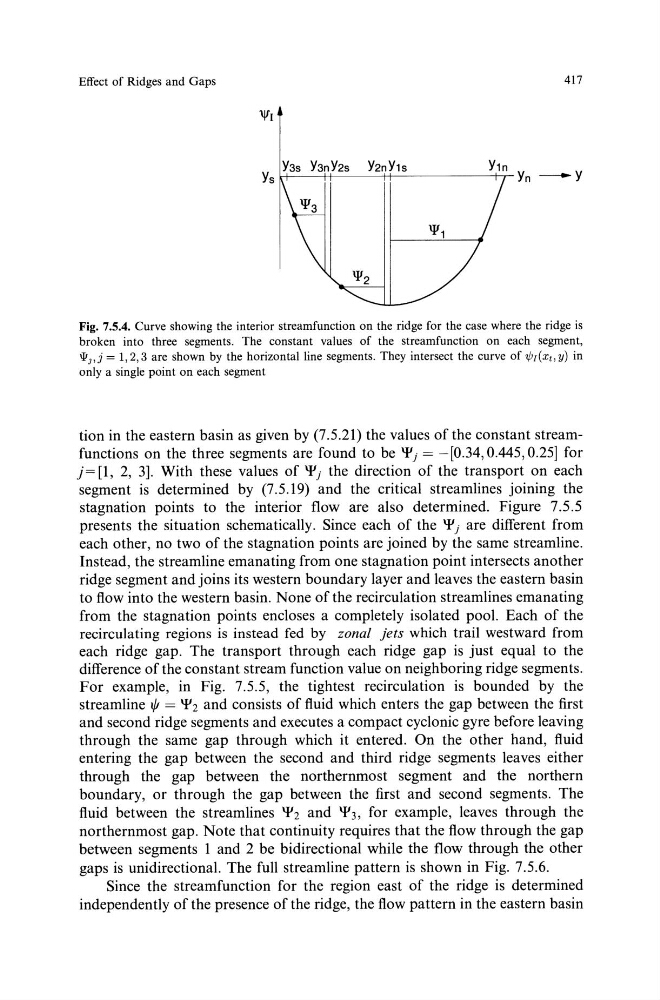
Fig. 7.5.4. Curve showing the interior streamfunction on the ridge for the case where the ridge is
broken into three segments. The constant values of the streamfunction on each segment,
iJ! 1 ,j = 1, 2,3 are shown by the horizontal line segments. They intersect the curve of '1/JI(Xt,Y) in
only a single point on each segment
tion in the eastern basin as given by (7.5.21) the values of the constant streamfunctions on the three segments are found to be 'Pi= -[0.34, 0.445, 0.25] for
j= [1, 2, 3]. With these values of 'Pi the direction of the transport on each
segment is determined by (7.5.19) and the critical streamlines joining the
stagnation points to the interior flow are also determined. Figure 7.5.5
presents the situation schematically. Since each of the 'Pi are different from
each other, no two of the stagnation points are joined by the same streamline.
Instead, the streamline emanating from one stagnation point intersects another
ridge segment and joins its western boundary layer and leaves the eastern basin
to flow into the western basin. None of the recirculation streamlines emanating
from the stagnation points encloses a completely isolated pool. Each of the
recirculating regions is instead fed by zonal jets which trail westward from
each ridge gap. The transport through each ridge gap is just equal to the
difference of the constant stream function value on neighboring ridge segments.
For example, in Fig. 7.5.5, the tightest recirculation is bounded by the
streamline If;= '1'2 and consists of fluid which enters the gap between the first
and second ridge segments and executes a compact cyclonic gyre before leaving
through the same gap through which it entered. On the other hand, fluid
entering the gap between the second and third ridge segments leaves either
through the gap between the northernmost segment and the northern
boundary, or through the gap between the first and second segments. The
fluid between the streamlines '1'2 and '1'3, for example, leaves through the
northernmost gap. Note that continuity requires that the flow through the gap
between segments 1 and 2 be bidirectional while the flow through the other
gaps is unidirectional. The full streamline pattern is shown in Fig. 7.5.6.
Since the streamfunction for the region east of the ridge is determined
independently of the presence of the ridge, the flow pattern in the eastern basin
417
'l'r
Yss YsnY2s Y2nY1s
Y1n
Ys k-t---++------tl!--------t--.- Yn -
Y
Fig. 7.5.4. Curve showing the interior streamfunction on the ridge for the case where the ridge is
broken into three segments. The constant values of the streamfunction on each segment,
iJ! 1 ,j = 1, 2,3 are shown by the horizontal line segments. They intersect the curve of '1/JI(Xt,Y) in
only a single point on each segment
tion in the eastern basin as given by (7.5.21) the values of the constant streamfunctions on the three segments are found to be 'Pi= -[0.34, 0.445, 0.25] for
j= [1, 2, 3]. With these values of 'Pi the direction of the transport on each
segment is determined by (7.5.19) and the critical streamlines joining the
stagnation points to the interior flow are also determined. Figure 7.5.5
presents the situation schematically. Since each of the 'Pi are different from
each other, no two of the stagnation points are joined by the same streamline.
Instead, the streamline emanating from one stagnation point intersects another
ridge segment and joins its western boundary layer and leaves the eastern basin
to flow into the western basin. None of the recirculation streamlines emanating
from the stagnation points encloses a completely isolated pool. Each of the
recirculating regions is instead fed by zonal jets which trail westward from
each ridge gap. The transport through each ridge gap is just equal to the
difference of the constant stream function value on neighboring ridge segments.
For example, in Fig. 7.5.5, the tightest recirculation is bounded by the
streamline If;= '1'2 and consists of fluid which enters the gap between the first
and second ridge segments and executes a compact cyclonic gyre before leaving
through the same gap through which it entered. On the other hand, fluid
entering the gap between the second and third ridge segments leaves either
through the gap between the northernmost segment and the northern
boundary, or through the gap between the first and second segments. The
fluid between the streamlines '1'2 and '1'3, for example, leaves through the
northernmost gap. Note that continuity requires that the flow through the gap
between segments 1 and 2 be bidirectional while the flow through the other
gaps is unidirectional. The full streamline pattern is shown in Fig. 7.5.6.
Since the streamfunction for the region east of the ridge is determined
independently of the presence of the ridge, the flow pattern in the eastern basin