

416
Abyssal Circulation
y
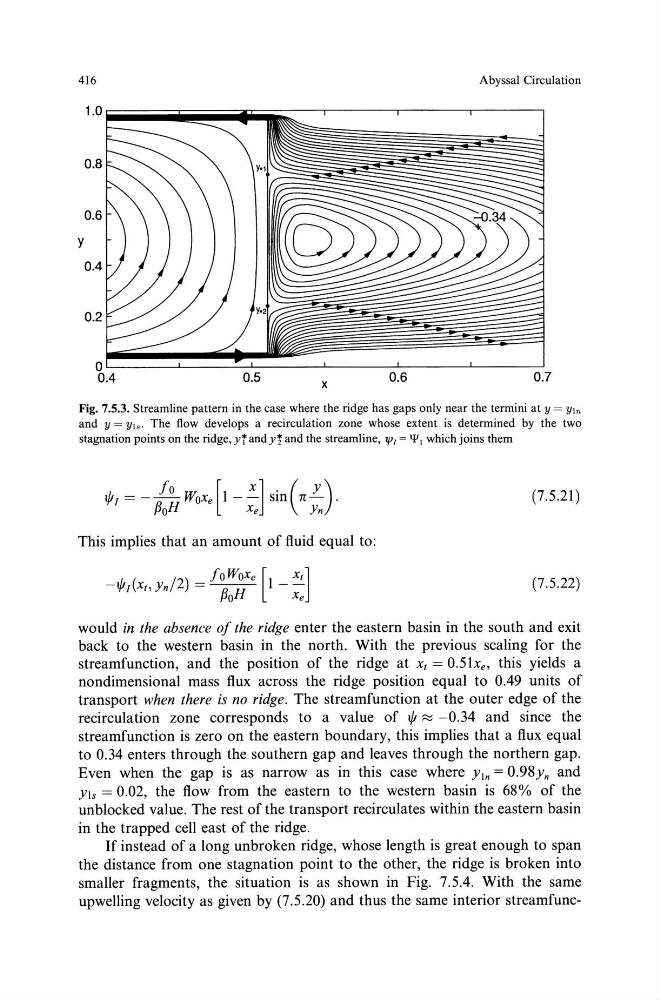
Fig. 7.5.3. Streamline pattern in the case where the ridge has gaps only near the termini at y =Yin
and y = YJ.<· The flow develops a recirculation zone whose extent is determined by the two
stagnation points on the ridge, yfandy! and the streamline, 1p1 = '1'1 which joins them
fo
[
x] . ( y)
t/1 1 = ---Woxe 1-- sm n- .
f3oH
Xe
Yn
(7.5.21)
This implies that an amount of fluid equal to:
_,1 , (
/ 2 ) _ foWoxe [ 1 _ Xr]
'I' 1 Xr, Yn
- {3 H
0
Xe
(7.5.22)
would in the absence of the ridge enter the eastern basin in the south and exit
back to the western basin in the north. With the previous scaling for the
streamfunction, and the position of the ridge at x1 = 0.5lxe, this yields a
nondimensional mass flux across the ridge position equal to 0.49 units of
transport when there is no ridge. The streamfunction at the outer edge of the
recirculation zone corresponds to a value of t/1 ~ -0.34 and since the
streamfunction is zero on the eastern boundary, this implies that a flux equal
to 0.34 enters through the southern gap and leaves through the northern gap.
Even when the gap is as narrow as in this case where y 1n = 0.98yn and
Yis = 0.02, the flow from the eastern to the western basin is 68% of the
unblocked value. The rest of the transport recirculates within the eastern basin
in the trapped cell east of the ridge.
If instead of a long unbroken ridge, whose length is great enough to span
the distance from one stagnation point to the other, the ridge is broken into
smaller fragments, the situation is as shown in Fig. 7.5.4. With the same
upwelling velocity as given by (7.5.20) and thus the same interior streamfunc-
Abyssal Circulation
y
Fig. 7.5.3. Streamline pattern in the case where the ridge has gaps only near the termini at y =Yin
and y = YJ.<· The flow develops a recirculation zone whose extent is determined by the two
stagnation points on the ridge, yfandy! and the streamline, 1p1 = '1'1 which joins them
fo
[
x] . ( y)
t/1 1 = ---Woxe 1-- sm n- .
f3oH
Xe
Yn
(7.5.21)
This implies that an amount of fluid equal to:
_,1 , (
/ 2 ) _ foWoxe [ 1 _ Xr]
'I' 1 Xr, Yn
- {3 H
0
Xe
(7.5.22)
would in the absence of the ridge enter the eastern basin in the south and exit
back to the western basin in the north. With the previous scaling for the
streamfunction, and the position of the ridge at x1 = 0.5lxe, this yields a
nondimensional mass flux across the ridge position equal to 0.49 units of
transport when there is no ridge. The streamfunction at the outer edge of the
recirculation zone corresponds to a value of t/1 ~ -0.34 and since the
streamfunction is zero on the eastern boundary, this implies that a flux equal
to 0.34 enters through the southern gap and leaves through the northern gap.
Even when the gap is as narrow as in this case where y 1n = 0.98yn and
Yis = 0.02, the flow from the eastern to the western basin is 68% of the
unblocked value. The rest of the transport recirculates within the eastern basin
in the trapped cell east of the ridge.
If instead of a long unbroken ridge, whose length is great enough to span
the distance from one stagnation point to the other, the ridge is broken into
smaller fragments, the situation is as shown in Fig. 7.5.4. With the same
upwelling velocity as given by (7.5.20) and thus the same interior streamfunc-