

Dipole Circulation Associated with Isolated Sources
407
therefore bidirectional, i.e., of a dipolar character. As shown in the figure, it is
positive in the northern subinterval where the pressure gradient is negative and
negative (westward) in the southern region where the pressure gradient is
positive. This is consistent with the closure of the meridional flow under the
source as shown in the figure.
The zonal velocity itself is determined from (7.4.1) by geostrophy and is
given by (7.3.8). Although the meridional integral of the pressure gradient is
exactly zero, the same is not true for the zonal velocity because of the factor
involving the Coriolis parameter. Thus we may write (7.3.8) in the revealing
form:
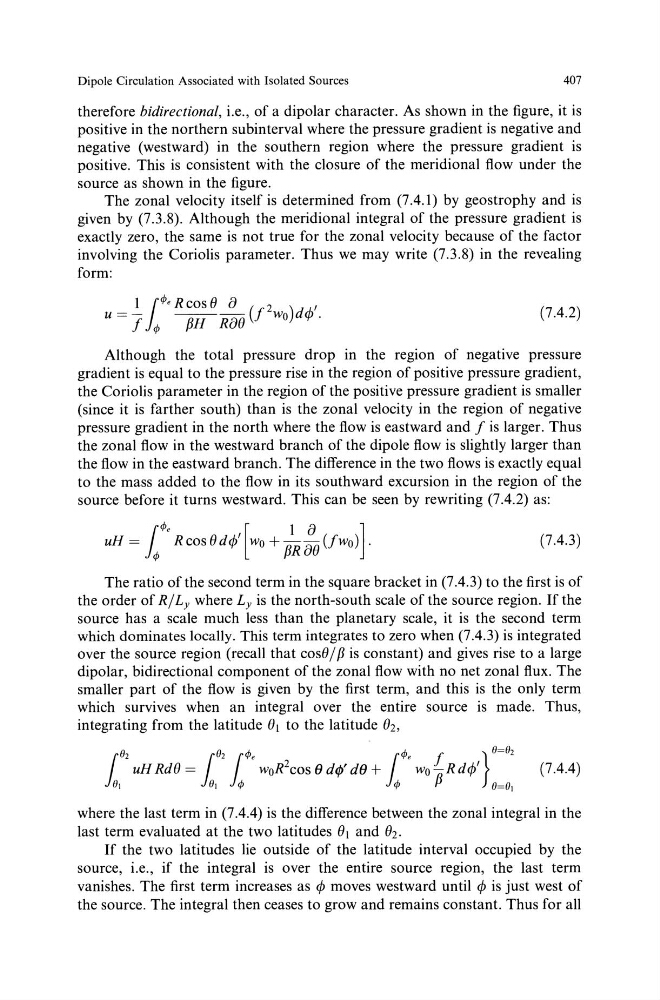
=2_1"''Rcos8 _!!_(! 2 )d¢'
u f wo
.
(7.4.2)
Although the total pressure drop in the region of negative pressure
gradient is equal to the pressure rise in the region of positive pressure gradient,
the Corio lis parameter in the region of the positive pressure gradient is smaller
(since it is farther south) than is the zonal velocity in the region of negative
pressure gradient in the north where the flow is eastward and f is larger. Thus
the zonal flow in the westward branch of the dipole flow is slightly larger than
the flow in the eastward branch. The difference in the two flows is exactly equal
to the mass added to the flow in its southward excursion in the region of the
source before it turns westward. This can be seen by rewriting (7.4.2) as:
1
1 8
]
uH = (7.4.3)
The ratio of the second term in the square bracket in (7 .4.3) to the first is of
the order of R/ Ly where Ly is the north-south scale of the source region. If the
source has a scale much less than the planetary scale, it is the second term
which dominates locally. This term integrates to zero when (7.4.3) is integrated
over the source region (recall that cos()/ fJ is constant) and gives rise to a large
dipolar, bidirectional component of the zonal flow with no net zonal flux. The
smaller part of the flow is given by the first term, and this is the only term
which survives when an integral over the entire source is made. Thus,
integrating from the latitude 81 to the latitude 82,
uH Rd() =
e woR 2 cos fJ dcp' dfJ + e Wo-Rd¢'
1
82
1
02
1
1
¢
f
}0=02
8,
8,
¢
8=8,
(7.4.4)
where the last term in (7.4.4) is the difference between the zonal integral in the
last term evaluated at the two latitudes (h and 82 .
If the two latitudes lie outside of the latitude interval occupied by the
source, i.e., if the integral is over the entire source region, the last term
vanishes. The first term increases as ¢ moves westward until ¢ is just west of
the source. The integral then ceases to grow and remains constant. Thus for all
407
therefore bidirectional, i.e., of a dipolar character. As shown in the figure, it is
positive in the northern subinterval where the pressure gradient is negative and
negative (westward) in the southern region where the pressure gradient is
positive. This is consistent with the closure of the meridional flow under the
source as shown in the figure.
The zonal velocity itself is determined from (7.4.1) by geostrophy and is
given by (7.3.8). Although the meridional integral of the pressure gradient is
exactly zero, the same is not true for the zonal velocity because of the factor
involving the Coriolis parameter. Thus we may write (7.3.8) in the revealing
form:
=2_1"''Rcos8 _!!_(! 2 )d¢'
u f wo
.
(7.4.2)
Although the total pressure drop in the region of negative pressure
gradient is equal to the pressure rise in the region of positive pressure gradient,
the Corio lis parameter in the region of the positive pressure gradient is smaller
(since it is farther south) than is the zonal velocity in the region of negative
pressure gradient in the north where the flow is eastward and f is larger. Thus
the zonal flow in the westward branch of the dipole flow is slightly larger than
the flow in the eastward branch. The difference in the two flows is exactly equal
to the mass added to the flow in its southward excursion in the region of the
source before it turns westward. This can be seen by rewriting (7.4.2) as:
1
1 8
]
uH = (7.4.3)
The ratio of the second term in the square bracket in (7 .4.3) to the first is of
the order of R/ Ly where Ly is the north-south scale of the source region. If the
source has a scale much less than the planetary scale, it is the second term
which dominates locally. This term integrates to zero when (7.4.3) is integrated
over the source region (recall that cos()/ fJ is constant) and gives rise to a large
dipolar, bidirectional component of the zonal flow with no net zonal flux. The
smaller part of the flow is given by the first term, and this is the only term
which survives when an integral over the entire source is made. Thus,
integrating from the latitude 81 to the latitude 82,
uH Rd() =
e woR 2 cos fJ dcp' dfJ + e Wo-Rd¢'
1
82
1
02
1
1
¢
f
}0=02
8,
8,
¢
8=8,
(7.4.4)
where the last term in (7.4.4) is the difference between the zonal integral in the
last term evaluated at the two latitudes (h and 82 .
If the two latitudes lie outside of the latitude interval occupied by the
source, i.e., if the integral is over the entire source region, the last term
vanishes. The first term increases as ¢ moves westward until ¢ is just west of
the source. The integral then ceases to grow and remains constant. Thus for all