

406
Abyssal Circulation
~I
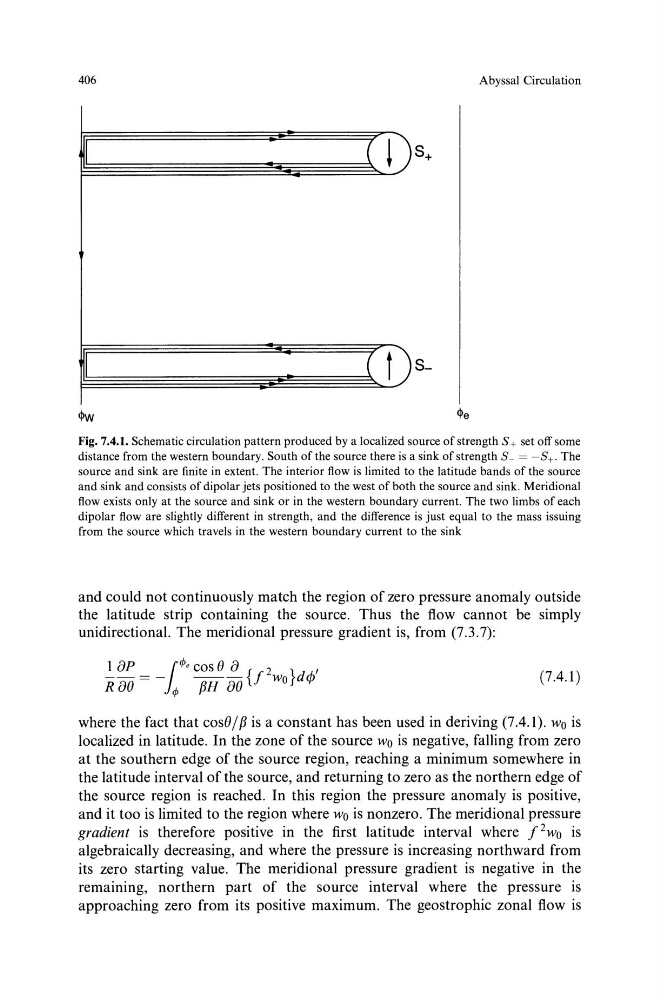
Fig. 7.4.1. Schematic circulation pattern produced by a localized source of strengthS+ set off some
distance from the western boundary. South of the source there is a sink of strengths_ = -S+. The
source and sink are finite in extent. The interior flow is limited to the latitude bands of the source
and sink and consists of dipolar jets positioned to the west of both the source and sink. Meridional
flow exists only at the source and sink or in the western boundary current. The two limbs of each
dipolar flow are slightly different in strength, and the difference is just equal to the mass issuing
from the source which travels in the western boundary current to the sink
and could not continuously match the region of zero pressure anomaly outside
the latitude strip containing the source. Thus the flow cannot be simply
unidirectional. The meridional pressure gradient is, from (7.3.7):
.!_ 8P = _ f
}
wo
(7.4.1)
where the fact that cos()jf3 is a constant has been used in deriving (7.4.1). w0 is
localized in latitude. In the zone of the source w0 is negative, falling from zero
at the southern edge of the source region, reaching a minimum somewhere in
the latitude interval of the source, and returning to zero as the northern edge of
the source region is reached. In this region the pressure anomaly is positive,
and it too is limited to the region where w0 is nonzero. The meridional pressure
gradient is therefore positive in the first latitude interval where f 2 wo is
algebraically decreasing, and where the pressure is increasing northward from
its zero starting value. The meridional pressure gradient is negative in the
remaining, northern part of the source interval where the pressure is
approaching zero from its positive maximum. The geostrophic zonal flow is
Abyssal Circulation
~I
Fig. 7.4.1. Schematic circulation pattern produced by a localized source of strengthS+ set off some
distance from the western boundary. South of the source there is a sink of strengths_ = -S+. The
source and sink are finite in extent. The interior flow is limited to the latitude bands of the source
and sink and consists of dipolar jets positioned to the west of both the source and sink. Meridional
flow exists only at the source and sink or in the western boundary current. The two limbs of each
dipolar flow are slightly different in strength, and the difference is just equal to the mass issuing
from the source which travels in the western boundary current to the sink
and could not continuously match the region of zero pressure anomaly outside
the latitude strip containing the source. Thus the flow cannot be simply
unidirectional. The meridional pressure gradient is, from (7.3.7):
.!_ 8P = _ f
}
wo
(7.4.1)
where the fact that cos()jf3 is a constant has been used in deriving (7.4.1). w0 is
localized in latitude. In the zone of the source w0 is negative, falling from zero
at the southern edge of the source region, reaching a minimum somewhere in
the latitude interval of the source, and returning to zero as the northern edge of
the source region is reached. In this region the pressure anomaly is positive,
and it too is limited to the region where w0 is nonzero. The meridional pressure
gradient is therefore positive in the first latitude interval where f 2 wo is
algebraically decreasing, and where the pressure is increasing northward from
its zero starting value. The meridional pressure gradient is negative in the
remaining, northern part of the source interval where the pressure is
approaching zero from its positive maximum. The geostrophic zonal flow is