

404
Abyssal Circulation
passes the latitude of the southern tip of the continent. The western boundary
layer transport falls from the value given by (7.3.17) to that given by (7.3.26).
Since the interior meridional transport is continuous across the latitude ()*, this
implies that the drop in transport is effected by a narrow jet, as shown in
Fig. 7.3.3, which carries the difference between the transports given by (7.3.17)
and (7.3.26), and which becomes the western boundary layer transport at the
southern tip of the continent. The eastward transport, T 1 , in the zonal jet
connecting the two western boundary currents is:
r 1 = Tw(e*) - r;(e*) = r,:(e*)
= woR 2 (4>* - cf>w)[1- 2sine*].
(7.3.27)
Note that the latitudes where the boundary layer transport vanishes are the
same in each subdomain if ()* lies south of 30°N. The presence of a barrier
splitting the basin, as would the presence of a continent such as South America,
produces a zonal jet linking the boundary currents of the two western
boundaries at the latitude where one of them terminates at the tip of the
continent.
Since the problem is linear, combinations of the examples described in this
section can be used to describe a complex picture of the total circulation of the
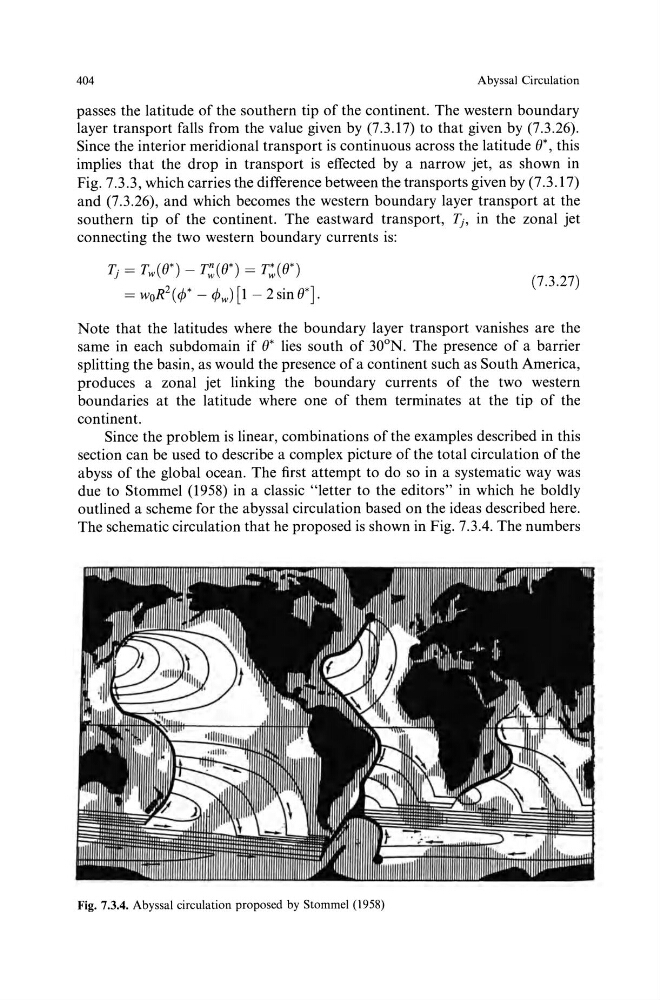
abyss of the global ocean. The first attempt to do so in a systematic way was
due to Stommel (1958) in a classic "letter to the editors" in which he boldly
outlined a scheme for the abyssal circulation based on the ideas described here.
The schematic circulation that he proposed is shown in Fig. 7.3.4. The numbers
Fig. 7.3.4. Abyssal circulation proposed by Stommel (1958)
Abyssal Circulation
passes the latitude of the southern tip of the continent. The western boundary
layer transport falls from the value given by (7.3.17) to that given by (7.3.26).
Since the interior meridional transport is continuous across the latitude ()*, this
implies that the drop in transport is effected by a narrow jet, as shown in
Fig. 7.3.3, which carries the difference between the transports given by (7.3.17)
and (7.3.26), and which becomes the western boundary layer transport at the
southern tip of the continent. The eastward transport, T 1 , in the zonal jet
connecting the two western boundary currents is:
r 1 = Tw(e*) - r;(e*) = r,:(e*)
= woR 2 (4>* - cf>w)[1- 2sine*].
(7.3.27)
Note that the latitudes where the boundary layer transport vanishes are the
same in each subdomain if ()* lies south of 30°N. The presence of a barrier
splitting the basin, as would the presence of a continent such as South America,
produces a zonal jet linking the boundary currents of the two western
boundaries at the latitude where one of them terminates at the tip of the
continent.
Since the problem is linear, combinations of the examples described in this
section can be used to describe a complex picture of the total circulation of the
abyss of the global ocean. The first attempt to do so in a systematic way was
due to Stommel (1958) in a classic "letter to the editors" in which he boldly
outlined a scheme for the abyssal circulation based on the ideas described here.
The schematic circulation that he proposed is shown in Fig. 7.3.4. The numbers
Fig. 7.3.4. Abyssal circulation proposed by Stommel (1958)