

Stommel-Arons Theory: Abyssal Flow on the Sphere
403
- - - - - - a *
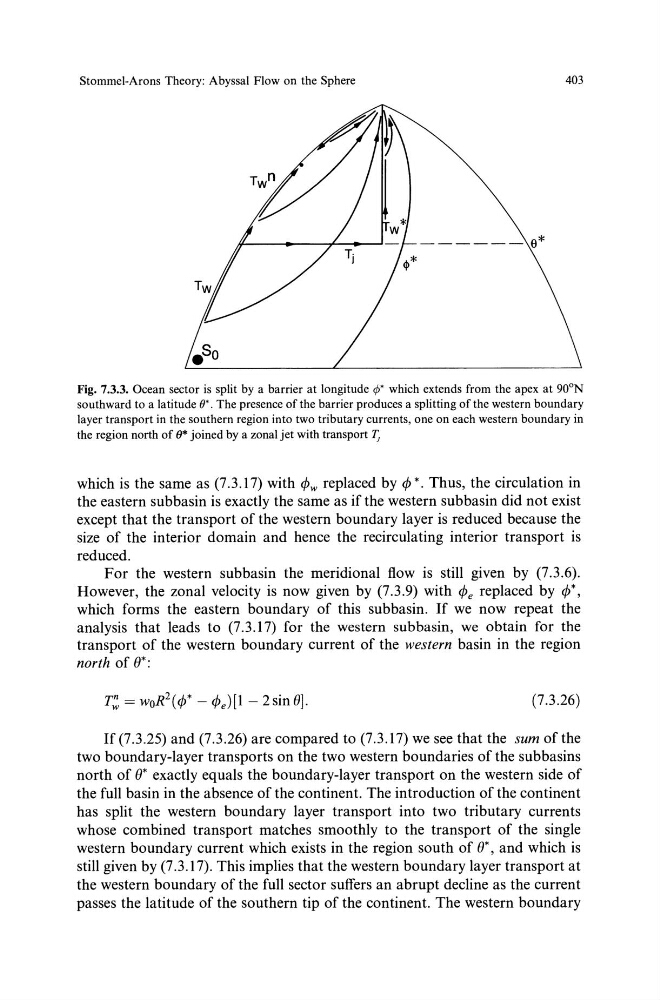
Fig. 7.3.3. Ocean sector is split by a barrier at longitude¢* which extends from the apex at 90°N
southward to a latitude 0*. The presence of the barrier produces a splitting of the western boundary
layer transport in the southern region into two tributary currents, one on each western boundary in
the region north of 0* joined by a zonal jet with transport T;
which is the same as (7.3.17) with 4>w replaced by 4> *. Thus, the circulation in
the eastern subbasin is exactly the same as if the western subbasin did not exist
except that the transport of the western boundary layer is reduced because the
size of the interior domain and hence the recirculating interior transport is
reduced.
For the western subbasin the meridional flow is still given by (7.3.6).
However, the zonal velocity is now given by (7.3.9) with 4>e replaced by cp*,
which forms the eastern boundary of this subbasin. If we now repeat the
analysis that leads to (7.3.17) for the western subbasin, we obtain for the
transport of the western boundary current of the western basin in the region
north of 8*:
(7.3.26)
If (7.3.25) and (7.3.26) are compared to (7.3.17) we see that the sum of the
two boundary-layer transports on the two western boundaries of the subbasins
north of 8* exactly equals the boundary-layer transport on the western side of
the full basin in the absence of the continent. The introduction of the continent
has split the western boundary layer transport into two tributary currents
whose combined transport matches smoothly to the transport of the single
western boundary current which exists in the region south of 8*, and which is
still given by (7.3.17). This implies that the western boundary layer transport at
the western boundary of the full sector suffers an abrupt decline as the current
passes the latitude of the southern tip of the continent. The western boundary
403
- - - - - - a *
Fig. 7.3.3. Ocean sector is split by a barrier at longitude¢* which extends from the apex at 90°N
southward to a latitude 0*. The presence of the barrier produces a splitting of the western boundary
layer transport in the southern region into two tributary currents, one on each western boundary in
the region north of 0* joined by a zonal jet with transport T;
which is the same as (7.3.17) with 4>w replaced by 4> *. Thus, the circulation in
the eastern subbasin is exactly the same as if the western subbasin did not exist
except that the transport of the western boundary layer is reduced because the
size of the interior domain and hence the recirculating interior transport is
reduced.
For the western subbasin the meridional flow is still given by (7.3.6).
However, the zonal velocity is now given by (7.3.9) with 4>e replaced by cp*,
which forms the eastern boundary of this subbasin. If we now repeat the
analysis that leads to (7.3.17) for the western subbasin, we obtain for the
transport of the western boundary current of the western basin in the region
north of 8*:
(7.3.26)
If (7.3.25) and (7.3.26) are compared to (7.3.17) we see that the sum of the
two boundary-layer transports on the two western boundaries of the subbasins
north of 8* exactly equals the boundary-layer transport on the western side of
the full basin in the absence of the continent. The introduction of the continent
has split the western boundary layer transport into two tributary currents
whose combined transport matches smoothly to the transport of the single
western boundary current which exists in the region south of 8*, and which is
still given by (7.3.17). This implies that the western boundary layer transport at
the western boundary of the full sector suffers an abrupt decline as the current
passes the latitude of the southern tip of the continent. The western boundary