

Physics of the EUC: Preliminaries
331
pressure in the west. That is, it produces a pressure force to the east. Where the
Coriolis acceleration is dominant, the response to the pressure gradient is a
geostrophically balanced equatorward velocity. On the equator itself, where f
vanishes, there can be no such geostrophic balance, and the pressure gradient
accelerates fluid down the gradient, producing a strong eastward current along
the equator.
This conventional verbal explanation for the EUC is fundamentally incomplete, as the following counterexample demonstrates. Consider a model for
the undercurrent which satisfies the content of the verbal argument just set
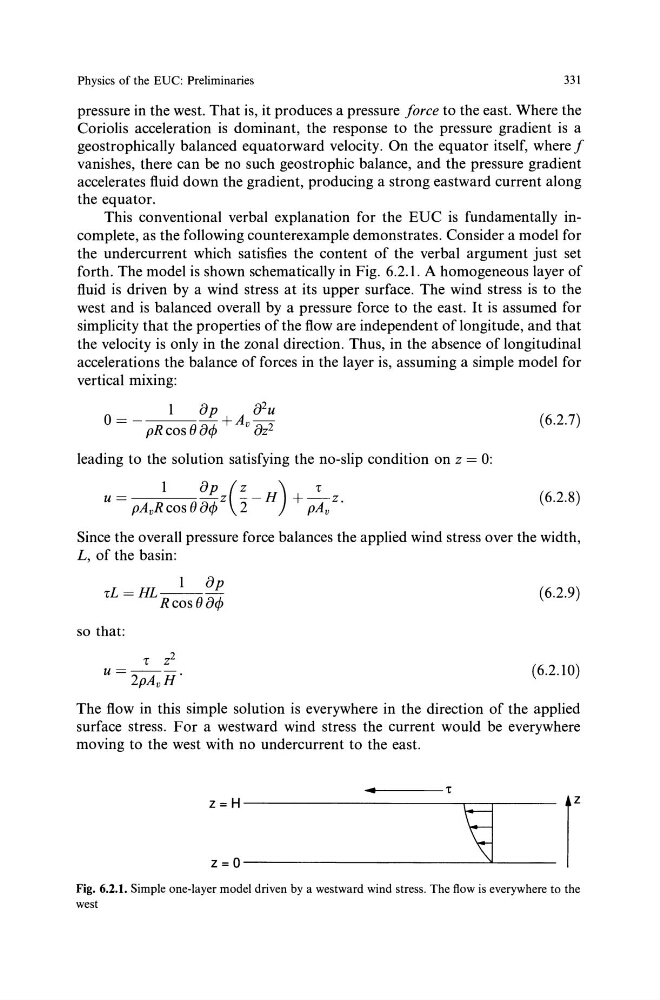
forth. The model is shown schematically in Fig. 6.2.1. A homogeneous layer of
fluid is driven by a wind stress at its upper surface. The wind stress is to the
west and is balanced overall by a pressure force to the east. It is assumed for
simplicity that the properties of the flow are independent of longitude, and that
the velocity is only in the zonal direction. Thus, in the absence of longitudinal
accelerations the balance of forces in the layer is, assuming a simple model for
vertical mixing:
0 = -
1
{) P + Av f)2u
pR cos (} {)cjJ
{)z2
(6.2.7)
leading to the solution satisfying the no-slip condition on z = 0:
1
8p (z ) -r
u = pAvR cos (} 8cjJ z 2 - H + pAv z.
(6.2.8)
Since the overall pressure force balances the applied wind stress over the width,
L, of the basin:
1 op
-rL = HL--(} !'l,J,.
Rcos v'V
so that:
't" z2
U = - - - .
2pAvH
(6.2.9)
( 6.2.10)
The flow in this simple solution is everywhere in the direction of the applied
surface stress. For a westward wind stress the current would be everywhere
moving to the west with no undercurrent to the east.
..-----1"
r
Fig. 6.2.1. Simple one-layer model driven by a westward wind stress. The flow is everywhere to the
west
331
pressure in the west. That is, it produces a pressure force to the east. Where the
Coriolis acceleration is dominant, the response to the pressure gradient is a
geostrophically balanced equatorward velocity. On the equator itself, where f
vanishes, there can be no such geostrophic balance, and the pressure gradient
accelerates fluid down the gradient, producing a strong eastward current along
the equator.
This conventional verbal explanation for the EUC is fundamentally incomplete, as the following counterexample demonstrates. Consider a model for
the undercurrent which satisfies the content of the verbal argument just set
forth. The model is shown schematically in Fig. 6.2.1. A homogeneous layer of
fluid is driven by a wind stress at its upper surface. The wind stress is to the
west and is balanced overall by a pressure force to the east. It is assumed for
simplicity that the properties of the flow are independent of longitude, and that
the velocity is only in the zonal direction. Thus, in the absence of longitudinal
accelerations the balance of forces in the layer is, assuming a simple model for
vertical mixing:
0 = -
1
{) P + Av f)2u
pR cos (} {)cjJ
{)z2
(6.2.7)
leading to the solution satisfying the no-slip condition on z = 0:
1
8p (z ) -r
u = pAvR cos (} 8cjJ z 2 - H + pAv z.
(6.2.8)
Since the overall pressure force balances the applied wind stress over the width,
L, of the basin:
1 op
-rL = HL--(} !'l,J,.
Rcos v'V
so that:
't" z2
U = - - - .
2pAvH
(6.2.9)
( 6.2.10)
The flow in this simple solution is everywhere in the direction of the applied
surface stress. For a westward wind stress the current would be everywhere
moving to the west with no undercurrent to the east.
..-----1"
r
Fig. 6.2.1. Simple one-layer model driven by a westward wind stress. The flow is everywhere to the
west