

330
Equatorial Dynamics of the Thermocline: The Equatorial Undercurrent
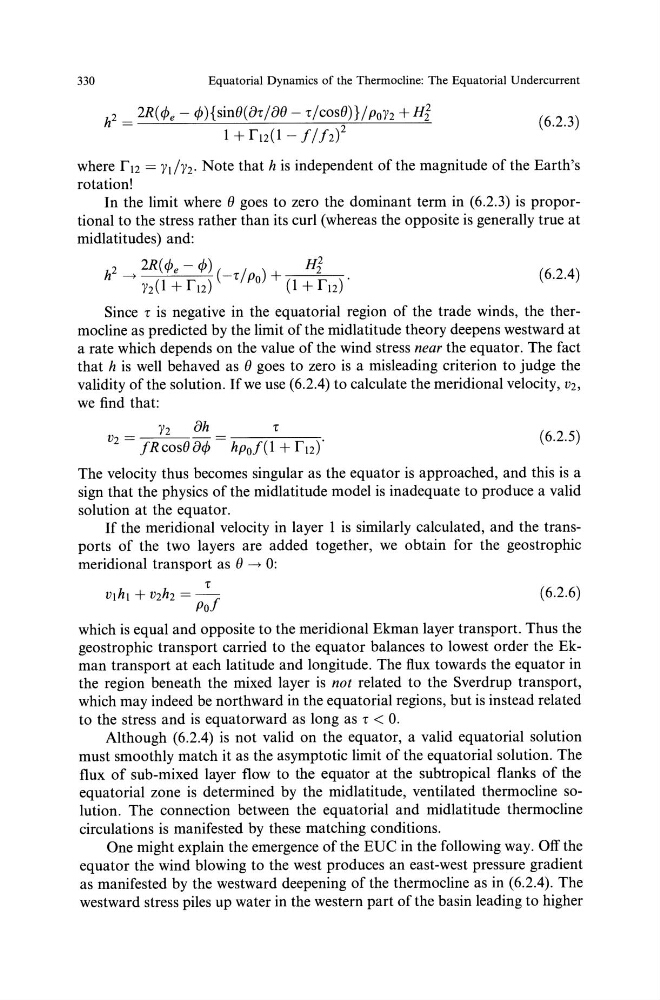
h2 = 2R(
(6.2.3)
where r12 = y 1 jy 2 • Note that his independent of the magnitude of the Earth's
rotation!
In the limit where e goes to zero the dominant term in (6.2.3) is proportional to the stress rather than its curl (whereas the opposite is generally true at
midlatitudes) and:
2
2R( H'f
h ___, Y2(1 + rl2) ( -T/ Po)+ (1 + rl2)"
(6.2.4)
Since 1: is negative in the equatorial region of the trade winds, the thermocline as predicted by the limit of the midlatitude theory deepens westward at
a rate which depends on the value of the wind stress near the equator. The fact
that h is well behaved as e goes to zero is a misleading criterion to judge the
validity of the solution. If we use (6.2.4) to calculate the meridional velocity, v2,
we find that:
Y2
8h
1:
V2 =
= ---,-----,jR case 8¢ hpof(l + r12f
(6.2.5)
The velocity thus becomes singular as the equator is approached, and this is a
sign that the physics of the midlatitude model is inadequate to produce a valid
solution at the equator.
If the meridional velocity in layer 1 is similarly calculated, and the transports of the two layers are added together, we obtain for the geostrophic
meridional transport as e ----t 0:
1:
Vthl + V2h2 = - 1
Po
(6.2.6)
which is equal and opposite to the meridional Ekman layer transport. Thus the
geostrophic transport carried to the equator balances to lowest order the Ekman transport at each latitude and longitude. The flux towards the equator in
the region beneath the mixed layer is not related to the Sverdrup transport,
which may indeed be northward in the equatorial regions, but is instead related
to the stress and is equatorward as long as 1: < 0.
Although (6.2.4) is not valid on the equator, a valid equatorial solution
must smoothly match it as the asymptotic limit of the equatorial solution. The
flux of sub-mixed layer flow to the equator at the subtropical flanks of the
equatorial zone is determined by the midlatitude, ventilated thermocline solution. The connection between the equatorial and midlatitude thermocline
circulations is manifested by these matching conditions.
One might explain the emergence of the EUC in the following way. Off the
equator the wind blowing to the west produces an east-west pressure gradient
as manifested by the westward deepening of the thermocline as in (6.2.4). The
westward stress piles up water in the western part of the basin leading to higher
Equatorial Dynamics of the Thermocline: The Equatorial Undercurrent
h2 = 2R(
(6.2.3)
where r12 = y 1 jy 2 • Note that his independent of the magnitude of the Earth's
rotation!
In the limit where e goes to zero the dominant term in (6.2.3) is proportional to the stress rather than its curl (whereas the opposite is generally true at
midlatitudes) and:
2
2R( H'f
h ___, Y2(1 + rl2) ( -T/ Po)+ (1 + rl2)"
(6.2.4)
Since 1: is negative in the equatorial region of the trade winds, the thermocline as predicted by the limit of the midlatitude theory deepens westward at
a rate which depends on the value of the wind stress near the equator. The fact
that h is well behaved as e goes to zero is a misleading criterion to judge the
validity of the solution. If we use (6.2.4) to calculate the meridional velocity, v2,
we find that:
Y2
8h
1:
V2 =
= ---,-----,jR case 8¢ hpof(l + r12f
(6.2.5)
The velocity thus becomes singular as the equator is approached, and this is a
sign that the physics of the midlatitude model is inadequate to produce a valid
solution at the equator.
If the meridional velocity in layer 1 is similarly calculated, and the transports of the two layers are added together, we obtain for the geostrophic
meridional transport as e ----t 0:
1:
Vthl + V2h2 = - 1
Po
(6.2.6)
which is equal and opposite to the meridional Ekman layer transport. Thus the
geostrophic transport carried to the equator balances to lowest order the Ekman transport at each latitude and longitude. The flux towards the equator in
the region beneath the mixed layer is not related to the Sverdrup transport,
which may indeed be northward in the equatorial regions, but is instead related
to the stress and is equatorward as long as 1: < 0.
Although (6.2.4) is not valid on the equator, a valid equatorial solution
must smoothly match it as the asymptotic limit of the equatorial solution. The
flux of sub-mixed layer flow to the equator at the subtropical flanks of the
equatorial zone is determined by the midlatitude, ventilated thermocline solution. The connection between the equatorial and midlatitude thermocline
circulations is manifested by these matching conditions.
One might explain the emergence of the EUC in the following way. Off the
equator the wind blowing to the west produces an east-west pressure gradient
as manifested by the westward deepening of the thermocline as in (6.2.4). The
westward stress piles up water in the western part of the basin leading to higher