

22
Sverdrup Theory
QOUL~--------L-~~~L-~---------L------~
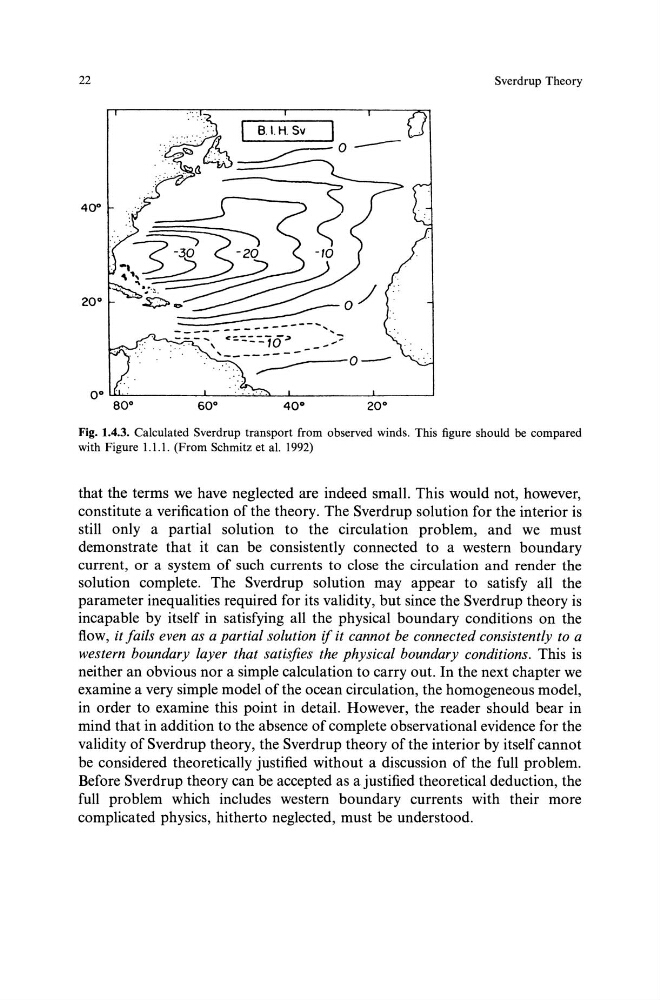
Fig. 1.4.3. Calculated Sverdrup transport from observed winds. This figure should be compared
with Figure 1.1.1. (From Schmitz et a!. 1992)
that the terms we have neglected are indeed small. This would not, however,
constitute a verification of the theory. The Sverdrup solution for the interior is
still only a partial solution to the circulation problem, and we must
demonstrate that it can be consistently connected to a western boundary
current, or a system of such currents to close the circulation and render the
solution complete. The Sverdrup solution may appear to satisfy all the
parameter inequalities required for its validity, but since the Sverdrup theory is
incapable by itself in satisfying all the physical boundary conditions on the
flow, it fails even as a partial solution if it cannot be connected consistently to a
western boundary layer that satisfies the physical boundary conditions. This is
neither an obvious nor a simple calculation to carry out. In the next chapter we
examine a very simple model of the ocean circulation, the homogeneous model,
in order to examine this point in detail. However, the reader should bear in
mind that in addition to the absence of complete observational evidence for the
validity of Sverdrup theory, the Sverdrup theory of the interior by itself cannot
be considered theoretically justified without a discussion of the full problem.
Before Sverdrup theory can be accepted as a justified theoretical deduction, the
full problem which includes western boundary currents with their more
complicated physics, hitherto neglected, must be understood.
Sverdrup Theory
QOUL~--------L-~~~L-~---------L------~
Fig. 1.4.3. Calculated Sverdrup transport from observed winds. This figure should be compared
with Figure 1.1.1. (From Schmitz et a!. 1992)
that the terms we have neglected are indeed small. This would not, however,
constitute a verification of the theory. The Sverdrup solution for the interior is
still only a partial solution to the circulation problem, and we must
demonstrate that it can be consistently connected to a western boundary
current, or a system of such currents to close the circulation and render the
solution complete. The Sverdrup solution may appear to satisfy all the
parameter inequalities required for its validity, but since the Sverdrup theory is
incapable by itself in satisfying all the physical boundary conditions on the
flow, it fails even as a partial solution if it cannot be connected consistently to a
western boundary layer that satisfies the physical boundary conditions. This is
neither an obvious nor a simple calculation to carry out. In the next chapter we
examine a very simple model of the ocean circulation, the homogeneous model,
in order to examine this point in detail. However, the reader should bear in
mind that in addition to the absence of complete observational evidence for the
validity of Sverdrup theory, the Sverdrup theory of the interior by itself cannot
be considered theoretically justified without a discussion of the full problem.
Before Sverdrup theory can be accepted as a justified theoretical deduction, the
full problem which includes western boundary currents with their more
complicated physics, hitherto neglected, must be understood.