

The Buoyancy- and Wind-Driven Subtropical Gyre: Analytical Solutions
319
of the northward flow. The important qualitative feature of the solution is the
fact that h(I) is a function only off/f.. That is, from (5.4.27), h(I} is a function
only of h~o). This means that to order b, h2 is a function only of h. Thus, the
isolines of h and h2 coincide, and, as we have noted above, this is the signature
of a region in which the circulation is thermodynamically direct, and in which
the horizontal nonlinear advection of density is negligible. The vertical velocity
and the cross-isopycnal velocity are in the same direction. This also implies that
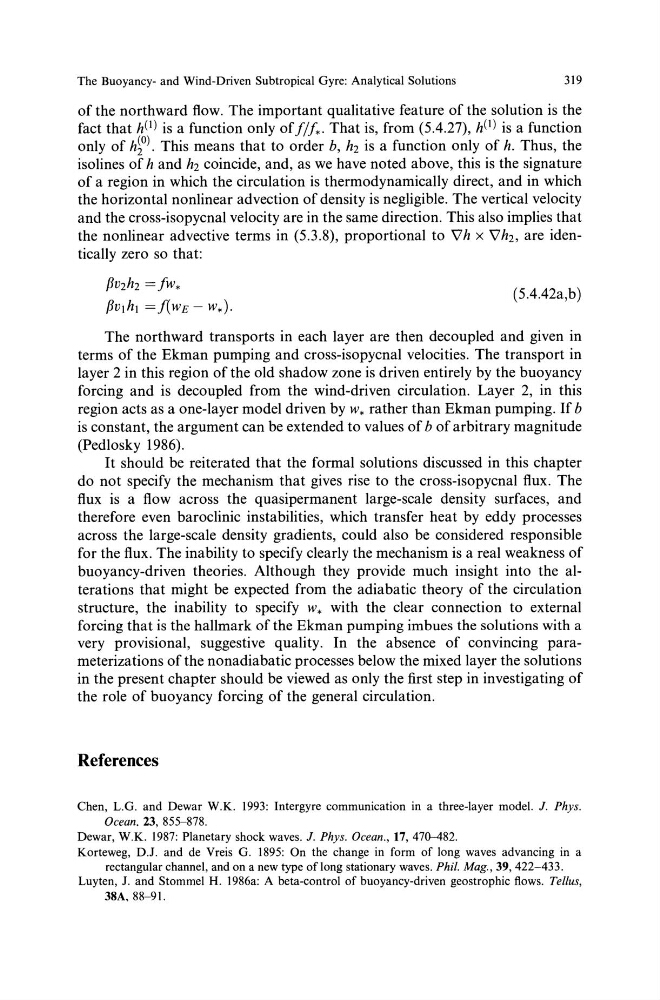
the nonlinear advective terms in (5.3.8), proportional to "\lh x "\lh2, are identically zero so that:
f3v2h2 =fw.
f3v1h1 =flwE- w.).
(5.4.42a,b)
The northward transports in each layer are then decoupled and given in
terms of the Ekman pumping and cross-isopycnal velocities. The transport in
layer 2 in this region of the old shadow zone is driven entirely by the buoyancy
forcing and is decoupled from the wind-driven circulation. Layer 2, in this
region acts as a one-layer model driven by w. rather than Ekman pumping. If b
is constant, the argument can be extended to values of b of arbitrary magnitude
(Pedlosky 1986).
It should be reiterated that the formal solutions discussed in this chapter
do not specify the mechanism that gives rise to the cross-isopycnal flux. The
flux is a flow across the quasipermanent large-scale density surfaces, and
therefore even baroclinic instabilities, which transfer heat by eddy processes
across the large-scale density gradients, could also be considered responsible
for the flux. The inability to specify clearly the mechanism is a real weakness of
buoyancy-driven theories. Although they provide much insight into the alterations that might be expected from the adiabatic theory of the circulation
structure, the inability to specify w. with the clear connection to external
forcing that is the hallmark of the Ekman pumping imbues the solutions with a
very provisional, suggestive quality. In the absence of convincing parameterizations of the nonadiabatic processes below the mixed layer the solutions
in the present chapter should be viewed as only the first step in investigating of
the role of buoyancy forcing of the general circulation.
References
Chen, L.G. and Dewar W.K. 1993: Intergyre communication in a three-layer model. J. Phys.
Ocean. 23, 855-878.
Dewar, W.K. 1987: Planetary shock waves. J. Phys. Ocean., 17, 470-482.
Korteweg, D.J. and de Vreis G. 1895: On the change in form of long waves advancing in a
rectangular channel, and on a new type oflong stationary waves. Phil. Mag., 39,422-433.
Luyten, J. and Stommel H. 1986a: A beta-control of buoyancy-driven geostrophic flows. Tel/us,
38A, 88-91.
319
of the northward flow. The important qualitative feature of the solution is the
fact that h(I) is a function only off/f.. That is, from (5.4.27), h(I} is a function
only of h~o). This means that to order b, h2 is a function only of h. Thus, the
isolines of h and h2 coincide, and, as we have noted above, this is the signature
of a region in which the circulation is thermodynamically direct, and in which
the horizontal nonlinear advection of density is negligible. The vertical velocity
and the cross-isopycnal velocity are in the same direction. This also implies that
the nonlinear advective terms in (5.3.8), proportional to "\lh x "\lh2, are identically zero so that:
f3v2h2 =fw.
f3v1h1 =flwE- w.).
(5.4.42a,b)
The northward transports in each layer are then decoupled and given in
terms of the Ekman pumping and cross-isopycnal velocities. The transport in
layer 2 in this region of the old shadow zone is driven entirely by the buoyancy
forcing and is decoupled from the wind-driven circulation. Layer 2, in this
region acts as a one-layer model driven by w. rather than Ekman pumping. If b
is constant, the argument can be extended to values of b of arbitrary magnitude
(Pedlosky 1986).
It should be reiterated that the formal solutions discussed in this chapter
do not specify the mechanism that gives rise to the cross-isopycnal flux. The
flux is a flow across the quasipermanent large-scale density surfaces, and
therefore even baroclinic instabilities, which transfer heat by eddy processes
across the large-scale density gradients, could also be considered responsible
for the flux. The inability to specify clearly the mechanism is a real weakness of
buoyancy-driven theories. Although they provide much insight into the alterations that might be expected from the adiabatic theory of the circulation
structure, the inability to specify w. with the clear connection to external
forcing that is the hallmark of the Ekman pumping imbues the solutions with a
very provisional, suggestive quality. In the absence of convincing parameterizations of the nonadiabatic processes below the mixed layer the solutions
in the present chapter should be viewed as only the first step in investigating of
the role of buoyancy forcing of the general circulation.
References
Chen, L.G. and Dewar W.K. 1993: Intergyre communication in a three-layer model. J. Phys.
Ocean. 23, 855-878.
Dewar, W.K. 1987: Planetary shock waves. J. Phys. Ocean., 17, 470-482.
Korteweg, D.J. and de Vreis G. 1895: On the change in form of long waves advancing in a
rectangular channel, and on a new type oflong stationary waves. Phil. Mag., 39,422-433.
Luyten, J. and Stommel H. 1986a: A beta-control of buoyancy-driven geostrophic flows. Tel/us,
38A, 88-91.