

318
O(b)
A p
f{.
_J o(b> L L
I :::I 011>
Buoyancy Forced Circulation and Cross-Gyre Flow
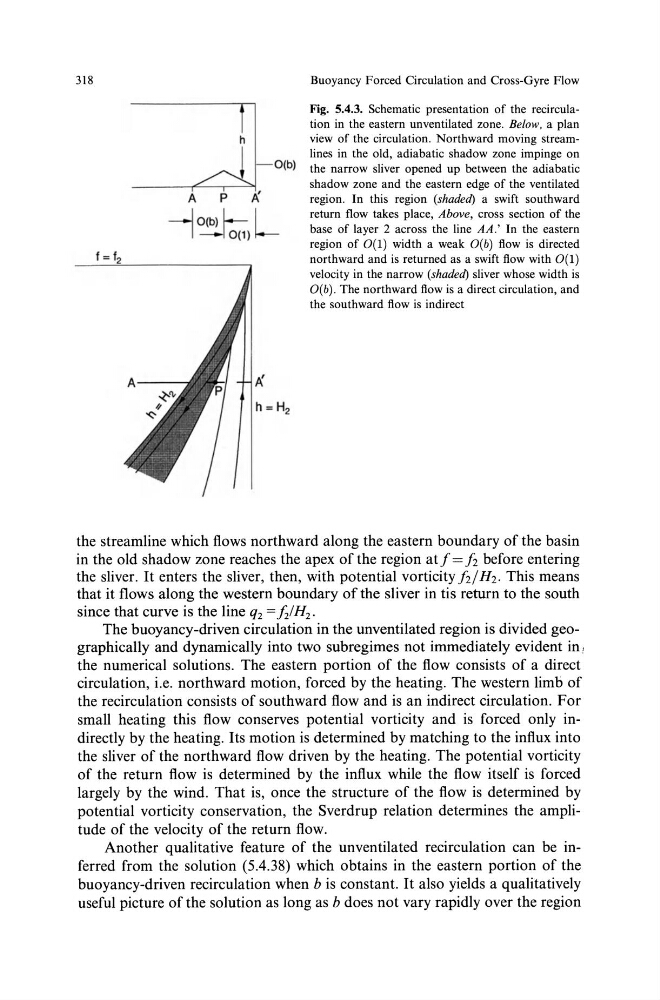
Fig. 5.4.3. Schematic presentation of the recirculation in the eastern unventilated zone. Below, a plan
view of the circulation. Northward moving streamlines in the old, adiabatic shadow zone impinge on
the narrow sliver opened up between the adiabatic
shadow zone and the eastern edge of the ventilated
region. In this region (shaded) a swift southward
return flow takes place, Above, cross section of the
base of layer 2 across the line AA.' In the eastern
region of 0(1) width a weak O(b) flow is directed
northward and is returned as a swift flow with 0(1)
velocity in the narrow (shaded) sliver whose width is
O(b). The northward flow is a direct circulation, and
the southward flow is indirect
the streamline which flows northward along the eastern boundary of the basin
in the old shadow zone reaches the apex of the region atf = !2 before entering
the sliver. It enters the sliver, then, with potential vorticity !2/ H2. This means
that it flows along the western boundary of the sliver in tis return to the south
since that curve is the line q2 = fz!H 2 •
The buoyancy-driven circulation in the unventilated region is divided geographically and dynamically into two subregimes not immediately evident in!
the numerical solutions. The eastern portion of the flow consists of a direct
circulation, i.e. northward motion, forced by the heating. The western limb of
the recirculation consists of southward flow and is an indirect circulation. For
small heating this flow conserves potential vorticity and is forced only indirectly by the heating. Its motion is determined by matching to the influx into
the sliver of the northward flow driven by the heating. The potential vorticity
of the return flow is determined by the influx while the flow itself is forced
largely by the wind. That is, once the structure of the flow is determined by
potential vorticity conservation, the Sverdrup relation determines the amplitude of the velocity of the return flow.
Another qualitative feature of the unventilated recirculation can be inferred from the solution (5.4.38) which obtains in the eastern portion of the
buoyancy-driven recirculation when b is constant. It also yields a qualitatively
useful picture of the solution as long as b does not vary rapidly over the region
O(b)
A p
f{.
_J o(b> L L
I :::I 011>
Buoyancy Forced Circulation and Cross-Gyre Flow
Fig. 5.4.3. Schematic presentation of the recirculation in the eastern unventilated zone. Below, a plan
view of the circulation. Northward moving streamlines in the old, adiabatic shadow zone impinge on
the narrow sliver opened up between the adiabatic
shadow zone and the eastern edge of the ventilated
region. In this region (shaded) a swift southward
return flow takes place, Above, cross section of the
base of layer 2 across the line AA.' In the eastern
region of 0(1) width a weak O(b) flow is directed
northward and is returned as a swift flow with 0(1)
velocity in the narrow (shaded) sliver whose width is
O(b). The northward flow is a direct circulation, and
the southward flow is indirect
the streamline which flows northward along the eastern boundary of the basin
in the old shadow zone reaches the apex of the region atf = !2 before entering
the sliver. It enters the sliver, then, with potential vorticity !2/ H2. This means
that it flows along the western boundary of the sliver in tis return to the south
since that curve is the line q2 = fz!H 2 •
The buoyancy-driven circulation in the unventilated region is divided geographically and dynamically into two subregimes not immediately evident in!
the numerical solutions. The eastern portion of the flow consists of a direct
circulation, i.e. northward motion, forced by the heating. The western limb of
the recirculation consists of southward flow and is an indirect circulation. For
small heating this flow conserves potential vorticity and is forced only indirectly by the heating. Its motion is determined by matching to the influx into
the sliver of the northward flow driven by the heating. The potential vorticity
of the return flow is determined by the influx while the flow itself is forced
largely by the wind. That is, once the structure of the flow is determined by
potential vorticity conservation, the Sverdrup relation determines the amplitude of the velocity of the return flow.
Another qualitative feature of the unventilated recirculation can be inferred from the solution (5.4.38) which obtains in the eastern portion of the
buoyancy-driven recirculation when b is constant. It also yields a qualitatively
useful picture of the solution as long as b does not vary rapidly over the region