

Nonadiabatic Equations in Characteristic Form
293
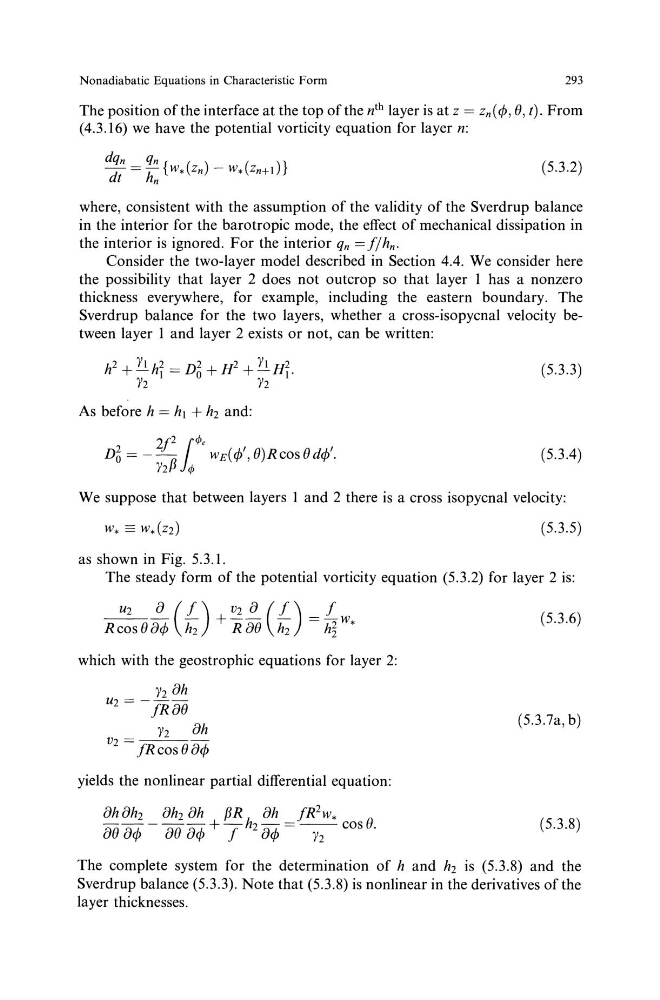
The position of the interface at the top of the nth layer is at z = zn( c/J, (}, t). From
(4.3.16) we have the potential vorticity equation for layer n:
ddtn = h: {w*(zn)- w*(zn+i)}
(5.3.2)
where, consistent with the assumption of the validity of the Sverdrup balance
in the interior for the barotropic mode, the effect of mechanical dissipation in
the interior is ignored. For the interior qn = f/hn.
Consider the two-layer model described in Section 4.4. We consider here
the possibility that layer 2 does not outcrop so that layer 1 has a nonzero
thickness everywhere, for example, including the eastern boundary. The
Sverdrup balance for the two layers, whether a cross-isopycnal velocity between layer 1 and layer 2 exists or not, can be written:
h2 + y, hf = D~ +H2 +l'lHf,
Y2
Y2
( 5.3.3)
As before h = h1 + h2 and:
2j21e
D~ = - - 13
wE(c/J',e)Rcos{}dc/J'.
Y2 <1>
( 5.3.4)
We suppose that between layers 1 and 2 there is a cross isopycnal velocity:
(5.3.5)
as shown in Fig. 5.3.1.
The steady form of the potential vorticity equation (5.3.2) for layer 2 is:
U2
0 ( f )
V2 {) ( f )
f
Rcos {}{)c/J h2 + R f)(} h 2 = h~ w*
which with the geostrophic equations for layer 2:
Y2 8h
u 2 = -JRae
Y2 8h
V2 = _:..=..____
fRcos {}{)c/J
yields the nonlinear partial differential equation:
(5.3.6)
(5.3.7a, b)
(5.3.8)
The complete system for the determination of h and h2 is (5.3.8) and the
Sverdrup balance (5.3.3). Note that (5.3.8) is nonlinear in the derivatives of the
layer thicknesses.
293
The position of the interface at the top of the nth layer is at z = zn( c/J, (}, t). From
(4.3.16) we have the potential vorticity equation for layer n:
ddtn = h: {w*(zn)- w*(zn+i)}
(5.3.2)
where, consistent with the assumption of the validity of the Sverdrup balance
in the interior for the barotropic mode, the effect of mechanical dissipation in
the interior is ignored. For the interior qn = f/hn.
Consider the two-layer model described in Section 4.4. We consider here
the possibility that layer 2 does not outcrop so that layer 1 has a nonzero
thickness everywhere, for example, including the eastern boundary. The
Sverdrup balance for the two layers, whether a cross-isopycnal velocity between layer 1 and layer 2 exists or not, can be written:
h2 + y, hf = D~ +H2 +l'lHf,
Y2
Y2
( 5.3.3)
As before h = h1 + h2 and:
2j21e
D~ = - - 13
wE(c/J',e)Rcos{}dc/J'.
Y2 <1>
( 5.3.4)
We suppose that between layers 1 and 2 there is a cross isopycnal velocity:
(5.3.5)
as shown in Fig. 5.3.1.
The steady form of the potential vorticity equation (5.3.2) for layer 2 is:
U2
0 ( f )
V2 {) ( f )
f
Rcos {}{)c/J h2 + R f)(} h 2 = h~ w*
which with the geostrophic equations for layer 2:
Y2 8h
u 2 = -JRae
Y2 8h
V2 = _:..=..____
fRcos {}{)c/J
yields the nonlinear partial differential equation:
(5.3.6)
(5.3.7a, b)
(5.3.8)
The complete system for the determination of h and h2 is (5.3.8) and the
Sverdrup balance (5.3.3). Note that (5.3.8) is nonlinear in the derivatives of the
layer thicknesses.