

292
Buoyancy Forced Circulation and Cross-Gyre Flow
pagate westward. After about 8 years the interface is well on its way, as seen in
panel c, to a solution in which the interface is flat, with no cross-gyre flow,
except in the region where the steady window is expected. The final steady
solution (panel d), shows the interface whose slope in the window exactly
matches the slope anticipated by the steady theory. The implication then is that
nonadiabatic dynamics on the gyre boundary, represented here by specified
alterations in the stratification, determines the degree to which the two gyres
can communicate.
5.3 Nonadiabatic Equations in Characteristic Form
Formulation
The presence of cross-isopycnal fluxes of fluid represents the nonadiabatic
processes in the body of the fluid which, among other things, destroy the
conservative property of the potential vorticity. We have relied heavily on
conservation of potential vorticity to deal with the nonlinear dynamics of the
wind driven circulation. Therefore the presence of cross-isopycnal motion, as
well as yielding an additional mechanism for motion, removes an important
and useful constraint on the motion. This section describes a two-layer model
including cross-isopycnal velocity following a formulation by Luyten and
Stommel (1986a,b). The formulation is analogous to the transformation used
by Rhines and Young (1982) for quasi-geostrophic motion and described in
Section 3.5. In the quasi-geostrophic limit the transfomation yields a linear
differential equation (3.5.12) for the baroclinic field once the barotropic circulation is determined independently from the Sverdrup relation. In the present
case, as we see below, a similar approach in the dynamics on the planetary
scale, where the layer thicknesses can vary by the order of 1, leads to a quasilinear differential equation which is a great simplification for analysis.
In the work described below the cross-isopycnal velocity, w., is specified as
a function of geographical location. This is clearly an inadequate representation of the physics since the cross-isopycnal velocity is certainly a result of
turbulent processes that depend on the state of the ocean's local stratification
and velocity. However, there is as yet no truly convincing parameterization of
deep nonadiabatic processes that can be used to link w. to the large scale
density field. Extant theories take the cross-isopycnal velocity as a prescribed
function of position analogous to the Ekman pumping although of course it is
physically not an external quantity as is the wind-driven Ekman pumping.
We recall from (3.2.18) that w. is related to the motion and the depth of the
nth interface by:
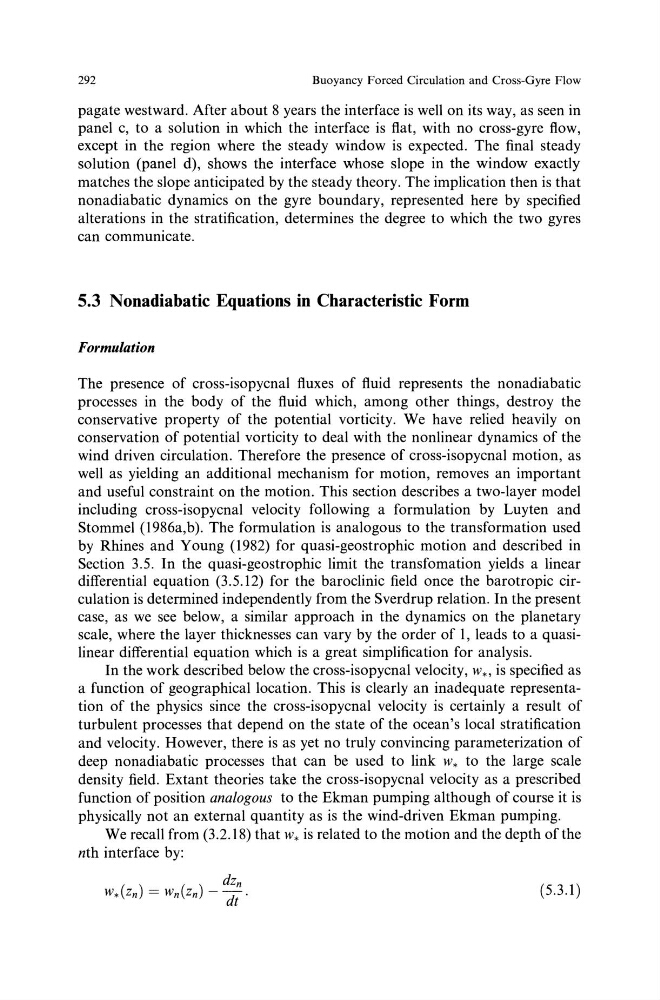
(5.3.1)
Buoyancy Forced Circulation and Cross-Gyre Flow
pagate westward. After about 8 years the interface is well on its way, as seen in
panel c, to a solution in which the interface is flat, with no cross-gyre flow,
except in the region where the steady window is expected. The final steady
solution (panel d), shows the interface whose slope in the window exactly
matches the slope anticipated by the steady theory. The implication then is that
nonadiabatic dynamics on the gyre boundary, represented here by specified
alterations in the stratification, determines the degree to which the two gyres
can communicate.
5.3 Nonadiabatic Equations in Characteristic Form
Formulation
The presence of cross-isopycnal fluxes of fluid represents the nonadiabatic
processes in the body of the fluid which, among other things, destroy the
conservative property of the potential vorticity. We have relied heavily on
conservation of potential vorticity to deal with the nonlinear dynamics of the
wind driven circulation. Therefore the presence of cross-isopycnal motion, as
well as yielding an additional mechanism for motion, removes an important
and useful constraint on the motion. This section describes a two-layer model
including cross-isopycnal velocity following a formulation by Luyten and
Stommel (1986a,b). The formulation is analogous to the transformation used
by Rhines and Young (1982) for quasi-geostrophic motion and described in
Section 3.5. In the quasi-geostrophic limit the transfomation yields a linear
differential equation (3.5.12) for the baroclinic field once the barotropic circulation is determined independently from the Sverdrup relation. In the present
case, as we see below, a similar approach in the dynamics on the planetary
scale, where the layer thicknesses can vary by the order of 1, leads to a quasilinear differential equation which is a great simplification for analysis.
In the work described below the cross-isopycnal velocity, w., is specified as
a function of geographical location. This is clearly an inadequate representation of the physics since the cross-isopycnal velocity is certainly a result of
turbulent processes that depend on the state of the ocean's local stratification
and velocity. However, there is as yet no truly convincing parameterization of
deep nonadiabatic processes that can be used to link w. to the large scale
density field. Extant theories take the cross-isopycnal velocity as a prescribed
function of position analogous to the Ekman pumping although of course it is
physically not an external quantity as is the wind-driven Ekman pumping.
We recall from (3.2.18) that w. is related to the motion and the depth of the
nth interface by:
(5.3.1)