

280
Buoyancy Forced Circulation and Cross-Gyre Flow
(5.2.3)
where nn as defined in (3.2.12) allows us, with the use of the hydrostatic relation
between nn and the layer thicknesses, hn, to write the Sverdrup relation as:
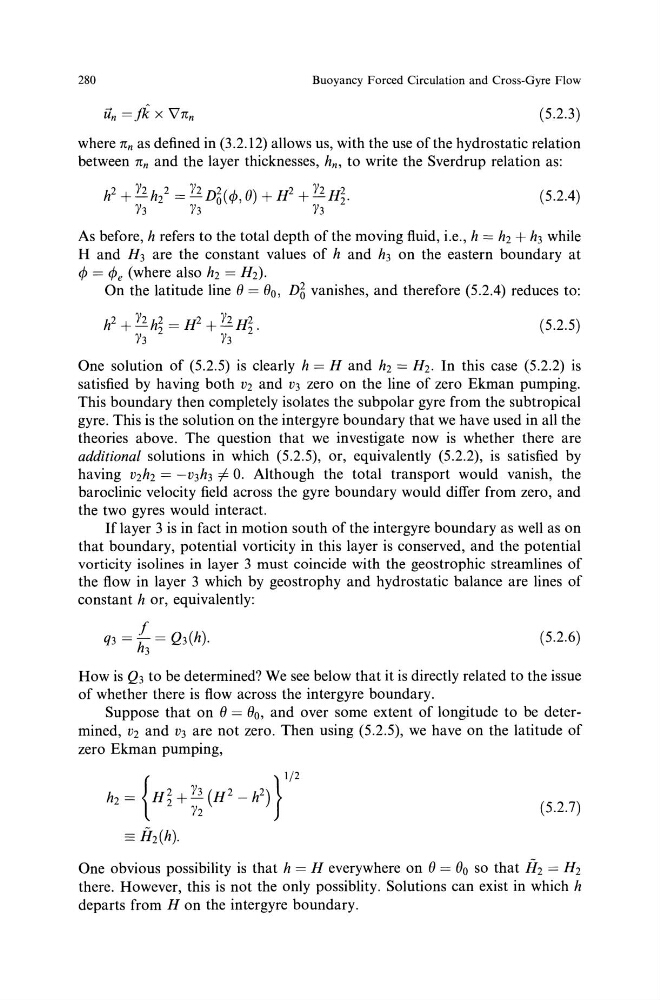
hz + Yz hzz = Yz D~(4>, e)+ Hz+ Yz H~.
1'3
1'3
1'3
(5.2.4)
As before, h refers to the total depth of the moving fluid, i.e., h = hz + h3 while
H and H3 are the constant values of h and h3 on the eastern boundary at
4> = 4>e (where also hz = Hz).
On the latitude line e = eo, Dij vanishes, and therefore (5.2.4) reduces to:
hz + Yz hz = Hz + Yz Hz .
1'3 z
1'3 z
(5.2.5)
One solution of (5.2.5) is clearly h = H and hz = Hz. In this case (5.2.2) is
satisfied by having both vz and v3 zero on the line of zero Ekman pumping.
This boundary then completely isolates the subpolar gyre from the subtropical
gyre. This is the solution on the intergyre boundary that we have used in all the
theories above. The question that we investigate now is whether there are
additional solutions in which (5.2.5), or, equivalently (5.2.2), is satisfied by
having vzhz = -v3h3 # 0. Although the total transport would vanish, the
baroclinic velocity field across the gyre boundary would differ from zero, and
the two gyres would interact.
If layer 3 is in fact in motion south of the intergyre boundary as well as on
that boundary, potential vorticity in this layer is conserved, and the potential
vorticity isolines in layer 3 must coincide with the geostrophic streamlines of
the flow in layer 3 which by geostrophy and hydrostatic balance are lines of
constant h or, equivalently:
(5.2.6)
How is Q3 to be determined? We see below that it is directly related to the issue
of whether there is flow across the intergyre boundary.
Suppose that on e = e0, and over some extent of longitude to be determined, vz and v3 are not zero. Then using (5.2.5), we have on the latitude of
zero Ekman pumping,
{
}
Ip
hz = H~ + ~~ (Hz-hz)
(5.2.7)
= Hz(h).
One obvious possibility is that h = H everywhere on e = eo so that Hz = Hz
there. However, this is not the only possiblity. Solutions can exist in which h
departs from H on the intergyre boundary.
Buoyancy Forced Circulation and Cross-Gyre Flow
(5.2.3)
where nn as defined in (3.2.12) allows us, with the use of the hydrostatic relation
between nn and the layer thicknesses, hn, to write the Sverdrup relation as:
hz + Yz hzz = Yz D~(4>, e)+ Hz+ Yz H~.
1'3
1'3
1'3
(5.2.4)
As before, h refers to the total depth of the moving fluid, i.e., h = hz + h3 while
H and H3 are the constant values of h and h3 on the eastern boundary at
4> = 4>e (where also hz = Hz).
On the latitude line e = eo, Dij vanishes, and therefore (5.2.4) reduces to:
hz + Yz hz = Hz + Yz Hz .
1'3 z
1'3 z
(5.2.5)
One solution of (5.2.5) is clearly h = H and hz = Hz. In this case (5.2.2) is
satisfied by having both vz and v3 zero on the line of zero Ekman pumping.
This boundary then completely isolates the subpolar gyre from the subtropical
gyre. This is the solution on the intergyre boundary that we have used in all the
theories above. The question that we investigate now is whether there are
additional solutions in which (5.2.5), or, equivalently (5.2.2), is satisfied by
having vzhz = -v3h3 # 0. Although the total transport would vanish, the
baroclinic velocity field across the gyre boundary would differ from zero, and
the two gyres would interact.
If layer 3 is in fact in motion south of the intergyre boundary as well as on
that boundary, potential vorticity in this layer is conserved, and the potential
vorticity isolines in layer 3 must coincide with the geostrophic streamlines of
the flow in layer 3 which by geostrophy and hydrostatic balance are lines of
constant h or, equivalently:
(5.2.6)
How is Q3 to be determined? We see below that it is directly related to the issue
of whether there is flow across the intergyre boundary.
Suppose that on e = e0, and over some extent of longitude to be determined, vz and v3 are not zero. Then using (5.2.5), we have on the latitude of
zero Ekman pumping,
{
}
Ip
hz = H~ + ~~ (Hz-hz)
(5.2.7)
= Hz(h).
One obvious possibility is that h = H everywhere on e = eo so that Hz = Hz
there. However, this is not the only possiblity. Solutions can exist in which h
departs from H on the intergyre boundary.