

248
Theory of the Ventilated Thermocline
If the motion is adiabatic w or W* vanishes, and the motion becomes twodimensional in density coordinates. Note the similarity between (4.11.8) and
the layer version of the equation for mass conservation (4.2.1). The similarity
becomes even stronger if a finite difference version of ( 4.11.8) in density
coordinates is used so that 8z I 8p ----> & I !1p and & is identified with the layer
thickness of a particular density layer that has a density interval 11p.
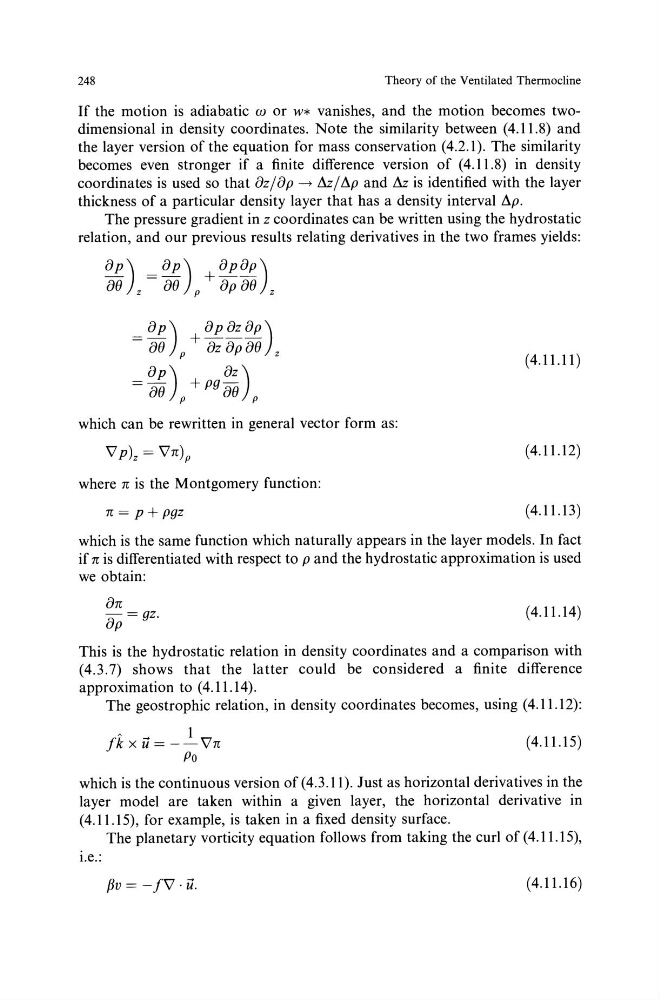
The pressure gradient in z coordinates can be written using the hydrostatic
relation, and our previous results relating derivatives in the two frames yields:
8p) 8p) 8p8p)
ae z = ae p + ap ae z
8p) 8p az 8p)
- - + - - -
- ae p az 8p ae z
8p)
az)
= ae p + pg ae p
(4.11.11)
which can be rewritten in general vector form as:
( 4.11.12)
where n is the Montgomery function:
n = p+ pgz
(4.11.13)
which is the same function which naturally appears in the layer models. In fact
if n is differentiated with respect to p and the hydrostatic approximation is used
we obtain:
an
8p = gz.
(4.11.14)
This is the hydrostatic relation in density coordinates and a comparison with
(4.3.7) shows that the latter could be considered a finite difference
approximation to (4.11.14).
The geostrophic relation, in density coordinates becomes, using ( 4.11.12):
A
1
fkxu=--'Vn
Po
(4.11.15)
which is the continuous version of (4.3.11). Just as horizontal derivatives in the
layer model are taken within a given layer, the horizontal derivative in
( 4.11.15), for example, is taken in a fixed density surface.
The planetary vorticity equation follows from taking the curl of ( 4.11.15),
I.e.:
{3v = - f'\7 · u.
( 4.11.16)
Theory of the Ventilated Thermocline
If the motion is adiabatic w or W* vanishes, and the motion becomes twodimensional in density coordinates. Note the similarity between (4.11.8) and
the layer version of the equation for mass conservation (4.2.1). The similarity
becomes even stronger if a finite difference version of ( 4.11.8) in density
coordinates is used so that 8z I 8p ----> & I !1p and & is identified with the layer
thickness of a particular density layer that has a density interval 11p.
The pressure gradient in z coordinates can be written using the hydrostatic
relation, and our previous results relating derivatives in the two frames yields:
8p) 8p) 8p8p)
ae z = ae p + ap ae z
8p) 8p az 8p)
- - + - - -
- ae p az 8p ae z
8p)
az)
= ae p + pg ae p
(4.11.11)
which can be rewritten in general vector form as:
( 4.11.12)
where n is the Montgomery function:
n = p+ pgz
(4.11.13)
which is the same function which naturally appears in the layer models. In fact
if n is differentiated with respect to p and the hydrostatic approximation is used
we obtain:
an
8p = gz.
(4.11.14)
This is the hydrostatic relation in density coordinates and a comparison with
(4.3.7) shows that the latter could be considered a finite difference
approximation to (4.11.14).
The geostrophic relation, in density coordinates becomes, using ( 4.11.12):
A
1
fkxu=--'Vn
Po
(4.11.15)
which is the continuous version of (4.3.11). Just as horizontal derivatives in the
layer model are taken within a given layer, the horizontal derivative in
( 4.11.15), for example, is taken in a fixed density surface.
The planetary vorticity equation follows from taking the curl of ( 4.11.15),
I.e.:
{3v = - f'\7 · u.
( 4.11.16)