

Continuous Models of the Ventilated Thermocline
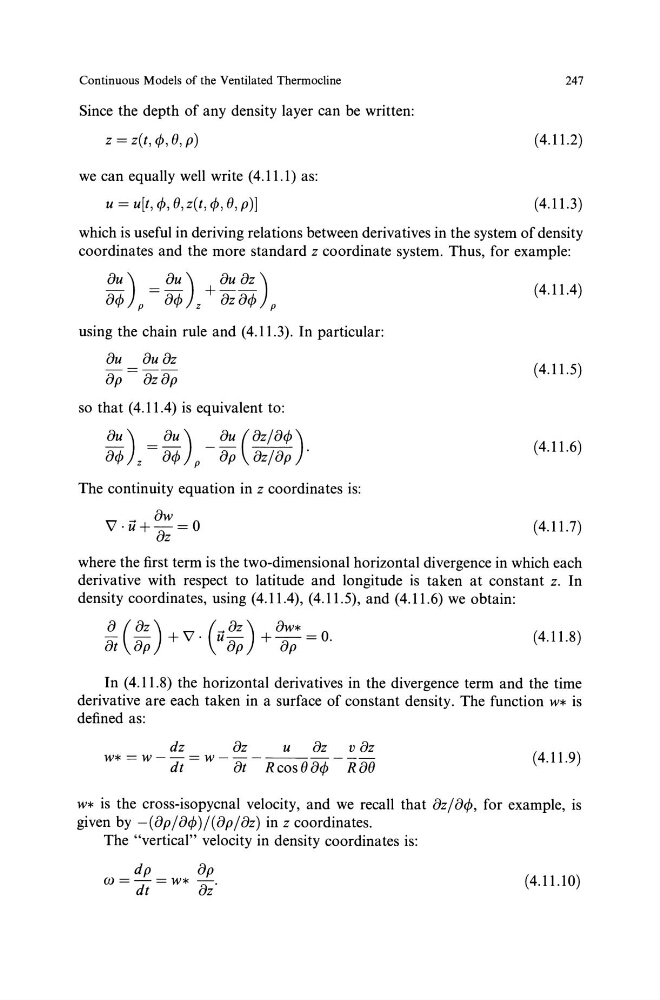
Since the depth of any density layer can be written:
z = z(t, ¢, e, p)
we can equally well write ( 4.11.1) as:
u = u[t, ¢, e, z(t, ¢, e, p)]
247
(4.11.2)
(4.11.3)
which is useful in deriving relations between derivatives in the system of density
coordinates and the more standard z coordinate system. Thus, for example:
using the chain rule and (4.11.3). In particular:
ou ou oz
op ozop
so that (4.11.4) is equivalent to:
The continuity equation in z coordinates is:
" - ow 0
v ·u+-=
oz
(4.11.4)
(4.11.5)
( 4.11.6)
(4.11.7)
where the first term is the two-dimensional horizontal divergence in which each
derivative with respect to latitude and longitude is taken at constant z. In
density coordinates, using (4.11.4), (4.11.5), and (4.11.6) we obtain:
(4.11.8)
In (4.11.8) the horizontal derivatives in the divergence term and the time
derivative are each taken in a surface of constant density. The function W* is
defined as:
dz
oz
u oz v oz
W* = w - - = w - - - - - - - - -
dt
ot Rcos8o¢ Roe
(4.11.9)
W* is the cross-isopycnal velocity, and we recall that ozjo¢, for example, is
given by -(opjo¢)/(opjoz) in z coordinates.
The "vertical" velocity in density coordinates is:
dp
op
W=-=W* -.
dt
oz
(4.11.10)
Since the depth of any density layer can be written:
z = z(t, ¢, e, p)
we can equally well write ( 4.11.1) as:
u = u[t, ¢, e, z(t, ¢, e, p)]
247
(4.11.2)
(4.11.3)
which is useful in deriving relations between derivatives in the system of density
coordinates and the more standard z coordinate system. Thus, for example:
using the chain rule and (4.11.3). In particular:
ou ou oz
op ozop
so that (4.11.4) is equivalent to:
The continuity equation in z coordinates is:
" - ow 0
v ·u+-=
oz
(4.11.4)
(4.11.5)
( 4.11.6)
(4.11.7)
where the first term is the two-dimensional horizontal divergence in which each
derivative with respect to latitude and longitude is taken at constant z. In
density coordinates, using (4.11.4), (4.11.5), and (4.11.6) we obtain:
(4.11.8)
In (4.11.8) the horizontal derivatives in the divergence term and the time
derivative are each taken in a surface of constant density. The function W* is
defined as:
dz
oz
u oz v oz
W* = w - - = w - - - - - - - - -
dt
ot Rcos8o¢ Roe
(4.11.9)
W* is the cross-isopycnal velocity, and we recall that ozjo¢, for example, is
given by -(opjo¢)/(opjoz) in z coordinates.
The "vertical" velocity in density coordinates is:
dp
op
W=-=W* -.
dt
oz
(4.11.10)