

Effect of Finite Mixed Layer Depth
243
and Vm < 0. The sum of the first two terms yields the vertical velocity at the
base of the mixed layer. The third term yields the flow which leaves the mixed
layer due to the horizontal velocity (which is continuous across the mixed layer
base) multiplied by the slope of the mixed layer. With the solution obtained as
described above an explicit representation of this ventilation flux can be found.
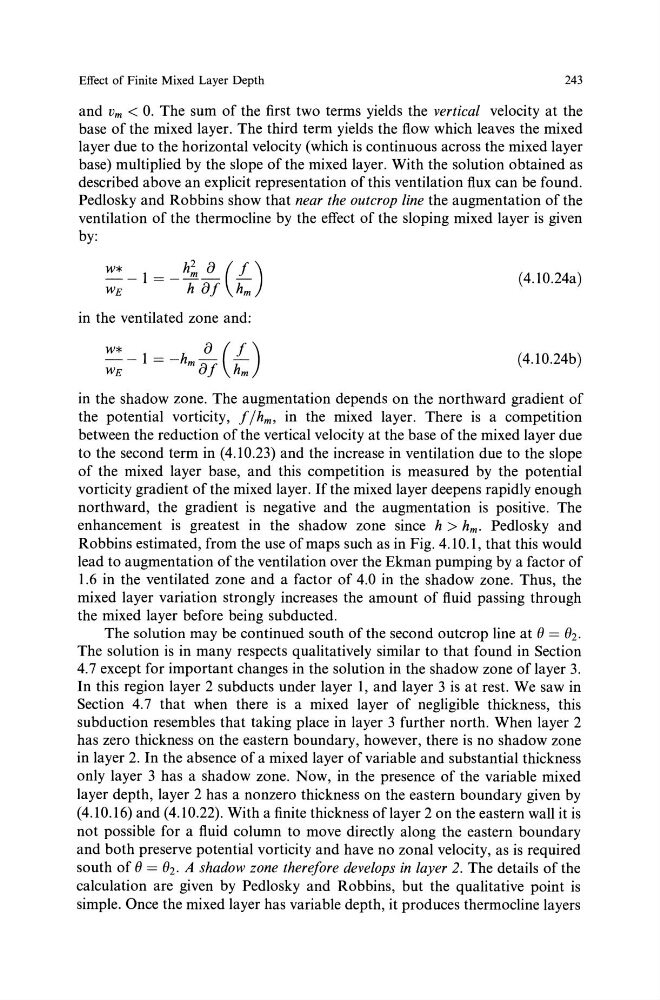
Pedlosky and Robbins show that near the outcrop line the augmentation of the
ventilation of the thermocline by the effect of the sloping mixed layer is given
by:
- - 1 = - - - -
W*
h~8(j)
WE
h 8j hm
(4.10.24a)
in the ventilated zone and:
W*- 1 = -hm}!_ (L)
WE
8j hm
(4.10.24b)
in the shadow zone. The augmentation depends on the northward gradient of
the potential vorticity, f /hm, in the mixed layer. There is a competition
between the reduction of the vertical velocity at the base of the mixed layer due
to the second term in (4.10.23) and the increase in ventilation due to the slope
of the mixed layer base, and this competition is measured by the potential
vorticity gradient of the mixed layer. If the mixed layer deepens rapidly enough
northward, the gradient is negative and the augmentation is positive. The
enhancement is greatest in the shadow zone since h > hm. Pedlosky and
Robbins estimated, from the use of maps such as in Fig. 4.10.1, that this would
lead to augmentation of the ventilation over the Ekman pumping by a factor of
1.6 in the ventilated zone and a factor of 4.0 in the shadow zone. Thus, the
mixed layer variation strongly increases the amount of fluid passing through
the mixed layer before being subducted.
The solution may be continued south of the second outcrop line at e = 82.
The solution is in many respects qualitatively similar to that found in Section
4. 7 except for important changes in the solution in the shadow zone of layer 3.
In this region layer 2 subducts under layer 1, and layer 3 is at rest. We saw in
Section 4.7 that when there is a mixed layer of negligible thickness, this
subduction resembles that taking place in layer 3 further north. When layer 2
has zero thickness on the eastern boundary, however, there is no shadow zone
in layer 2. In the absence of a mixed layer of variable and substantial thickness
only layer 3 has a shadow zone. Now, in the presence of the variable mixed
layer depth, layer 2 has a nonzero thickness on the eastern boundary given by
(4.10.16) and (4.10.22). With a finite thickness oflayer 2 on the eastern wall it is
not possible for a fluid column to move directly along the eastern boundary
and both preserve potential vorticity and have no zonal velocity, as is required
south of 0 = 82. A shadow zone therefore develops in layer 2. The details of the
calculation are given by Pedlosky and Robbins, but the qualitative point is
simple. Once the mixed layer has variable depth, it produces thermocline layers
243
and Vm < 0. The sum of the first two terms yields the vertical velocity at the
base of the mixed layer. The third term yields the flow which leaves the mixed
layer due to the horizontal velocity (which is continuous across the mixed layer
base) multiplied by the slope of the mixed layer. With the solution obtained as
described above an explicit representation of this ventilation flux can be found.
Pedlosky and Robbins show that near the outcrop line the augmentation of the
ventilation of the thermocline by the effect of the sloping mixed layer is given
by:
- - 1 = - - - -
W*
h~8(j)
WE
h 8j hm
(4.10.24a)
in the ventilated zone and:
W*- 1 = -hm}!_ (L)
WE
8j hm
(4.10.24b)
in the shadow zone. The augmentation depends on the northward gradient of
the potential vorticity, f /hm, in the mixed layer. There is a competition
between the reduction of the vertical velocity at the base of the mixed layer due
to the second term in (4.10.23) and the increase in ventilation due to the slope
of the mixed layer base, and this competition is measured by the potential
vorticity gradient of the mixed layer. If the mixed layer deepens rapidly enough
northward, the gradient is negative and the augmentation is positive. The
enhancement is greatest in the shadow zone since h > hm. Pedlosky and
Robbins estimated, from the use of maps such as in Fig. 4.10.1, that this would
lead to augmentation of the ventilation over the Ekman pumping by a factor of
1.6 in the ventilated zone and a factor of 4.0 in the shadow zone. Thus, the
mixed layer variation strongly increases the amount of fluid passing through
the mixed layer before being subducted.
The solution may be continued south of the second outcrop line at e = 82.
The solution is in many respects qualitatively similar to that found in Section
4. 7 except for important changes in the solution in the shadow zone of layer 3.
In this region layer 2 subducts under layer 1, and layer 3 is at rest. We saw in
Section 4.7 that when there is a mixed layer of negligible thickness, this
subduction resembles that taking place in layer 3 further north. When layer 2
has zero thickness on the eastern boundary, however, there is no shadow zone
in layer 2. In the absence of a mixed layer of variable and substantial thickness
only layer 3 has a shadow zone. Now, in the presence of the variable mixed
layer depth, layer 2 has a nonzero thickness on the eastern boundary given by
(4.10.16) and (4.10.22). With a finite thickness oflayer 2 on the eastern wall it is
not possible for a fluid column to move directly along the eastern boundary
and both preserve potential vorticity and have no zonal velocity, as is required
south of 0 = 82. A shadow zone therefore develops in layer 2. The details of the
calculation are given by Pedlosky and Robbins, but the qualitative point is
simple. Once the mixed layer has variable depth, it produces thermocline layers