

a
V3
b
c
242
0.2
0.4
0.6
0.8
1.0
x/x 8
0.8
0.6
0.4
•
0.2
d
0.6
f/1J
0.4
Theory of the Ventilated Thermocline
0.4
0.6
x/x 8
0.8
•
•
•
1.0
0 o~----o~.2-----o~.4-----oL.6-----oL.8----~1.o
x/x 8
e
0 oL-----0~.2-----0~.4-----0~.6-----0~.8--==~1.0
xlx 8
O.-----.--L-•~~-·.~~th_o_n& __ ••,••_n_w_al_l ~----~
-0.2
-0.4
-0.6
-0.8
H -1.0 J------------------------..l
-1 .2 .__ ____ .J...._ _ _ _ _ ..J.._ _ _ _ _ -L.. _ _ _ _ __.. _ _ _ _ __.
0.2
0.4
0.6
0.8
1.0 f
0
0.2
0.4
0.6
0.8
flf~
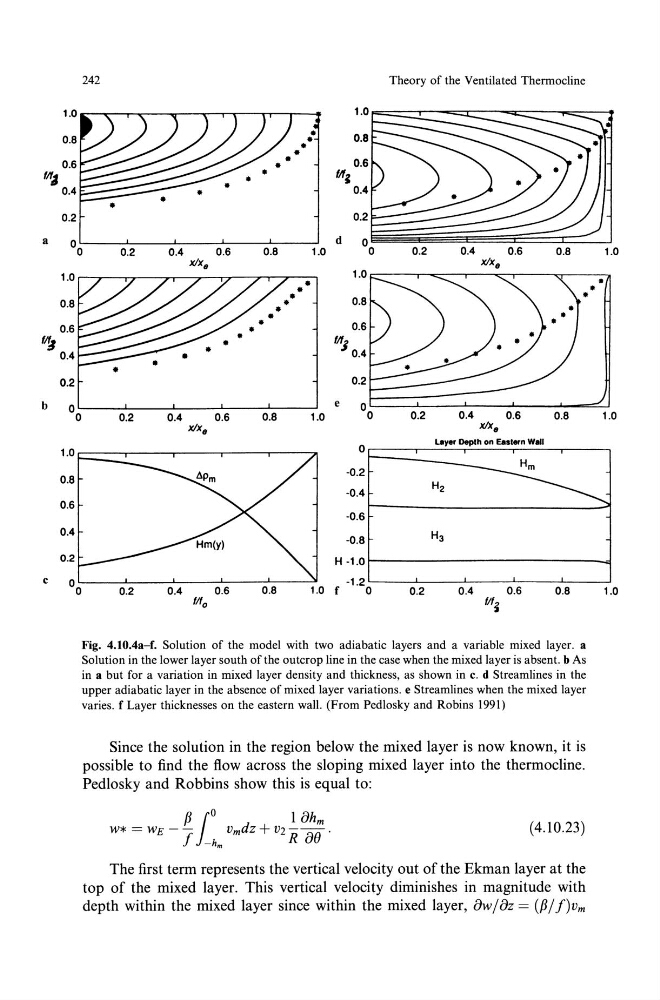
Fig. 4.10.4a-f. Solution of the model with two adiabatic layers and a variable mixed layer. a
Solution in the lower layer south of the outcrop line in the case when the mixed layer is absent. bAs
in a but for a variation in mixed layer density and thickness, as shown in c. d Streamlines in the
upper adiabatic layer in the absence of mixed layer variations. e Streamlines when the mixed layer
varies. f Layer thicknesses on the eastern wall. (From Pedlosky and Robins 1991)
Since the solution in the region below the mixed layer is now known, it is
possible to find the flow across the sloping mixed layer into the thermocline.
Pedlosky and Robbins show this is equal to:
{31°
1 8hm
W* = WE - -
V dz + V2 - - - -
f -hm m
R 8() .
(4.10.23)
The first term represents the vertical velocity out of the Ekman layer at the
top of the mixed layer. This vertical velocity diminishes in magnitude with
depth within the mixed layer since within the mixed layer, aw;az = ([3/ f)vm
1.0
V3
b
c
242
0.2
0.4
0.6
0.8
1.0
x/x 8
0.8
0.6
0.4
•
0.2
d
0.6
f/1J
0.4
Theory of the Ventilated Thermocline
0.4
0.6
x/x 8
0.8
•
•
•
1.0
0 o~----o~.2-----o~.4-----oL.6-----oL.8----~1.o
x/x 8
e
0 oL-----0~.2-----0~.4-----0~.6-----0~.8--==~1.0
xlx 8
O.-----.--L-•~~-·.~~th_o_n& __ ••,••_n_w_al_l ~----~
-0.2
-0.4
-0.6
-0.8
H -1.0 J------------------------..l
-1 .2 .__ ____ .J...._ _ _ _ _ ..J.._ _ _ _ _ -L.. _ _ _ _ __.. _ _ _ _ __.
0.2
0.4
0.6
0.8
1.0 f
0
0.2
0.4
0.6
0.8
flf~
Fig. 4.10.4a-f. Solution of the model with two adiabatic layers and a variable mixed layer. a
Solution in the lower layer south of the outcrop line in the case when the mixed layer is absent. bAs
in a but for a variation in mixed layer density and thickness, as shown in c. d Streamlines in the
upper adiabatic layer in the absence of mixed layer variations. e Streamlines when the mixed layer
varies. f Layer thicknesses on the eastern wall. (From Pedlosky and Robins 1991)
Since the solution in the region below the mixed layer is now known, it is
possible to find the flow across the sloping mixed layer into the thermocline.
Pedlosky and Robbins show this is equal to:
{31°
1 8hm
W* = WE - -
V dz + V2 - - - -
f -hm m
R 8() .
(4.10.23)
The first term represents the vertical velocity out of the Ekman layer at the
top of the mixed layer. This vertical velocity diminishes in magnitude with
depth within the mixed layer since within the mixed layer, aw;az = ([3/ f)vm
1.0