

The Geostrophic Sverdrup Relation
13
WG(O) = -wE(O) =curl ( p:f)
(1.3.7)
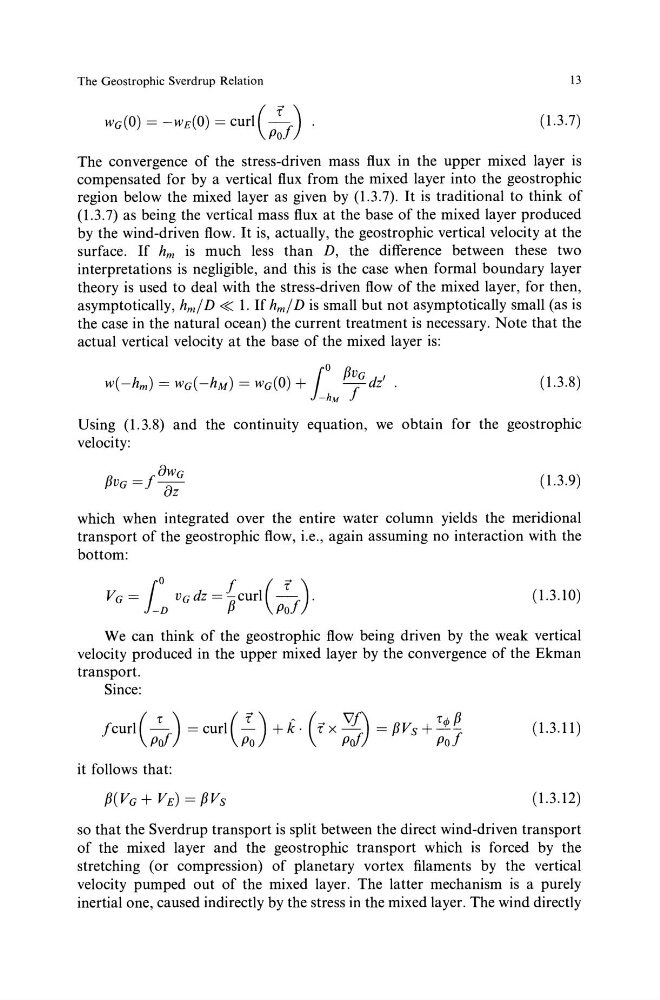
The convergence of the stress-driven mass flux in the upper mixed layer is
compensated for by a vertical flux from the mixed layer into the geostrophic
region below the mixed layer as given by (1.3.7). It is traditional to think of
(1.3.7) as being the vertical mass flux at the base of the mixed layer produced
by the wind-driven flow. It is, actually, the geostrophic vertical velocity at the
surface. If hm is much less than D, the difference between these two
interpretations is negligible, and this is the case when formal boundary layer
theory is used to deal with the stress-driven flow of the mixed layer, for then,
asymptotically, hm/ D « 1. If hm/ Dis small but not asymptotically small (as is
the case in the natural ocean) the current treatment is necessary. Note that the
actual vertical velocity at the base of the mixed layer is:
( 1.3.8)
Using (1.3.8) and the continuity equation, we obtain for the geostrophic
velocity:
[3 _ 1 awG
VG- - -
8z
(1.3.9)
which when integrated over the entire water column yields the meridional
transport of the geostrophic flow, i.e., again assuming no interaction with the
bottom:
Va = 1: vadz=£curl(p:f).
(1.3.10)
We can think of the geostrophic flow being driven by the weak vertical
velocity produced in the upper mixed layer by the convergence of the Ekman
transport.
Since:
fcurl -
=curl -
+ k · r x - = f3Vs + -( r )
( r ) A (~ Vf)
rq, [3
pof
Po
Pof
Po f
(1.3.11)
it follows that:
( 1.3.12)
so that the Sverdrup transport is split between the direct wind-driven transport
of the mixed layer and the geostrophic transport which is forced by the
stretching (or compression) of planetary vortex filaments by the vertical
velocity pumped out of the mixed layer. The latter mechanism is a purely
inertial one, caused indirectly by the stress in the mixed layer. The wind directly
13
WG(O) = -wE(O) =curl ( p:f)
(1.3.7)
The convergence of the stress-driven mass flux in the upper mixed layer is
compensated for by a vertical flux from the mixed layer into the geostrophic
region below the mixed layer as given by (1.3.7). It is traditional to think of
(1.3.7) as being the vertical mass flux at the base of the mixed layer produced
by the wind-driven flow. It is, actually, the geostrophic vertical velocity at the
surface. If hm is much less than D, the difference between these two
interpretations is negligible, and this is the case when formal boundary layer
theory is used to deal with the stress-driven flow of the mixed layer, for then,
asymptotically, hm/ D « 1. If hm/ Dis small but not asymptotically small (as is
the case in the natural ocean) the current treatment is necessary. Note that the
actual vertical velocity at the base of the mixed layer is:
( 1.3.8)
Using (1.3.8) and the continuity equation, we obtain for the geostrophic
velocity:
[3 _ 1 awG
VG- - -
8z
(1.3.9)
which when integrated over the entire water column yields the meridional
transport of the geostrophic flow, i.e., again assuming no interaction with the
bottom:
Va = 1: vadz=£curl(p:f).
(1.3.10)
We can think of the geostrophic flow being driven by the weak vertical
velocity produced in the upper mixed layer by the convergence of the Ekman
transport.
Since:
fcurl -
=curl -
+ k · r x - = f3Vs + -( r )
( r ) A (~ Vf)
rq, [3
pof
Po
Pof
Po f
(1.3.11)
it follows that:
( 1.3.12)
so that the Sverdrup transport is split between the direct wind-driven transport
of the mixed layer and the geostrophic transport which is forced by the
stretching (or compression) of planetary vortex filaments by the vertical
velocity pumped out of the mixed layer. The latter mechanism is a purely
inertial one, caused indirectly by the stress in the mixed layer. The wind directly