

236
Theory of the Ventilated Thermocline
Pn
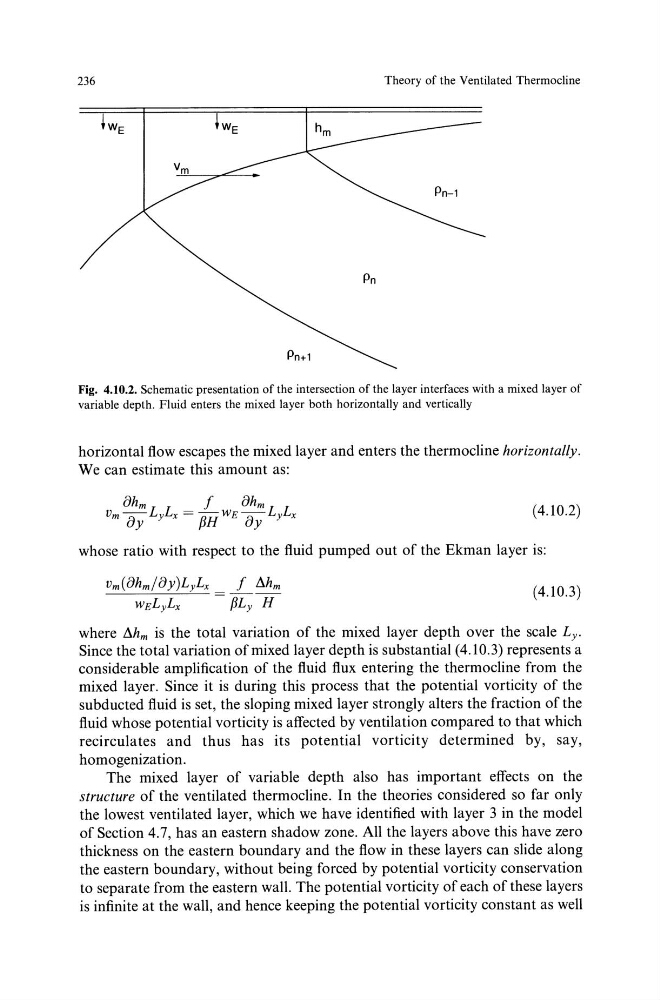
Fig. 4.10.2. Schematic presentation of the intersection of the layer interfaces with a mixed layer of
variable depth. Fluid enters the mixed layer both horizontally and vertically
horizontal flow escapes the mixed layer and enters the thermocline horizontally.
We can estimate this amount as:
8hm
J 8hm
Vm Dy LyLx = fJH W£ Dy LyLx
(4.10.2)
whose ratio with respect to the fluid pumped out of the Ekman layer is:
WELyLx
/3Ly H
(4.10.3)
where Ahm is the total variation of the mixed layer depth over the scale Ly.
Since the total variation of mixed layer depth is substantial (4.10.3) represents a
considerable amplification of the fluid flux entering the thermocline from the
mixed layer. Since it is during this process that the potential vorticity of the
subducted fluid is set, the sloping mixed layer strongly alters the fraction of the
fluid whose potential vorticity is affected by ventilation compared to that which
recirculates and thus has its potential vorticity determined by, say,
homogenization.
The mixed layer of variable depth also has important effects on the
structure of the ventilated thermocline. In the theories considered so far only
the lowest ventilated layer, which we have identified with layer 3 in the model
of Section 4.7, has an eastern shadow zone. All the layers above this have zero
thickness on the eastern boundary and the flow in these layers can slide along
the eastern boundary, without being forced by potential vorticity conservation
to separate from the eastern wall. The potential vorticity of each of these layers
is infinite at the wall, and hence keeping the potential vorticity constant as well
Theory of the Ventilated Thermocline
Pn
Fig. 4.10.2. Schematic presentation of the intersection of the layer interfaces with a mixed layer of
variable depth. Fluid enters the mixed layer both horizontally and vertically
horizontal flow escapes the mixed layer and enters the thermocline horizontally.
We can estimate this amount as:
8hm
J 8hm
Vm Dy LyLx = fJH W£ Dy LyLx
(4.10.2)
whose ratio with respect to the fluid pumped out of the Ekman layer is:
WELyLx
/3Ly H
(4.10.3)
where Ahm is the total variation of the mixed layer depth over the scale Ly.
Since the total variation of mixed layer depth is substantial (4.10.3) represents a
considerable amplification of the fluid flux entering the thermocline from the
mixed layer. Since it is during this process that the potential vorticity of the
subducted fluid is set, the sloping mixed layer strongly alters the fraction of the
fluid whose potential vorticity is affected by ventilation compared to that which
recirculates and thus has its potential vorticity determined by, say,
homogenization.
The mixed layer of variable depth also has important effects on the
structure of the ventilated thermocline. In the theories considered so far only
the lowest ventilated layer, which we have identified with layer 3 in the model
of Section 4.7, has an eastern shadow zone. All the layers above this have zero
thickness on the eastern boundary and the flow in these layers can slide along
the eastern boundary, without being forced by potential vorticity conservation
to separate from the eastern wall. The potential vorticity of each of these layers
is infinite at the wall, and hence keeping the potential vorticity constant as well