

222
Theory of the Ventilated Thermocline
is at the northern boundary of the gyre where the Ekman pumping vanishes,
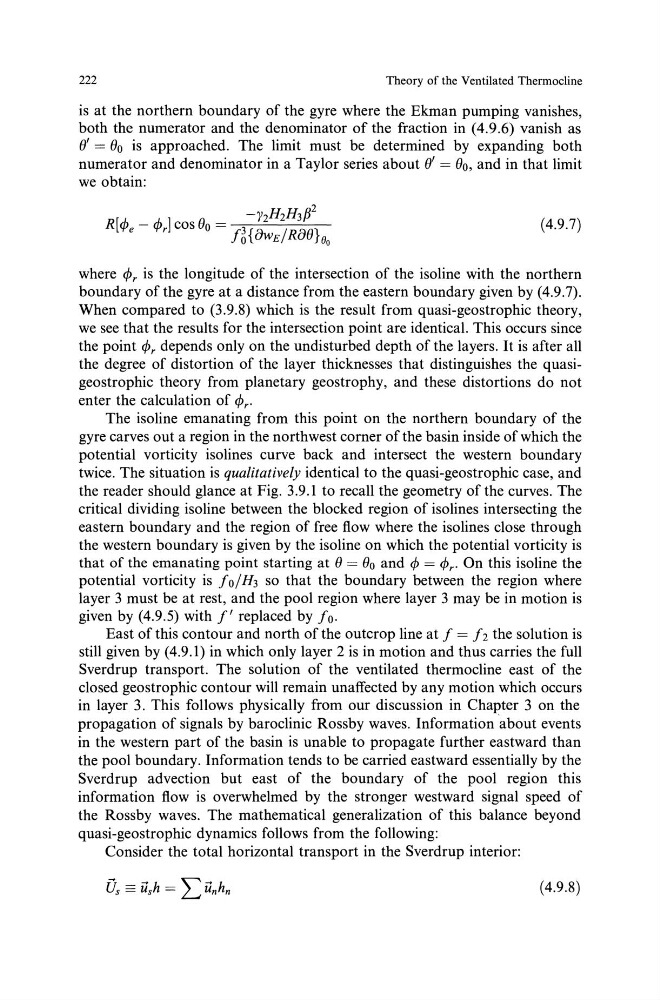
both the numerator and the denominator of the fraction in (4.9.6) vanish as
e' = e0 is approached. The limit must be determined by expanding both
numerator and denominator in a Taylor series about ()' = e0, and in that limit
we obtain:
(4.9.7)
where ¢ 7 is the longitude of the intersection of the isoline with the northern
boundary of the gyre at a distance from the eastern boundary given by (4.9.7).
When compared to (3.9.8) which is the result from quasi-geostrophic theory,
we see that the results for the intersection point are identical. This occurs since
the point c/J 7 depends only on the undisturbed depth of the layers. It is after all
the degree of distortion of the layer thicknesses that distinguishes the quasigeostrophic theory from planetary geostrophy, and these distortions do not
enter the calculation of cPr·
The isoline emanating from this point on the northern boundary of the
gyre carves out a region in the northwest corner of the basin inside of which the
potential vorticity isolines curve back and intersect the western boundary
twice. The situation is qualitatively identical to the quasi-geostrophic case, and
the reader should glance at Fig. 3.9.1 to recall the geometry of the curves. The
critical dividing isoline between the blocked region of isolines intersecting the
eastern boundary and the region of free flow where the isolines close through
the western boundary is given by the isoline on which the potential vorticity is
that of the emanating point starting at e = eo and c/J = cPr· On this isoline the
potential vorticity is fo/H3 so that the boundary between the region where
layer 3 must be at rest, and the pool region where layer 3 may be in motion is
given by (4.9.5) with f' replaced by fo.
East of this contour and north of the outcrop line at f = h the solution is
still given by (4.9.1) in which only layer 2 is in motion and thus carries the full
Sverdrup transport. The solution of the ventilated thermocline east of the
closed geostrophic contour will remain unaffected by any motion which occurs
in layer 3. This follows physically from our discussion in Chapter 3 on the
propagation of signals by baroclinic Rossby waves. Information ·about events
in the western part of the basin is unable to propagate further eastward than
the pool boundary. Information tends to be carried eastward essentially by the
Sverdrup advection but east of the boundary of the pool region this
information flow is overwhelmed by the stronger westward signal speed of
the Rossby waves. The mathematical generalization of this balance beyond
quasi-geostrophic dynamics follows from the following:
Consider the total horizontal transport in the Sverdrup interior:
(4.9.8)
Theory of the Ventilated Thermocline
is at the northern boundary of the gyre where the Ekman pumping vanishes,
both the numerator and the denominator of the fraction in (4.9.6) vanish as
e' = e0 is approached. The limit must be determined by expanding both
numerator and denominator in a Taylor series about ()' = e0, and in that limit
we obtain:
(4.9.7)
where ¢ 7 is the longitude of the intersection of the isoline with the northern
boundary of the gyre at a distance from the eastern boundary given by (4.9.7).
When compared to (3.9.8) which is the result from quasi-geostrophic theory,
we see that the results for the intersection point are identical. This occurs since
the point c/J 7 depends only on the undisturbed depth of the layers. It is after all
the degree of distortion of the layer thicknesses that distinguishes the quasigeostrophic theory from planetary geostrophy, and these distortions do not
enter the calculation of cPr·
The isoline emanating from this point on the northern boundary of the
gyre carves out a region in the northwest corner of the basin inside of which the
potential vorticity isolines curve back and intersect the western boundary
twice. The situation is qualitatively identical to the quasi-geostrophic case, and
the reader should glance at Fig. 3.9.1 to recall the geometry of the curves. The
critical dividing isoline between the blocked region of isolines intersecting the
eastern boundary and the region of free flow where the isolines close through
the western boundary is given by the isoline on which the potential vorticity is
that of the emanating point starting at e = eo and c/J = cPr· On this isoline the
potential vorticity is fo/H3 so that the boundary between the region where
layer 3 must be at rest, and the pool region where layer 3 may be in motion is
given by (4.9.5) with f' replaced by fo.
East of this contour and north of the outcrop line at f = h the solution is
still given by (4.9.1) in which only layer 2 is in motion and thus carries the full
Sverdrup transport. The solution of the ventilated thermocline east of the
closed geostrophic contour will remain unaffected by any motion which occurs
in layer 3. This follows physically from our discussion in Chapter 3 on the
propagation of signals by baroclinic Rossby waves. Information ·about events
in the western part of the basin is unable to propagate further eastward than
the pool boundary. Information tends to be carried eastward essentially by the
Sverdrup advection but east of the boundary of the pool region this
information flow is overwhelmed by the stronger westward signal speed of
the Rossby waves. The mathematical generalization of this balance beyond
quasi-geostrophic dynamics follows from the following:
Consider the total horizontal transport in the Sverdrup interior:
(4.9.8)