

Ventilation and Homogenization: A Unified Theory
221
that here, generally speaking, the potential vorticity isolines strike the eastern
boundary so that layer 3 will remains at rest near the eastern boundary. If we
start with this hypothesis we can construct the solution sequentially as follows:
North of the outcrop line and sufficiently close to the eastern boundary
only layer 2 is in motion. The solution is given by (4.4.6), i.e.:
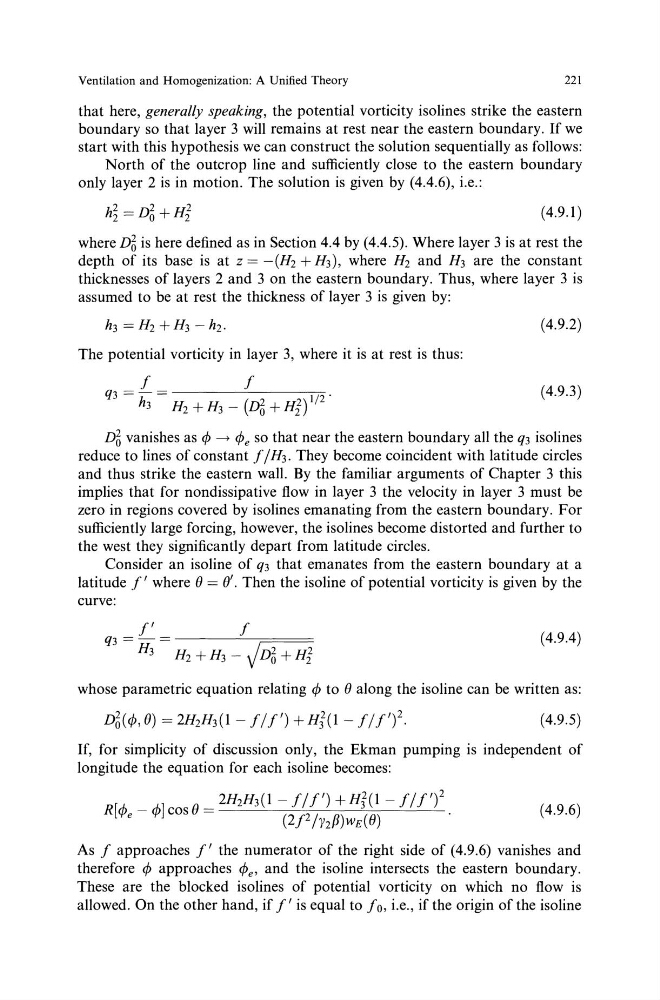
(4.9.1)
where D~ is here defined as in Section 4.4 by (4.4.5). Where layer 3 is at rest the
depth of its base is at z = -(H2 + H3), where H2 and H3 are the constant
thicknesses of layers 2 and 3 on the eastern boundary. Thus, where layer 3 is
assumed to be at rest the thickness of layer 3 is given by:
(4.9.2)
The potential vorticity in layer 3, where it is at rest is thus:
f
f
q 3 = h3 = H2 +H3- (~ +Hi) 112 .
( 4.9.3)
D~ vanishes as 4J----) 4Je so that near the eastern boundary all the q3 isolines
reduce to lines of constant f I H3• They become coincident with latitude circles
and thus strike the eastern wall. By the familiar arguments of Chapter 3 this
implies that for nondissipative flow in layer 3 the velocity in layer 3 must be
zero in regions covered by isolines emanating from the eastern boundary. For
sufficiently large forcing, however, the isolines become distorted and further to
the west they significantly depart from latitude circles.
Consider an isoline of q3 that emanates from the eastern boundary at a
latitude f' where 0 = 0'. Then the isoline of potential vorticity is given by the
curve:
f'
f
q3 = - = -----'-----;====
H 3 H2 +H3- Jn~ +H}
( 4.9.4)
whose parametric equation relating 4J to 0 along the isoline can be written as:
(4.9.5)
If, for simplicity of discussion only, the Ekman pumping is independent of
longitude the equation for each isoline becomes:
R[ "' _ "']
O = 2H2H3(l- !If') +Hf(l- !1!')
2
'l'e
'I' cos
(2j2 /y2{J)wE( 0)
(4.9.6)
As f approaches f' the numerator of the right side of (4.9.6) vanishes and
therefore 4J approaches 4Je, and the isoline intersects the eastern boundary.
These are the blocked isolines of potential vorticity on which no flow is
allowed. On the other hand, iff' is equal to f 0 , i.e., if the origin of the isoline
221
that here, generally speaking, the potential vorticity isolines strike the eastern
boundary so that layer 3 will remains at rest near the eastern boundary. If we
start with this hypothesis we can construct the solution sequentially as follows:
North of the outcrop line and sufficiently close to the eastern boundary
only layer 2 is in motion. The solution is given by (4.4.6), i.e.:
(4.9.1)
where D~ is here defined as in Section 4.4 by (4.4.5). Where layer 3 is at rest the
depth of its base is at z = -(H2 + H3), where H2 and H3 are the constant
thicknesses of layers 2 and 3 on the eastern boundary. Thus, where layer 3 is
assumed to be at rest the thickness of layer 3 is given by:
(4.9.2)
The potential vorticity in layer 3, where it is at rest is thus:
f
f
q 3 = h3 = H2 +H3- (~ +Hi) 112 .
( 4.9.3)
D~ vanishes as 4J----) 4Je so that near the eastern boundary all the q3 isolines
reduce to lines of constant f I H3• They become coincident with latitude circles
and thus strike the eastern wall. By the familiar arguments of Chapter 3 this
implies that for nondissipative flow in layer 3 the velocity in layer 3 must be
zero in regions covered by isolines emanating from the eastern boundary. For
sufficiently large forcing, however, the isolines become distorted and further to
the west they significantly depart from latitude circles.
Consider an isoline of q3 that emanates from the eastern boundary at a
latitude f' where 0 = 0'. Then the isoline of potential vorticity is given by the
curve:
f'
f
q3 = - = -----'-----;====
H 3 H2 +H3- Jn~ +H}
( 4.9.4)
whose parametric equation relating 4J to 0 along the isoline can be written as:
(4.9.5)
If, for simplicity of discussion only, the Ekman pumping is independent of
longitude the equation for each isoline becomes:
R[ "' _ "']
O = 2H2H3(l- !If') +Hf(l- !1!')
2
'l'e
'I' cos
(2j2 /y2{J)wE( 0)
(4.9.6)
As f approaches f' the numerator of the right side of (4.9.6) vanishes and
therefore 4J approaches 4Je, and the isoline intersects the eastern boundary.
These are the blocked isolines of potential vorticity on which no flow is
allowed. On the other hand, iff' is equal to f 0 , i.e., if the origin of the isoline