

The Three-Layer Model
207
There is an interesting interplay between the depth of layer 2 on the
northern (and eastern) boundary of the gyre and the relative extents of the
various regions. As H 2 increases, the streamlines in the ventilated region swing
westward, as can be seen by examining (4.4.21). Thus if H2 increases, the
shadow zone increases in longitudinal extent, and the zonal extent of the pool
region correspondingly shrinks.
4.7 The Three-Layer Model
In their original paper Luyten et al. (1983) described a three-layer model of the
thermocline. The three-layer model is of interest for several reasons. First of
all, in a quantitative way it leads to a better vertical resolution of the velocity
and density structure of the circulation. Of course, a three-layer model is still a
rather crude model of the continuous thermocline, and the principal
motivation for the present discussion of the three-layer version of the model
described in Sections 4.4--4.6 is to present certain new qualitative features of the
solution. We emphasize these new features and allow the reader to consult the
paper of Luyten et al. for details of the solution.
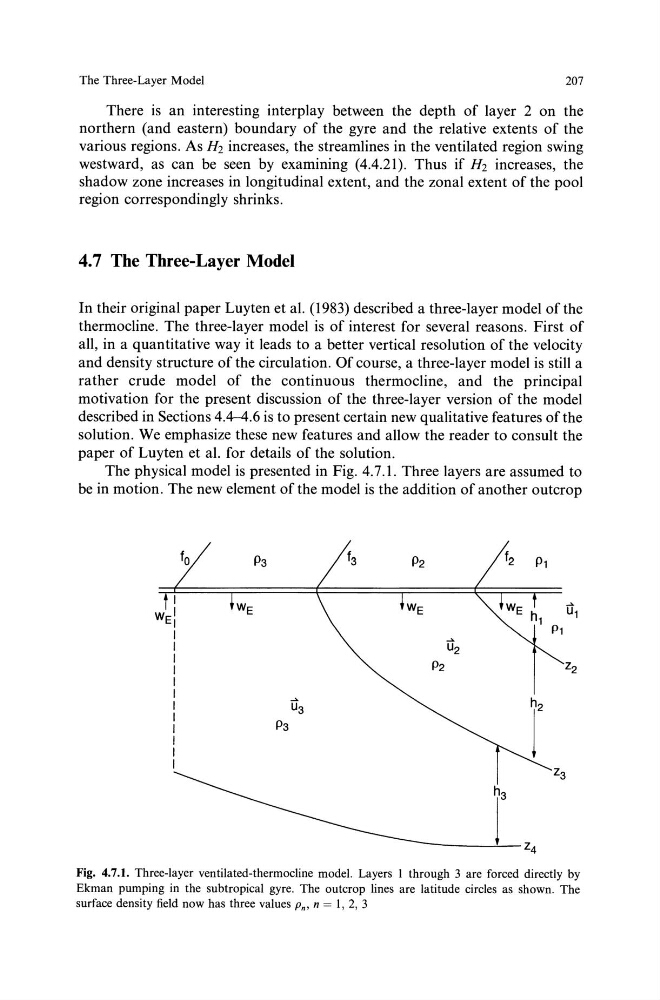
The physical model is presented in Fig. 4. 7.1. Three layers are assumed to
be in motion. The new element of the model is the addition of another outcrop
fo
P3
f3
P2
f2 P1
WE
rt1
P1
rt2
P2
z2
rt3
P3
z3
r z4
Fig. 4.7.1. Three-layer ventilated-thermocline model. Layers I through 3 are forced directly by
Ekman pumping in the subtropical gyre. The outcrop lines are latitude circles as shown. The
surface density field now has three values Pn, n = I, 2, 3
207
There is an interesting interplay between the depth of layer 2 on the
northern (and eastern) boundary of the gyre and the relative extents of the
various regions. As H 2 increases, the streamlines in the ventilated region swing
westward, as can be seen by examining (4.4.21). Thus if H2 increases, the
shadow zone increases in longitudinal extent, and the zonal extent of the pool
region correspondingly shrinks.
4.7 The Three-Layer Model
In their original paper Luyten et al. (1983) described a three-layer model of the
thermocline. The three-layer model is of interest for several reasons. First of
all, in a quantitative way it leads to a better vertical resolution of the velocity
and density structure of the circulation. Of course, a three-layer model is still a
rather crude model of the continuous thermocline, and the principal
motivation for the present discussion of the three-layer version of the model
described in Sections 4.4--4.6 is to present certain new qualitative features of the
solution. We emphasize these new features and allow the reader to consult the
paper of Luyten et al. for details of the solution.
The physical model is presented in Fig. 4. 7.1. Three layers are assumed to
be in motion. The new element of the model is the addition of another outcrop
fo
P3
f3
P2
f2 P1
WE
rt1
P1
rt2
P2
z2
rt3
P3
z3
r z4
Fig. 4.7.1. Three-layer ventilated-thermocline model. Layers I through 3 are forced directly by
Ekman pumping in the subtropical gyre. The outcrop lines are latitude circles as shown. The
surface density field now has three values Pn, n = I, 2, 3