

206
Theory of the Ventilated Thermocline
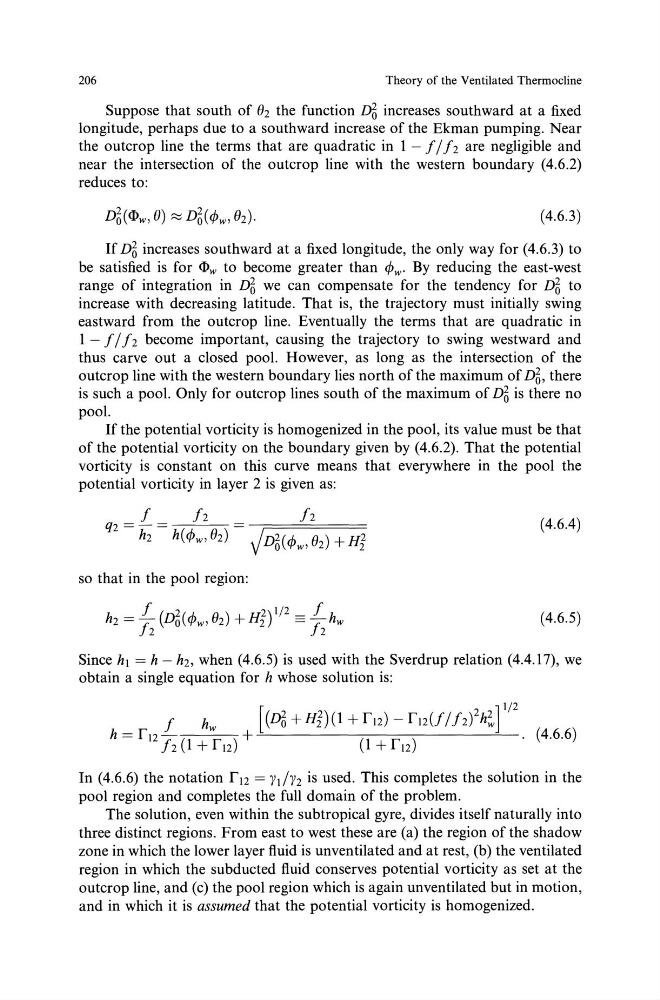
Suppose that south of lh the function Dij increases southward at a fixed
longitude, perhaps due to a southward increase of the Ekman pumping. Near
the outcrop line the terms that are quadratic in 1 - f I h are negligible and
near the intersection of the outcrop line with the western boundary (4.6.2)
reduces to:
(4.6.3)
If Dij increases southward at a fixed longitude, the only way for (4.6.3) to
be satisfied is for ~w to become greater than cPw· By reducing the east-west
range of integration in Dij we can compensate for the tendency for Dij to
increase with decreasing latitude. That is, the trajectory must initially swing
eastward from the outcrop line. Eventually the terms that are quadratic in
1 - f I h become important, causing the trajectory to swing westward and
thus carve out a closed pool. However, as long as the intersection of the
outcrop line with the western boundary lies north of the maximum of Dij, there
is such a pool. Only for outcrop lines south of the maximum of Dij is there no
pool.
If the potential vorticity is homogenized in the pool, its value must be that
of the potential vorticity on the boundary given by (4.6.2). That the potential
vorticity is constant on this curve means that everywhere in the pool the
potential vorticity in layer 2 is given as:
(4.6.4)
so that in the pool region:
(4.6.5)
Since h1 = h- h2, when (4.6.5) is used with the Sverdrup relation (4.4.17), we
obtain a single equation for h whose solution is:
In (4.6.6) the notation r 12 = yify 2 is used. This completes the solution in the
pool region and completes the full domain of the problem.
The solution, even within the subtropical gyre, divides itself naturally into
three distinct regions. From east to west these are (a) the region of the shadow
zone in which the lower layer fluid is unventilated and at rest, (b) the ventilated
region in which the subducted fluid conserves potential vorticity as set at the
outcrop line, and (c) the pool region which is again unventilated but in motion,
and in which it is assumed that the potential vorticity is homogenized.
Theory of the Ventilated Thermocline
Suppose that south of lh the function Dij increases southward at a fixed
longitude, perhaps due to a southward increase of the Ekman pumping. Near
the outcrop line the terms that are quadratic in 1 - f I h are negligible and
near the intersection of the outcrop line with the western boundary (4.6.2)
reduces to:
(4.6.3)
If Dij increases southward at a fixed longitude, the only way for (4.6.3) to
be satisfied is for ~w to become greater than cPw· By reducing the east-west
range of integration in Dij we can compensate for the tendency for Dij to
increase with decreasing latitude. That is, the trajectory must initially swing
eastward from the outcrop line. Eventually the terms that are quadratic in
1 - f I h become important, causing the trajectory to swing westward and
thus carve out a closed pool. However, as long as the intersection of the
outcrop line with the western boundary lies north of the maximum of Dij, there
is such a pool. Only for outcrop lines south of the maximum of Dij is there no
pool.
If the potential vorticity is homogenized in the pool, its value must be that
of the potential vorticity on the boundary given by (4.6.2). That the potential
vorticity is constant on this curve means that everywhere in the pool the
potential vorticity in layer 2 is given as:
(4.6.4)
so that in the pool region:
(4.6.5)
Since h1 = h- h2, when (4.6.5) is used with the Sverdrup relation (4.4.17), we
obtain a single equation for h whose solution is:
In (4.6.6) the notation r 12 = yify 2 is used. This completes the solution in the
pool region and completes the full domain of the problem.
The solution, even within the subtropical gyre, divides itself naturally into
three distinct regions. From east to west these are (a) the region of the shadow
zone in which the lower layer fluid is unventilated and at rest, (b) the ventilated
region in which the subducted fluid conserves potential vorticity as set at the
outcrop line, and (c) the pool region which is again unventilated but in motion,
and in which it is assumed that the potential vorticity is homogenized.