

Scaling for Sverdrup Theory
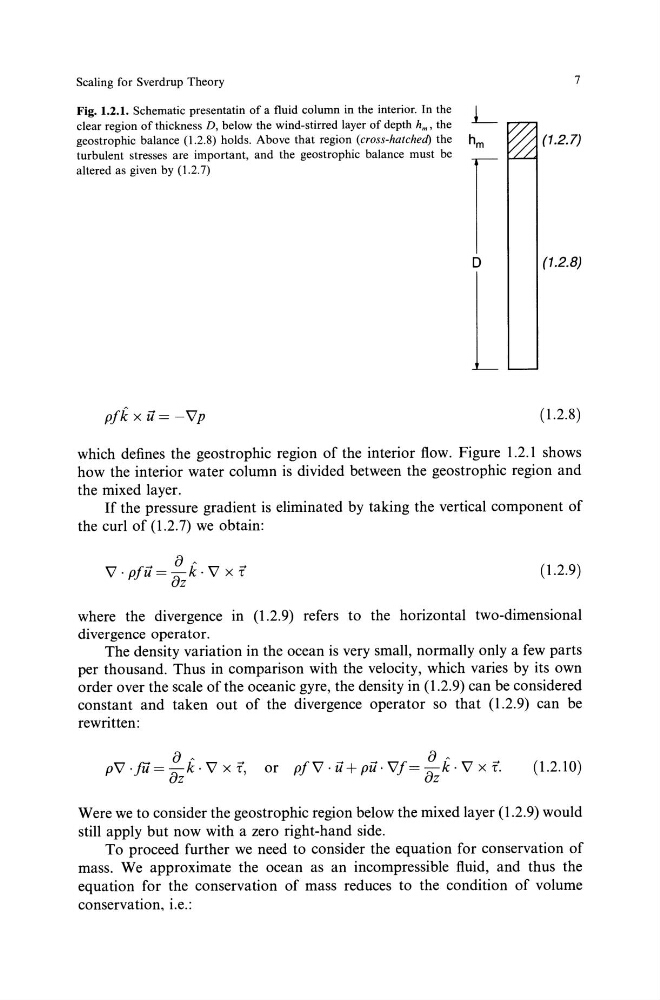
Fig. 1.2.1. Schematic presentatin of a fluid column in the interior. In the
clear region of thickness D, below the wind-stirred layer of depth hrn, the
geostrophic balance (1.2.8) holds. Above that region (cross-hatched) the
turbulent stresses are important, and the geostrophic balance must be
altered as given by (1.2. 7)
pfk XU= -'\lp
D
7
(1.2.7)
(1.2.8)
( 1.2.8)
which defines the geostrophic region of the interior flow. Figure 1.2.1 shows
how the interior water column is divided between the geostrophic region and
the mixed layer.
If the pressure gradient is eliminated by taking the vertical component of
the curl of (1.2.7) we obtain:
.r- f) k, n
-
'\1 · p1 u = - · v x r
&z
( 1.2.9)
where the divergence in (1.2.9) refers to the horizontal two-dimensional
divergence operator.
The density variation in the ocean is very small, normally only a few parts
per thousand. Thus in comparison with the velocity, which varies by its own
order over the scale of the oceanic gyre, the density in (1.2.9) can be considered
constant and taken out of the divergence operator so that (1.2.9) can be
rewritten:
p'\1 · fil = :Z k · '\1 X r, or pf '\1 · U + pu· '\lf = :Z k · '\1 X r. ( 1.2.10)
Were we to consider the geostrophic region below the mixed layer (1.2.9) would
still apply but now with a zero right-hand side.
To proceed further we need to consider the equation for conservation of
mass. We approximate the ocean as an incompressible fluid, and thus the
equation for the conservation of mass reduces to the condition of volume
conservation, i.e.:
Fig. 1.2.1. Schematic presentatin of a fluid column in the interior. In the
clear region of thickness D, below the wind-stirred layer of depth hrn, the
geostrophic balance (1.2.8) holds. Above that region (cross-hatched) the
turbulent stresses are important, and the geostrophic balance must be
altered as given by (1.2. 7)
pfk XU= -'\lp
D
7
(1.2.7)
(1.2.8)
( 1.2.8)
which defines the geostrophic region of the interior flow. Figure 1.2.1 shows
how the interior water column is divided between the geostrophic region and
the mixed layer.
If the pressure gradient is eliminated by taking the vertical component of
the curl of (1.2.7) we obtain:
.r- f) k, n
-
'\1 · p1 u = - · v x r
&z
( 1.2.9)
where the divergence in (1.2.9) refers to the horizontal two-dimensional
divergence operator.
The density variation in the ocean is very small, normally only a few parts
per thousand. Thus in comparison with the velocity, which varies by its own
order over the scale of the oceanic gyre, the density in (1.2.9) can be considered
constant and taken out of the divergence operator so that (1.2.9) can be
rewritten:
p'\1 · fil = :Z k · '\1 X r, or pf '\1 · U + pu· '\lf = :Z k · '\1 X r. ( 1.2.10)
Were we to consider the geostrophic region below the mixed layer (1.2.9) would
still apply but now with a zero right-hand side.
To proceed further we need to consider the equation for conservation of
mass. We approximate the ocean as an incompressible fluid, and thus the
equation for the conservation of mass reduces to the condition of volume
conservation, i.e.: