

6
8f
'S =-+'Sn
az
Sverdrup Theory
(1.2.4)
where z is a coordinate parallel to the local vertical direction. The second term
on the right side of (1.2.4) is often written as:
(1.2.5)
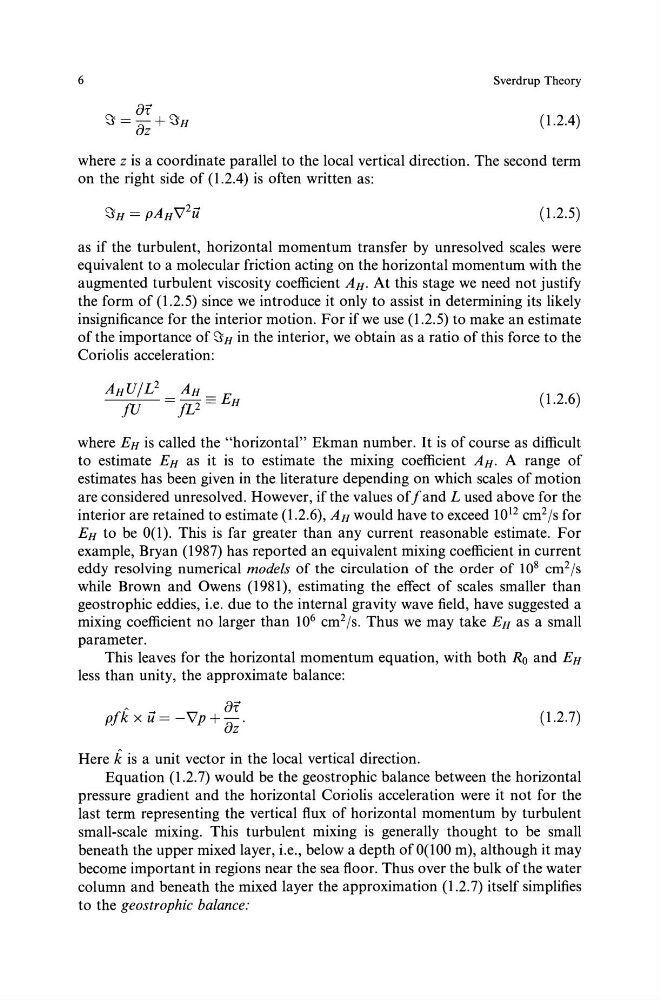
as if the turbulent, horizontal momentum transfer by unresolved scales were
equivalent to a molecular friction acting on the horizontal momentum with the
augmented turbulent viscosity coefficient An. At this stage we need not justify
the form of (1.2.5) since we introduce it only to assist in determining its likely
insignificance for the interior motion. For if we use (1.2.5) to make an estimate
of the importance of 'Sn in the interior, we obtain as a ratio of this force to the
Coriolis acceleration:
(1.2.6)
where En is called the "horizontal" Ekman number. It is of course as difficult
to estimate En as it is to estimate the mixing coefficient An. A range of
estimates has been given in the literature depending on which scales of motion
are considered unresolved. However, if the values off and L used above for the
interior are retained to estimate (1.2.6), An would have to exceed 10 12 cm 2 js for
En to be 0(1). This is far greater than any current reasonable estimate. For
example, Bryan (1987) has reported an equivalent mixing coefficient in current
eddy resolving numerical models of the circulation of the order of 10 8 cm 2 /s
while Brown and Owens (1981), estimating the effect of scales smaller than
geostrophic eddies, i.e. due to the internal gravity wave field, have suggested a
mixing coefficient no larger than 10 6 cm 2 /s. Thus we may take En as a small
parameter.
This leaves for the horizontal momentum equation, with both Ro and En
less than unity, the approximate balance:
A
8f
pfk XU= -\lp+ az·
(1.2.7)
Here k is a unit vector in the local vertical direction.
Equation (1.2. 7) would be the geostrophic balance between the horizontal
pressure gradient and the horizontal Coriolis acceleration were it not for the
last term representing the vertical flux of horizontal momentum by turbulent
small-scale mixing. This turbulent mixing is generally thought to be small
beneath the upper mixed layer, i.e., below a depth ofO(lOO m), although it may
become important in regions near the sea floor. Thus over the bulk of the water
column and beneath the mixed layer the approximation (1.2.7) itself simplifies
to the geostrophic balance:
8f
'S =-+'Sn
az
Sverdrup Theory
(1.2.4)
where z is a coordinate parallel to the local vertical direction. The second term
on the right side of (1.2.4) is often written as:
(1.2.5)
as if the turbulent, horizontal momentum transfer by unresolved scales were
equivalent to a molecular friction acting on the horizontal momentum with the
augmented turbulent viscosity coefficient An. At this stage we need not justify
the form of (1.2.5) since we introduce it only to assist in determining its likely
insignificance for the interior motion. For if we use (1.2.5) to make an estimate
of the importance of 'Sn in the interior, we obtain as a ratio of this force to the
Coriolis acceleration:
(1.2.6)
where En is called the "horizontal" Ekman number. It is of course as difficult
to estimate En as it is to estimate the mixing coefficient An. A range of
estimates has been given in the literature depending on which scales of motion
are considered unresolved. However, if the values off and L used above for the
interior are retained to estimate (1.2.6), An would have to exceed 10 12 cm 2 js for
En to be 0(1). This is far greater than any current reasonable estimate. For
example, Bryan (1987) has reported an equivalent mixing coefficient in current
eddy resolving numerical models of the circulation of the order of 10 8 cm 2 /s
while Brown and Owens (1981), estimating the effect of scales smaller than
geostrophic eddies, i.e. due to the internal gravity wave field, have suggested a
mixing coefficient no larger than 10 6 cm 2 /s. Thus we may take En as a small
parameter.
This leaves for the horizontal momentum equation, with both Ro and En
less than unity, the approximate balance:
A
8f
pfk XU= -\lp+ az·
(1.2.7)
Here k is a unit vector in the local vertical direction.
Equation (1.2. 7) would be the geostrophic balance between the horizontal
pressure gradient and the horizontal Coriolis acceleration were it not for the
last term representing the vertical flux of horizontal momentum by turbulent
small-scale mixing. This turbulent mixing is generally thought to be small
beneath the upper mixed layer, i.e., below a depth ofO(lOO m), although it may
become important in regions near the sea floor. Thus over the bulk of the water
column and beneath the mixed layer the approximation (1.2.7) itself simplifies
to the geostrophic balance: