

178
I
I
I
I
I
I
a
Theory of the Ventilated Thermocline
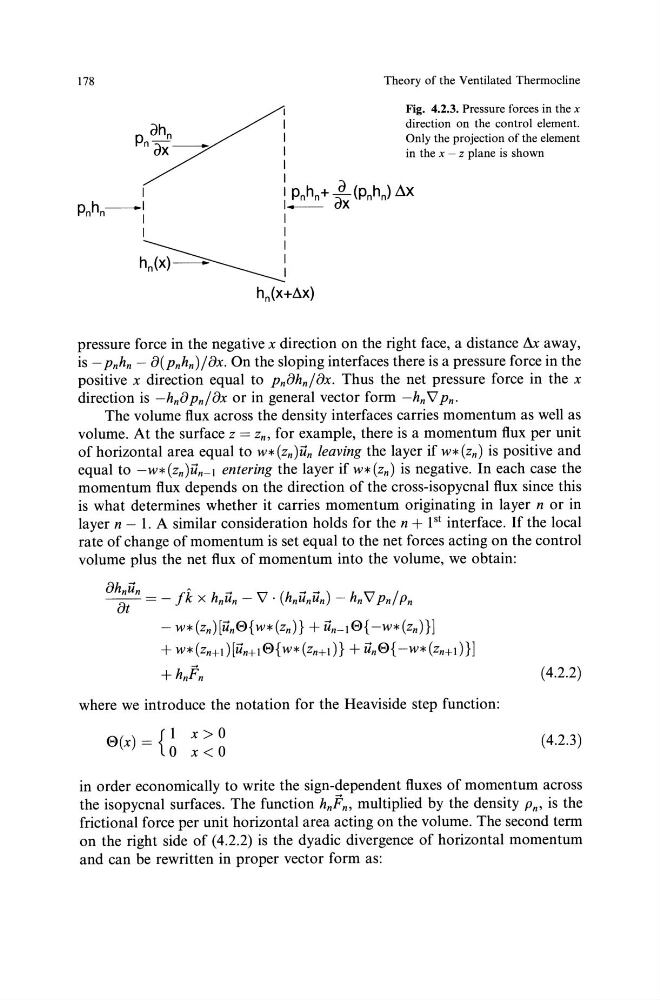
Fig. 4.2.3. Pressure forces in the x
direction on the control element.
Only the projection of the element
in the x - z plane is shown
I
I Pnhn+ -(Pnhn) ~X
P h---1
1 - ax
n n
I
I
I
I
h~
hn(X+LlX)
pressure force in the negative x direction on the right face, a distance fu: away,
is- Pnhn- 8(Pnhn)/8x. On the sloping interfaces there is a pressure force in the
positive x direction equal to Pn8hn/8x. Thus the net pressure force in the x
direction is -hn8Pn/8x or in general vector form -hn'VPn·
The volume flux across the density interfaces carries momentum as well as
volume. At the surface z = zn, for example, there is a momentum flux per unit
of horizontal area equal to W* (zn)iln leaving the layer if W* (zn) is positive and
equal to -W* (zn)iln-i entering the layer if W* (zn) is negative. In each case the
momentum flux depends on the direction of the cross-isopycnal flux since this
is what determines whether it carries momentum originating in layer n or in
layer n - 1. A similar consideration holds for the n + 1st interface. If the local
rate of change of momentum is set equal to the net forces acting on the control
volume plus the net flux of momentum into the volume, we obtain:
8hnUn
j' h ~
( ~ ~ ) h
/
-----a(= - k X nUn - '\1 · hnUnUn - n '\1 Pn Pn
- W* (zn) [unE>{ W* (zn)} + Un-i E>{ -W* (zn)}]
+ W* (zn+i )[un+i E>{ W* (zn+i)} + ilnE>{ -W* (zn+i)}]
+hnFn
where we introduce the notation for the Heaviside step function:
E>(x) = { 1 x > 0
0 X< 0
(4.2.2)
( 4.2.3)
in order economically to write the sign-dependent fluxes of momentum across
the isopycnal surfaces. The function hnFn, multiplied by the density Pn, is the
frictional force per unit horizontal area acting on the volume. The second term
on the right side of (4.2.2) is the dyadic divergence of horizontal momentum
and can be rewritten in proper vector form as:
I
I
I
I
I
I
a
Theory of the Ventilated Thermocline
Fig. 4.2.3. Pressure forces in the x
direction on the control element.
Only the projection of the element
in the x - z plane is shown
I
I Pnhn+ -(Pnhn) ~X
P h---1
1 - ax
n n
I
I
I
I
h~
hn(X+LlX)
pressure force in the negative x direction on the right face, a distance fu: away,
is- Pnhn- 8(Pnhn)/8x. On the sloping interfaces there is a pressure force in the
positive x direction equal to Pn8hn/8x. Thus the net pressure force in the x
direction is -hn8Pn/8x or in general vector form -hn'VPn·
The volume flux across the density interfaces carries momentum as well as
volume. At the surface z = zn, for example, there is a momentum flux per unit
of horizontal area equal to W* (zn)iln leaving the layer if W* (zn) is positive and
equal to -W* (zn)iln-i entering the layer if W* (zn) is negative. In each case the
momentum flux depends on the direction of the cross-isopycnal flux since this
is what determines whether it carries momentum originating in layer n or in
layer n - 1. A similar consideration holds for the n + 1st interface. If the local
rate of change of momentum is set equal to the net forces acting on the control
volume plus the net flux of momentum into the volume, we obtain:
8hnUn
j' h ~
( ~ ~ ) h
/
-----a(= - k X nUn - '\1 · hnUnUn - n '\1 Pn Pn
- W* (zn) [unE>{ W* (zn)} + Un-i E>{ -W* (zn)}]
+ W* (zn+i )[un+i E>{ W* (zn+i)} + ilnE>{ -W* (zn+i)}]
+hnFn
where we introduce the notation for the Heaviside step function:
E>(x) = { 1 x > 0
0 X< 0
(4.2.2)
( 4.2.3)
in order economically to write the sign-dependent fluxes of momentum across
the isopycnal surfaces. The function hnFn, multiplied by the density Pn, is the
frictional force per unit horizontal area acting on the volume. The second term
on the right side of (4.2.2) is the dyadic divergence of horizontal momentum
and can be rewritten in proper vector form as: