

Formulation of the Model
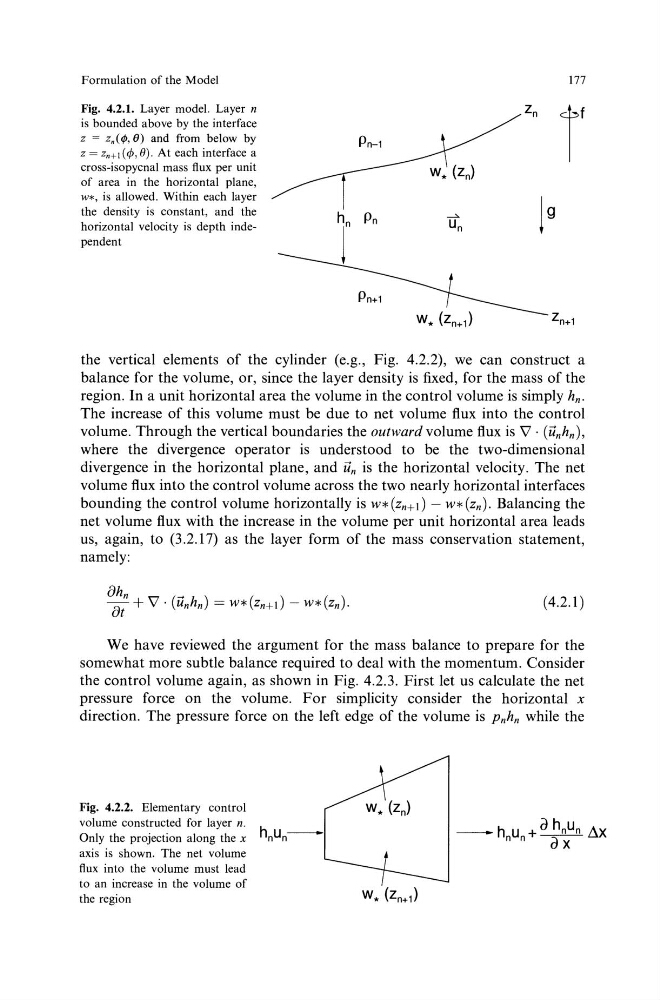
Fig. 4.2.1. Layer model. Layer n
is bounded above by the interface
z = z.(tfJ, 8) and from below by
z = Zn+J ( , 9). At each interface a
cross-isopycnal mass flux per unit
of area in the horizontal plane,
W*, is allowed. Within each layer
the density is constant, and the
horizontal velocity is depth independent
177
r
the vertical elements of the cylinder (e.g., Fig. 4.2.2), we can construct a
balance for the volume, or, since the layer density is fixed, for the mass of the
region. In a unit horizontal area the volume in the control volume is simply hn.
The increase of this volume must be due to net volume flux into the control
volume. Through the vertical boundaries the outward volume flux is V' · (unhn),
where the divergence operator is understood to be the two-dimensional
divergence in the horizontal plane, and Un is the horizontal velocity. The net
volume flux into the control volume across the two nearly horizontal interfaces
bounding the control volume horizontally is w*(Zn+I)- w*(zn)· Balancing the
net volume flux with the increase in the volume per unit horizontal area leads
us, again, to (3.2.17) as the layer form of the mass conservation statement,
namely:
(4.2.1)
We have reviewed the argument for the mass balance to prepare for the
somewhat more subtle balance required to deal with the momentum. Consider
the control volume again, as shown in Fig. 4.2.3. First let us calculate the net
pressure force on the volume. For simplicity consider the horizontal x
direction. The pressure force on the left edge of the volume is Pnhn while the
Fig. 4.2.2. Elementary control
volume constructed for layer n.
Only the projection along the x
axis is shown. The net volume
flux into the volume must lead
to an increase in the volume of
the region
-
h U +a hnun dX
n n
a X
Fig. 4.2.1. Layer model. Layer n
is bounded above by the interface
z = z.(tfJ, 8) and from below by
z = Zn+J ( , 9). At each interface a
cross-isopycnal mass flux per unit
of area in the horizontal plane,
W*, is allowed. Within each layer
the density is constant, and the
horizontal velocity is depth independent
177
r
the vertical elements of the cylinder (e.g., Fig. 4.2.2), we can construct a
balance for the volume, or, since the layer density is fixed, for the mass of the
region. In a unit horizontal area the volume in the control volume is simply hn.
The increase of this volume must be due to net volume flux into the control
volume. Through the vertical boundaries the outward volume flux is V' · (unhn),
where the divergence operator is understood to be the two-dimensional
divergence in the horizontal plane, and Un is the horizontal velocity. The net
volume flux into the control volume across the two nearly horizontal interfaces
bounding the control volume horizontally is w*(Zn+I)- w*(zn)· Balancing the
net volume flux with the increase in the volume per unit horizontal area leads
us, again, to (3.2.17) as the layer form of the mass conservation statement,
namely:
(4.2.1)
We have reviewed the argument for the mass balance to prepare for the
somewhat more subtle balance required to deal with the momentum. Consider
the control volume again, as shown in Fig. 4.2.3. First let us calculate the net
pressure force on the volume. For simplicity consider the horizontal x
direction. The pressure force on the left edge of the volume is Pnhn while the
Fig. 4.2.2. Elementary control
volume constructed for layer n.
Only the projection along the x
axis is shown. The net volume
flux into the volume must lead
to an increase in the volume of
the region
-
h U +a hnun dX
n n
a X