

174
Theory of the Ventilated Thermocline
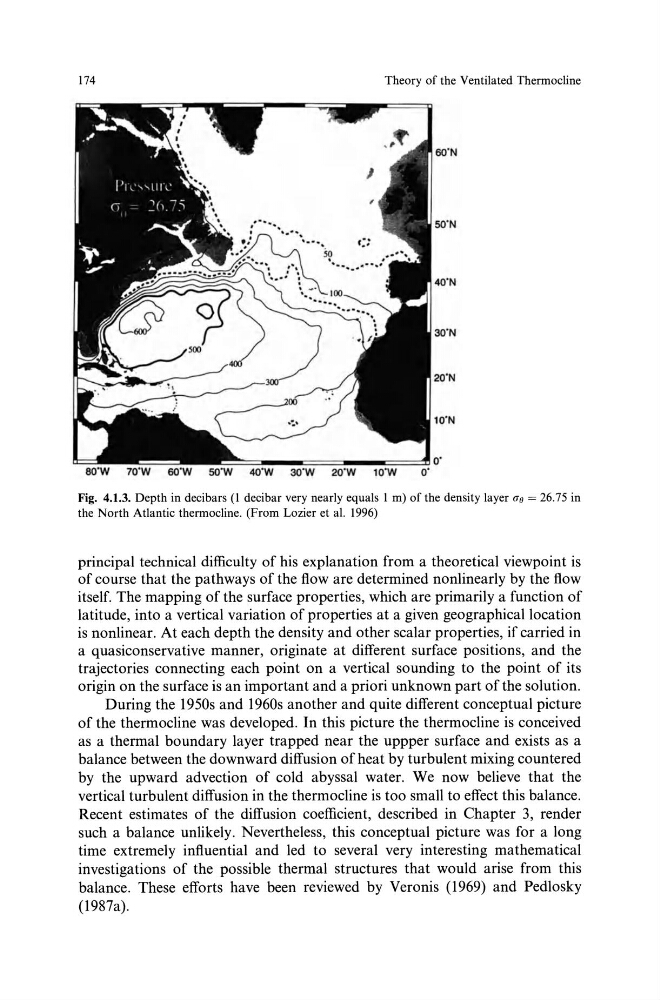
Fig. 4.1.3. Depth in decibars (I decibar very nearly equals I m) of the density layer a0 = 26.75 in
the North Atlantic thermocline. (From Lozier et al. 1996)
principal technical difficulty of his explanation from a theoretical viewpoint is
of course that the pathways of the flow are determined nonlinearly by the flow
itself. The mapping of the surface properties, which are primarily a function of
latitude, into a vertical variation of properties at a given geographical location
is nonlinear. At each depth the density and other scalar properties, if carried in
a quasiconservative manner, originate at different surface positions, and the
trajectories connecting each point on a vertical sounding to the point of its
origin on the surface is an important and a priori unknown part of the solution.
During the 1950s and 1960s another and quite different conceptual picture
of the thermocline was developed. In this picture the thermocline is conceived
as a thermal boundary layer trapped near the uppper surface and exists as a
balance between the downward diffusion of heat by turbulent mixing countered
by the upward advection of cold abyssal water. We now believe that the
vertical turbulent diffusion in the thermocline is too small to effect this balance.
Recent estimates of the diffusion coefficient, described in Chapter 3, render
such a balance unlikely. Nevertheless, this conceptual picture was for a long
time extremely influential and led to several very interesting mathematical
investigations of the possible thermal structures that would arise from this
balance. These efforts have been reviewed by Veronis (1969) and Pedlosky
(1987a).
Theory of the Ventilated Thermocline
Fig. 4.1.3. Depth in decibars (I decibar very nearly equals I m) of the density layer a0 = 26.75 in
the North Atlantic thermocline. (From Lozier et al. 1996)
principal technical difficulty of his explanation from a theoretical viewpoint is
of course that the pathways of the flow are determined nonlinearly by the flow
itself. The mapping of the surface properties, which are primarily a function of
latitude, into a vertical variation of properties at a given geographical location
is nonlinear. At each depth the density and other scalar properties, if carried in
a quasiconservative manner, originate at different surface positions, and the
trajectories connecting each point on a vertical sounding to the point of its
origin on the surface is an important and a priori unknown part of the solution.
During the 1950s and 1960s another and quite different conceptual picture
of the thermocline was developed. In this picture the thermocline is conceived
as a thermal boundary layer trapped near the uppper surface and exists as a
balance between the downward diffusion of heat by turbulent mixing countered
by the upward advection of cold abyssal water. We now believe that the
vertical turbulent diffusion in the thermocline is too small to effect this balance.
Recent estimates of the diffusion coefficient, described in Chapter 3, render
such a balance unlikely. Nevertheless, this conceptual picture was for a long
time extremely influential and led to several very interesting mathematical
investigations of the possible thermal structures that would arise from this
balance. These efforts have been reviewed by Veronis (1969) and Pedlosky
(1987a).