

Introduction
90S
60
30
lATITUDE
EQ
30
173
60
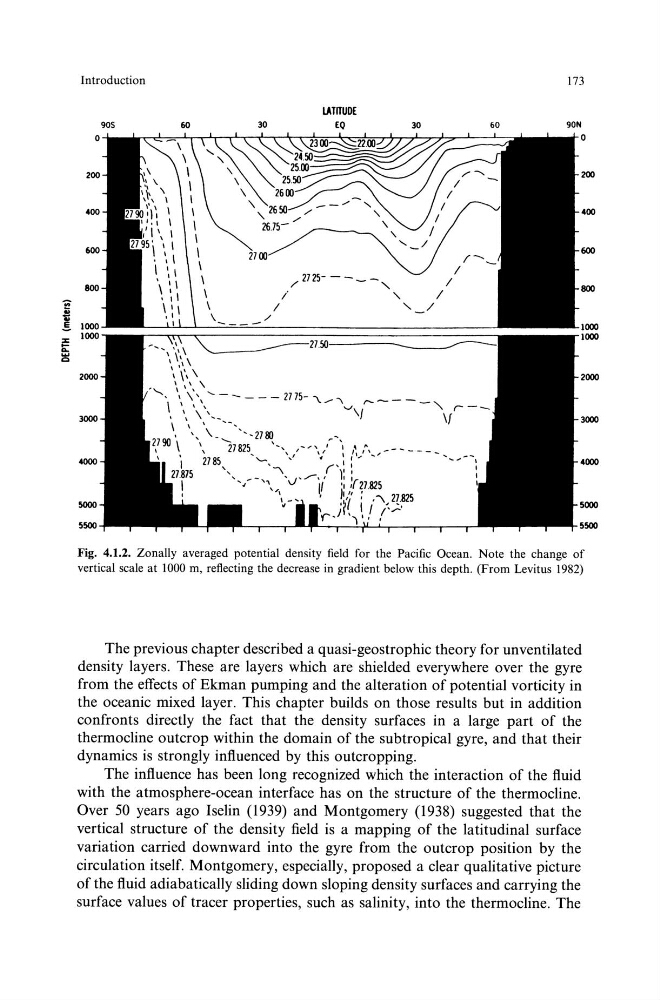
Fig. 4.1.2. Zonally averaged potential density field for the Pacific Ocean. Note the change of
vertical scale at 1000 m, reflecting the decrease in gradient below this depth. (From Levitus 1982)
The previous chapter described a quasi-geostrophic theory for unventilated
density layers. These are layers which are shielded everywhere over the gyre
from the effects of Ekman pumping and the alteration of potential vorticity in
the oceanic mixed layer. This chapter builds on those results but in addition
confronts directly the fact that the density surfaces in a large part of the
thermocline outcrop within the domain of the subtropical gyre, and that their
dynamics is strongly influenced by this outcropping.
The influence has been long recognized which the interaction of the fluid
with the atmosphere-ocean interface has on the structure of the thermocline.
Over 50 years ago Iselin (1939) and Montgomery (1938) suggested that the
vertical structure of the density field is a mapping of the latitudinal surface
variation carried downward into the gyre from the outcrop position by the
circulation itself. Montgomery, especially, proposed a clear qualitative picture
of the fluid adiabatically sliding down sloping density surfaces and carrying the
surface values of tracer properties, such as salinity, into the thermocline. The
90S
60
30
lATITUDE
EQ
30
173
60
Fig. 4.1.2. Zonally averaged potential density field for the Pacific Ocean. Note the change of
vertical scale at 1000 m, reflecting the decrease in gradient below this depth. (From Levitus 1982)
The previous chapter described a quasi-geostrophic theory for unventilated
density layers. These are layers which are shielded everywhere over the gyre
from the effects of Ekman pumping and the alteration of potential vorticity in
the oceanic mixed layer. This chapter builds on those results but in addition
confronts directly the fact that the density surfaces in a large part of the
thermocline outcrop within the domain of the subtropical gyre, and that their
dynamics is strongly influenced by this outcropping.
The influence has been long recognized which the interaction of the fluid
with the atmosphere-ocean interface has on the structure of the thermocline.
Over 50 years ago Iselin (1939) and Montgomery (1938) suggested that the
vertical structure of the density field is a mapping of the latitudinal surface
variation carried downward into the gyre from the outcrop position by the
circulation itself. Montgomery, especially, proposed a clear qualitative picture
of the fluid adiabatically sliding down sloping density surfaces and carrying the
surface values of tracer properties, such as salinity, into the thermocline. The