

Quasi-Geostrophic Model with Continuous Stratification
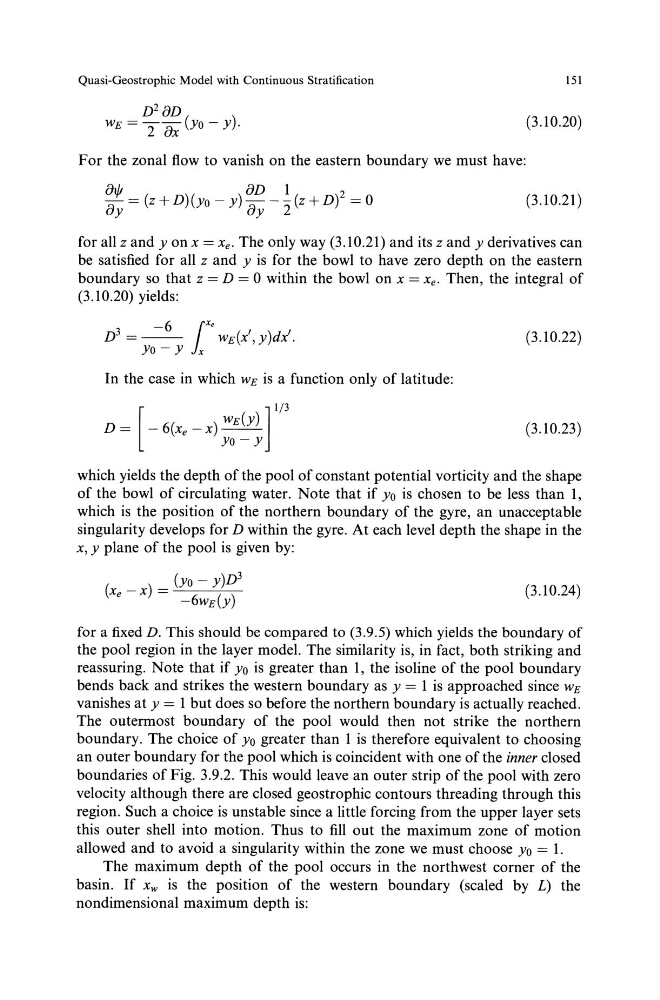
D 2 aD
WE= --(yo- y).
2 ax
For the zonal flow to vanish on the eastern boundary we must have:
aljJ
an 1
2
-=(z+D)(yo-y)---(z+D) =0
ay
ay 2
!51
(3.10.20)
(3.1 0.21)
for all z andy on x = Xe. The only way (3.10.21) and its z andy derivatives can
be satisfied for all z and y is for the bowl to have zero depth on the eastern
boundary so that z = D = 0 within the bowl on x = Xe. Then, the integral of
(3.10.20) yields:
3
-6 1Xe I I
D = - -
WE(x,y)dx.
Yo- Y x
In the case in which WE is a function only of latitude:
[
]
1/3
wE(y)
D = - 6(xe - x ) - -
Yo- Y
(3.1 0.22)
(3.10.23)
which yields the depth of the pool of constant potential vorticity and the shape
of the bowl of circulating water. Note that if y0 is chosen to be less than 1,
which is the position of the northern boundary of the gyre, an unacceptable
singularity develops forD within the gyre. At each level depth the shape in the
x, y plane of the pool is given by:
(3.10.24)
for a fixed D. This should be compared to (3.9.5) which yields the boundary of
the pool region in the layer model. The similarity is, in fact, both striking and
reassuring. Note that if y 0 is greater than 1, the isoline of the pool boundary
bends back and strikes the western boundary as y = 1 is approached since WE
vanishes at y = 1 but does so before the northern boundary is actually reached.
The outermost boundary of the pool would then not strike the northern
boundary. The choice of yo greater than 1 is therefore equivalent to choosing
an outer boundary for the pool which is coincident with one of the inner closed
boundaries of Fig. 3.9.2. This would leave an outer strip of the pool with zero
velocity although there are closed geostrophic contours threading through this
region. Such a choice is unstable since a little forcing from the upper layer sets
this outer shell into motion. Thus to fill out the maximum zone of motion
allowed and to avoid a singularity within the zone we must choose y0 = 1.
The maximum depth of the pool occurs in the northwest corner of the
basin. If xw is the position of the western boundary (scaled by L) the
nondimensional maximum depth is:
D 2 aD
WE= --(yo- y).
2 ax
For the zonal flow to vanish on the eastern boundary we must have:
aljJ
an 1
2
-=(z+D)(yo-y)---(z+D) =0
ay
ay 2
!51
(3.10.20)
(3.1 0.21)
for all z andy on x = Xe. The only way (3.10.21) and its z andy derivatives can
be satisfied for all z and y is for the bowl to have zero depth on the eastern
boundary so that z = D = 0 within the bowl on x = Xe. Then, the integral of
(3.10.20) yields:
3
-6 1Xe I I
D = - -
WE(x,y)dx.
Yo- Y x
In the case in which WE is a function only of latitude:
[
]
1/3
wE(y)
D = - 6(xe - x ) - -
Yo- Y
(3.1 0.22)
(3.10.23)
which yields the depth of the pool of constant potential vorticity and the shape
of the bowl of circulating water. Note that if y0 is chosen to be less than 1,
which is the position of the northern boundary of the gyre, an unacceptable
singularity develops forD within the gyre. At each level depth the shape in the
x, y plane of the pool is given by:
(3.10.24)
for a fixed D. This should be compared to (3.9.5) which yields the boundary of
the pool region in the layer model. The similarity is, in fact, both striking and
reassuring. Note that if y 0 is greater than 1, the isoline of the pool boundary
bends back and strikes the western boundary as y = 1 is approached since WE
vanishes at y = 1 but does so before the northern boundary is actually reached.
The outermost boundary of the pool would then not strike the northern
boundary. The choice of yo greater than 1 is therefore equivalent to choosing
an outer boundary for the pool which is coincident with one of the inner closed
boundaries of Fig. 3.9.2. This would leave an outer strip of the pool with zero
velocity although there are closed geostrophic contours threading through this
region. Such a choice is unstable since a little forcing from the upper layer sets
this outer shell into motion. Thus to fill out the maximum zone of motion
allowed and to avoid a singularity within the zone we must choose y0 = 1.
The maximum depth of the pool occurs in the northwest corner of the
basin. If xw is the position of the western boundary (scaled by L) the
nondimensional maximum depth is: