

Application of the Theory to the Subtropical Gyre
137
achieved by the fluid in its journey through the interior. The ideas of
recirculation driven by potential vorticity homogenization, developed in the
previous section, appear to require a clear understanding of the potential
vorticity transformations everywhere on the closed contour of the recirculating
cell. Young and Rhines (1982) nevertheless boldly applied the basic ideas
developed above to a theory for the structure of the midlatitude subtropical
gyres in which western boundary currents play an important role, and the
issues associated with the closure of the circulation through the western
boundary layer remain unresolved. Their theory as applied to the oceanic
subtropical gyre is discussed in this section.
Note first that within quasi-geostrophic theory, for which (3.2.29), (3.2.31),
and (3.2.34) apply, there is no dynamical difference between the subtropical
gyre where the Ekman velocity, wE< 0, and the subpolar gyre, where WE > 0.
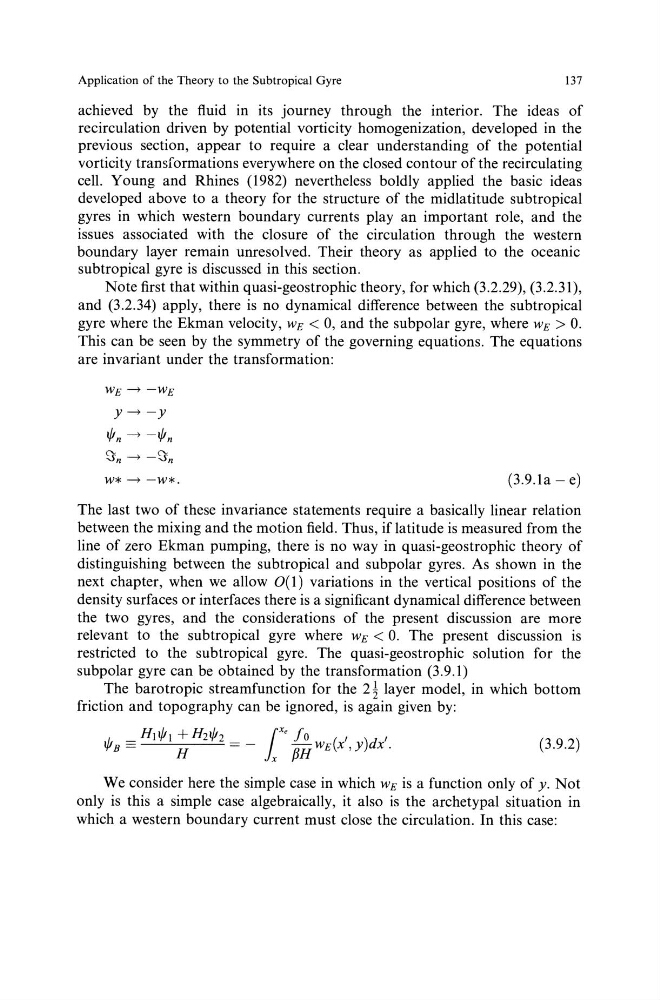
This can be seen by the symmetry of the governing equations. The equations
are invariant under the transformation:
(3.9.la-e)
The last two of these invariance statements require a basically linear relation
between the mixing and the motion field. Thus, if latitude is measured from the
line of zero Ekman pumping, there is no way in quasi-geostrophic theory of
distinguishing between the subtropical and subpolar gyres. As shown in the
next chapter, when we allow 0( 1) variations in the vertical positions of the
density surfaces or interfaces there is a significant dynamical difference between
the two gyres, and the considerations of the present discussion are more
relevant to the subtropical gyre where WE < 0. The present discussion is
restricted to the subtropical gyre. The quasi-geostrophic solution for the
subpolar gyre can be obtained by the transformation (3.9.1)
The barotropic streamfunction for the 2! layer model, in which bottom
friction and topography can be ignored, is again given by:
,1, =H1!/J1 +H2!/J2 _ -1x, fo ( 1 )d 1
-
f3 WE X, Y X.
H
X
H
(3.9.2)
We consider here the simple case in which wE is a function only of y. Not
only is this a simple case algebraically, it also is the archetypal situation in
which a western boundary current must close the circulation. In this case:
137
achieved by the fluid in its journey through the interior. The ideas of
recirculation driven by potential vorticity homogenization, developed in the
previous section, appear to require a clear understanding of the potential
vorticity transformations everywhere on the closed contour of the recirculating
cell. Young and Rhines (1982) nevertheless boldly applied the basic ideas
developed above to a theory for the structure of the midlatitude subtropical
gyres in which western boundary currents play an important role, and the
issues associated with the closure of the circulation through the western
boundary layer remain unresolved. Their theory as applied to the oceanic
subtropical gyre is discussed in this section.
Note first that within quasi-geostrophic theory, for which (3.2.29), (3.2.31),
and (3.2.34) apply, there is no dynamical difference between the subtropical
gyre where the Ekman velocity, wE< 0, and the subpolar gyre, where WE > 0.
This can be seen by the symmetry of the governing equations. The equations
are invariant under the transformation:
(3.9.la-e)
The last two of these invariance statements require a basically linear relation
between the mixing and the motion field. Thus, if latitude is measured from the
line of zero Ekman pumping, there is no way in quasi-geostrophic theory of
distinguishing between the subtropical and subpolar gyres. As shown in the
next chapter, when we allow 0( 1) variations in the vertical positions of the
density surfaces or interfaces there is a significant dynamical difference between
the two gyres, and the considerations of the present discussion are more
relevant to the subtropical gyre where WE < 0. The present discussion is
restricted to the subtropical gyre. The quasi-geostrophic solution for the
subpolar gyre can be obtained by the transformation (3.9.1)
The barotropic streamfunction for the 2! layer model, in which bottom
friction and topography can be ignored, is again given by:
,1, =H1!/J1 +H2!/J2 _ -1x, fo ( 1 )d 1
-
f3 WE X, Y X.
H
X
H
(3.9.2)
We consider here the simple case in which wE is a function only of y. Not
only is this a simple case algebraically, it also is the archetypal situation in
which a western boundary current must close the circulation. In this case: