

136
Vertical Structure: Baroclinic Quasi-Geostrophic Models
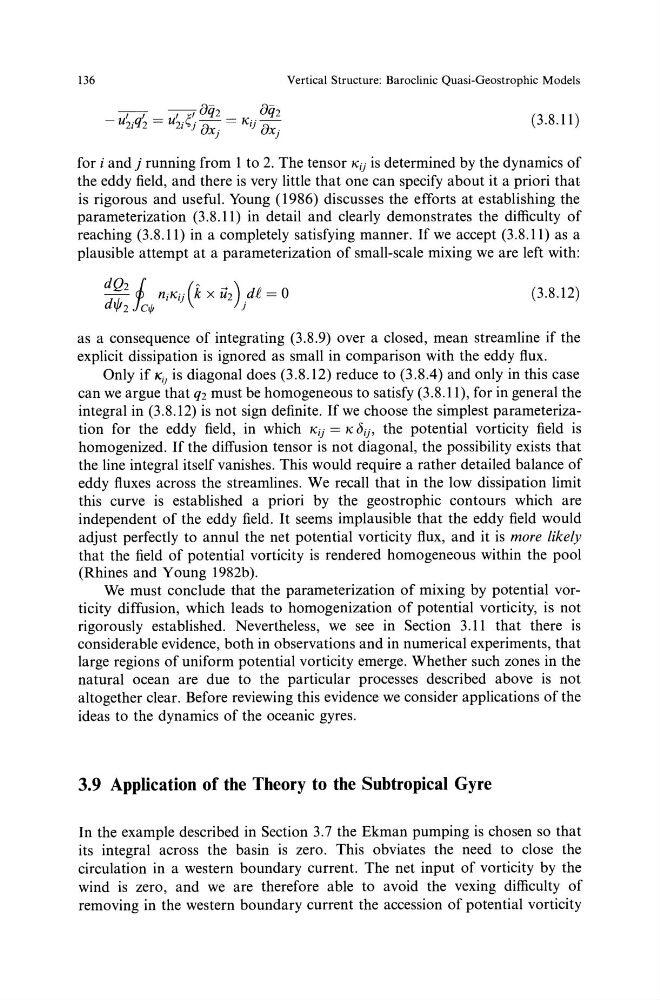
(3.8.11)
for i and j running from 1 to 2. The tensor K; 1 is determined by the dynamics of
the eddy field, and there is very little that one can specify about it a priori that
is rigorous and useful. Young ( 1986) discusses the efforts at establishing the
parameterization (3.8.11) in detail and clearly demonstrates the difficulty of
reaching (3.8.11) in a completely satisfying manner. If we accept (3.8.11) as a
plausible attempt at a parameterization of small-scale mixing we are left with:
dQ2 i (A -)
- -
n;K;j k X U2 d£ = 0
dt/12 Cf
1
(3.8.12)
as a consequence of integrating (3.8.9) over a closed, mean streamline if the
explicit dissipation is ignored as small in comparison with the eddy flux.
Only if K; 1 is diagonal does (3.8.12) reduce to (3.8.4) and only in this case
can we argue that q2 must be homogeneous to satisfy (3.8.11 ), for in general the
integral in (3.8.12) is not sign definite. If we choose the simplest parameterization for the eddy field, in which K; 1 = K 6; 1 , the potential vorticity field is
homogenized. If the diffusion tensor is not diagonal, the possibility exists that
the line integral itself vanishes. This would require a rather detailed balance of
eddy fluxes across the streamlines. We recall that in the low dissipation limit
this curve is established a priori by the geostrophic contours which are
independent of the eddy field. It seems implausible that the eddy field would
adjust perfectly to annul the net potential vorticity flux, and it is more likely
that the field of potential vorticity is rendered homogeneous within the pool
(Rhines and Young 1982b ).
We must conclude that the parameterization of mixing by potential vorticity diffusion, which leads to homogenization of potential vorticity, is not
rigorously established. Nevertheless, we see in Section 3.11 that there is
considerable evidence, both in observations and in numerical experiments, that
large regions of uniform potential vorticity emerge. Whether such zones in the
natural ocean are due to the particular processes described above is not
altogether clear. Before reviewing this evidence we consider applications of the
ideas to the dynamics of the oceanic gyres.
3.9 Application of the Theory to the Subtropical Gyre
In the example described in Section 3.7 the Ekman pumping is chosen so that
its integral across the basin is zero. This obviates the need to close the
circulation in a western boundary current. The net input of vorticity by the
wind is zero, and we are therefore able to avoid the vexing difficulty of
removing in the western boundary current the accession of potential vorticity
Vertical Structure: Baroclinic Quasi-Geostrophic Models
(3.8.11)
for i and j running from 1 to 2. The tensor K; 1 is determined by the dynamics of
the eddy field, and there is very little that one can specify about it a priori that
is rigorous and useful. Young ( 1986) discusses the efforts at establishing the
parameterization (3.8.11) in detail and clearly demonstrates the difficulty of
reaching (3.8.11) in a completely satisfying manner. If we accept (3.8.11) as a
plausible attempt at a parameterization of small-scale mixing we are left with:
dQ2 i (A -)
- -
n;K;j k X U2 d£ = 0
dt/12 Cf
1
(3.8.12)
as a consequence of integrating (3.8.9) over a closed, mean streamline if the
explicit dissipation is ignored as small in comparison with the eddy flux.
Only if K; 1 is diagonal does (3.8.12) reduce to (3.8.4) and only in this case
can we argue that q2 must be homogeneous to satisfy (3.8.11 ), for in general the
integral in (3.8.12) is not sign definite. If we choose the simplest parameterization for the eddy field, in which K; 1 = K 6; 1 , the potential vorticity field is
homogenized. If the diffusion tensor is not diagonal, the possibility exists that
the line integral itself vanishes. This would require a rather detailed balance of
eddy fluxes across the streamlines. We recall that in the low dissipation limit
this curve is established a priori by the geostrophic contours which are
independent of the eddy field. It seems implausible that the eddy field would
adjust perfectly to annul the net potential vorticity flux, and it is more likely
that the field of potential vorticity is rendered homogeneous within the pool
(Rhines and Young 1982b ).
We must conclude that the parameterization of mixing by potential vorticity diffusion, which leads to homogenization of potential vorticity, is not
rigorously established. Nevertheless, we see in Section 3.11 that there is
considerable evidence, both in observations and in numerical experiments, that
large regions of uniform potential vorticity emerge. Whether such zones in the
natural ocean are due to the particular processes described above is not
altogether clear. Before reviewing this evidence we consider applications of the
ideas to the dynamics of the oceanic gyres.
3.9 Application of the Theory to the Subtropical Gyre
In the example described in Section 3.7 the Ekman pumping is chosen so that
its integral across the basin is zero. This obviates the need to close the
circulation in a western boundary current. The net input of vorticity by the
wind is zero, and we are therefore able to avoid the vexing difficulty of
removing in the western boundary current the accession of potential vorticity